T-Shirt Printer Job Description
Printing designs onto T-shirts — screens, inks, placement and curing in the garment print shop
A T-shirt printer prints designs onto finished T-shirts. It is the most familiar job in garment printing: the printed tee is the clothing industry's canvas, sold as band merchandise, team kit, promotional clothing, fashion graphics and souvenirs, and nearly every one of them passed through the hands of a printer who set up the screens, mixed the inks, placed the design and cured the print. The work is order-based — a design, a shirt style and colour, a size run and a deadline — and the printer's craft is making the five-hundredth shirt match the approved first one exactly.
More Production Job Descriptions by Letter:
Artwork, Screens and Setup
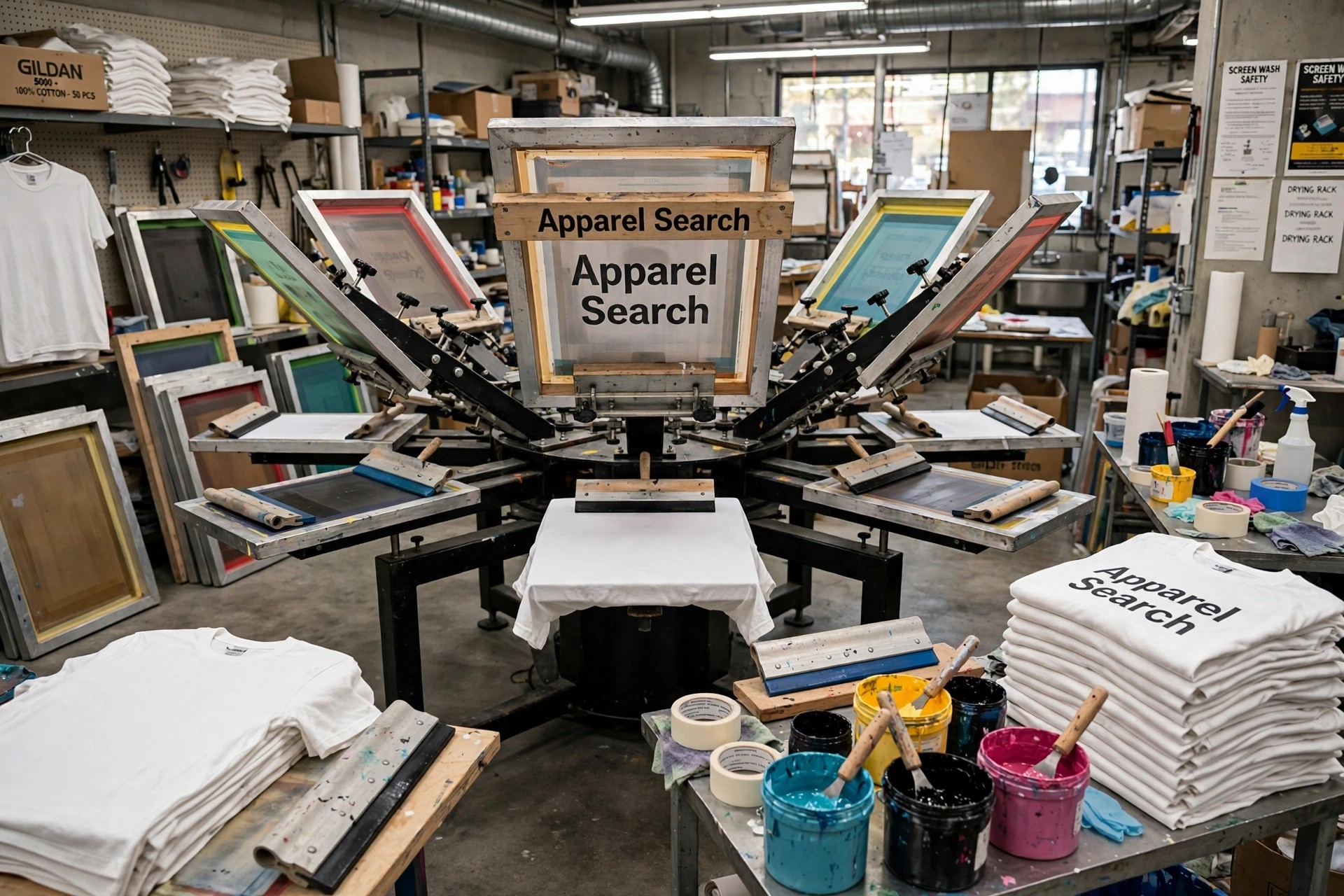
A T-shirt print begins with artwork. The printer or the shop's artworker separates the design into one screen per colour, checks that fine lines and halftones will hold on fabric, and exposes the screens — mesh stretched on frames, coated with emulsion, imaged and washed out to leave the design as a stencil. Inks are selected and mixed for the shirt in hand: plastisol for opacity on dark garments, water-based inks for a soft fashion hand, discharge inks that remove the shirt's dye and replace it with colour, and speciality inks — puff, metallic, glow, high-density — for effect prints. On digital direct-to-garment machines the setup is file preparation and pre-treatment instead of screens, but the judgement is the same: will this design, on this shirt colour, in this ink, look like the artwork promised?
Setup ends with the proof print. The printer loads a test shirt, sets the design's position from the customer's placement specification — distance from the collar, centred on the chest, sized to the smallest shirt in the run as well as the largest — registers every screen so the colours land exactly on each other, and prints the sample the run will be judged by. Experienced T-shirt printers know most bad runs are born at setup: a design two centimetres low, or a screen a millimetre out of register, repeats its error on every shirt that follows.
Printing the Run and Curing the Print
On a manual carousel the printer loads each shirt onto a platen, pulls the squeegee across each screen in turn, flash-cures between colours where the design needs it, and unloads at a rhythm that keeps quality steady for hours. Automatic presses print at far higher speed while the printer loads, unloads and watches registration, ink coverage and shirt placement across hundreds of pieces. Size changes within a run, mixed garment colours, and extra print positions — back prints, sleeve prints, inside-neck labels — are all handled inside the same job ticket without breaking the run's consistency.
Curing decides whether the print lives as long as the shirt. Printed tees pass through a tunnel dryer at the temperature and dwell time their ink system requires: under-cured prints crack, peel and wash out; scorched shirts and melted synthetic blends come from the opposite error. The printer tests cure by stretching and wash-checking samples, counts and folds against the order, and pulls misprints immediately. A print shop's reputation is the discipline that the faulty shirt never reaches the customer's box.
Orders, Customers and Print Shop Life
T-shirt printing serves occasions. A team's shirts are needed for Saturday's match, a festival's merchandise for the gates, a brand's graphic drop for its launch date, a company's staff tees for an event — the shop's board is a wall of promises, and the printer sequences jobs by deadline, shirt-stock availability and colour changeovers, grouping work to minimise screen wash-ups. Blank shirt stock is checked in against each order on arrival, because printing the right design on the wrong shirt colour is an error no press skill can undo.
In smaller shops the printer also meets the customer: advising which print method suits a design and a budget, explaining why a photograph needs digital printing or a process separation, and quoting quantities and turnaround. Work is typically daytime, in small teams, with overtime in the peaks — summer festivals, tour dates, sports seasons — and the variety of a different design on the press every few hours is exactly what draws many printers to the garment side of the printing trade.
Skills, Training and Career Path
The core skills are screen making, colour mixing, registration and placement judgement, plus the physical rhythm of loading, printing and unloading consistently at speed. Colour vision matters — matching an ink to artwork under proper light is daily work — and so does care with chemicals, solvents and hot dryers under the shop's safety rules. Digital garment printing adds file preparation, colour management and machine care skills that grow more valuable each year.
Most T-shirt printers train in a print shop, starting on catching, folding, screen cleaning and reclaiming, then printing one-colour work under a senior printer before taking multi-colour and automatic-press jobs. From senior printer the paths run to print shop supervisor or production manager, into artwork and separation specialisms, or into shop ownership — the classic route by which experienced garment printers start businesses of their own. Printers who want the fabric side of the trade will find it in the Textile Screen Printer and Textile Printer descriptions, which cover printing cloth before it is made into garments.
Common Questions
What does a T-shirt printer do?
Prints designs onto finished T-shirts: separating artwork into screens, mixing inks, setting print placement and registration on manual or automatic carousel presses (or running digital garment printers), curing the prints and checking every shirt against the approved sample.
How is T-shirt printing different from textile screen printing?
A T-shirt printer decorates garments that are already made, placing each design on an individual shirt in order-sized runs. A textile screen printer prints fabric yardage by the roll, before garments are cut, in long mill production runs.
Do T-shirt printers need qualifications?
Most train on the job in print shops, progressing from screen work and catching to supervised printing. Employers test practical press skills, colour matching and placement judgement rather than certificates.
More to Explore
Garment Printing Resources
References & Further Reading
More Job Description Categories
- Buying Job Descriptions
- Design Job Descriptions
- Marketing & PR Job Descriptions
- Miscellaneous Job Descriptions
- Planning & Allocation Job Descriptions
- Production & Sourcing Job Descriptions (current)
- Sales & Selling Job Descriptions
- Transportation & Warehouse Job Descriptions