Textile Screen Printer Job Description
Screen printing fabric by the roll — flatbed and rotary screens, colour separations, print pastes and register
A textile screen printer prints designs onto fabric yardage using screens — the method that has decorated most of the world's printed cloth for decades. Working in printworks and mills, the screen printer lays a design onto moving fabric one colour at a time: each screen carries a single colour of the pattern, applied through a mesh stencil by squeegee, on flatbed tables for shorter and finer work and on rotary machines, where cylindrical screens print continuously at production speed. The output is printed cloth by the roll, ready for garment makers and furnishing manufacturers, and the craft lies in register, colour and repeat held true across thousands of metres.
More Production Job Descriptions by Letter:
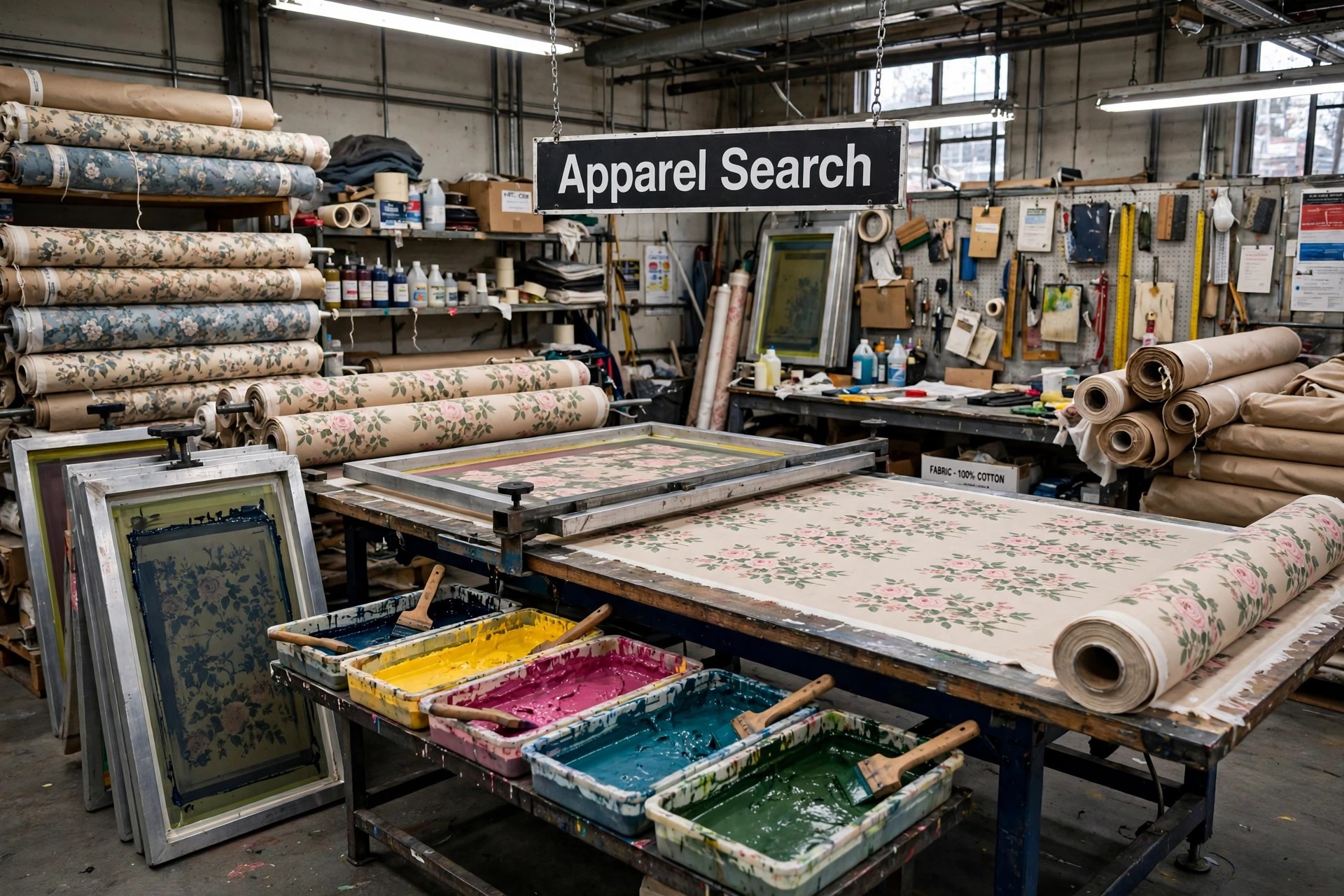
Screens, Separations and Print Pastes
Screen printing a design begins long before fabric moves. The artwork is separated into its component colours — a floral of nine colours may need nine screens — and each separation is imaged onto its screen: mesh coated with emulsion, exposed, and washed out so the colour's areas stand open. On rotary lines the screens are seamless cylinders; on flatbed lines they are framed rectangles lifted and advanced along the table. The printer checks each screen for pinholes, damage and correct repeat before it is fitted, because a screen fault does not print once — it prints every repeat, all run long.
Print pastes are matched to the fibre being printed. Pigment systems sit on the fabric surface and suit most fibres; reactive dyes bond chemically with cotton and viscose and give wash-fast brilliance; disperse dyes are fixed into polyester by heat; acid dyes serve nylon and silk. The printer mixes or receives pastes to the approved recipe, controls their viscosity so lines print sharp without bleeding, and prints the strike-off — the trial length assessed and approved against the design standard — before bulk yardage is committed.
Printing the Yardage: Register, Repeat and Run Control
On a flatbed line, fabric is fixed to the table and screens print in sequence down its length, the printer or the machine advancing screen by screen, colour by colour, with drying between passes on long tables. On a rotary line the cloth travels continuously beneath the rotating screens, each laying its colour in exact register with the others. In both, the printer's patrol work is the same: watching registration so motifs align, checking colour against the standard under correct light, catching screen blockages and damage that print as repeating faults, and controlling paste supply, squeegee pressure and speed before drift becomes rejected yardage.
The repeat governs everything. A design repeats at a fixed interval along the cloth, set by the screen circumference or the flatbed advance, and the printer verifies that joins are invisible and motifs run in the correct direction roll after roll. A fault in yardage printing multiplies silently — one damaged screen section marks every repeat until somebody stops the line — which is why mills pay for the printer's vigilance as much as for press speed.
Fixation, Washing and Inspection
A print is not finished when it leaves the screen. Colour must be fixed to the fibre — by steaming, baking or dry heat according to the dye system — then the cloth is washed to remove unfixed dye and print-paste thickener, and dried and finished to its final width and handle. The screen printer works with these stages as one process: under-fixed colour fails its wash test however beautifully it was laid down, and printers who understand fixation print with the whole journey of the cloth in mind.
Printed yardage is then inspected roll by roll for misregistration, colour variation within and between rolls, screen marks, stains and repeat faults. Suspect lengths are marked, segregated or downgraded before they reach a customer whose cutting room would find the fault at far greater cost, and the printer's sign-off against the standard is the printworks' promise to that customer. Screens are washed, reclaimed or stored by design, and the run's settings and paste recipes are recorded so a repeat order prints as the same fabric, not a near relative.
Skills, Training and Career Path
Textile screen printing asks for a trained colour eye, mechanical confidence with large machines, and stamina for shift-based production around inks, chemicals and moving cloth, under the safety discipline that work requires. Precision under repetition — checking the fiftieth roll as carefully as the first — and clean record-keeping mark the reliable printer. Knowledge of dye and paste chemistry, growing with experience, separates printers who can only run a standard from printers who can rescue a difficult design or a difficult fabric.
Most screen printers train inside a printworks, beginning on fabric handling, screen cleaning and paste mixing, then printing under supervision before running a line. Textile technology and printing courses supply colour theory and dye chemistry that shorten the climb. Progression leads to senior printer and print-room supervision, colour matching and strike-off development, and technical or quality roles in mills; printers who prefer decorating finished garments instead cross to the print-shop work described on the T-Shirt Printer page.
Common Questions
What does a textile screen printer print?
Fabric yardage — rolls of cloth printed with flatbed or rotary screens, one screen per colour, then fixed, washed and inspected by the roll. The printed fabric is later cut into garments and furnishings by other makers.
How does textile screen printing differ from T-shirt printing?
Scale and subject. The textile screen printer decorates the cloth itself in long production runs measured in metres, in a mill or printworks. A T-shirt printer decorates garments that are already made, placing a design on each individual shirt in a print shop.
What skills do textile screen printers need?
Colour judgement, screen making and registration, knowledge of print paste and dye systems for different fibres, machine operation on flatbed or rotary lines, and the vigilance to catch repeating faults across long runs.
More to Explore
Textile Printing Resources
Production Directory Pages by Letter
References & Further Reading
More Job Description Categories
- Buying Job Descriptions
- Design Job Descriptions
- Marketing & PR Job Descriptions
- Miscellaneous Job Descriptions
- Planning & Allocation Job Descriptions
- Production & Sourcing Job Descriptions (current)
- Sales & Selling Job Descriptions
- Transportation & Warehouse Job Descriptions