Textile Printer Job Description
Printing pattern onto fabric by the yard — the printworks craft behind printed cloth
A textile printer prints designs onto fabric itself — the bolts and rolls of cloth that will later be cut into garments, bedding and furnishings. Working in printworks and textile mills, the printer runs the machines that lay a design onto moving yardage: flatbed and rotary screen printers laying one colour per screen, and digital printers jetting the whole design at once. It is production work measured in metres and repeat accuracy, where a design of eight colours must land in perfect register along thousands of metres of cloth, at a shade that matches the approved standard from the first metre to the last.
More Production Job Descriptions by Letter:
Running the Print Machines
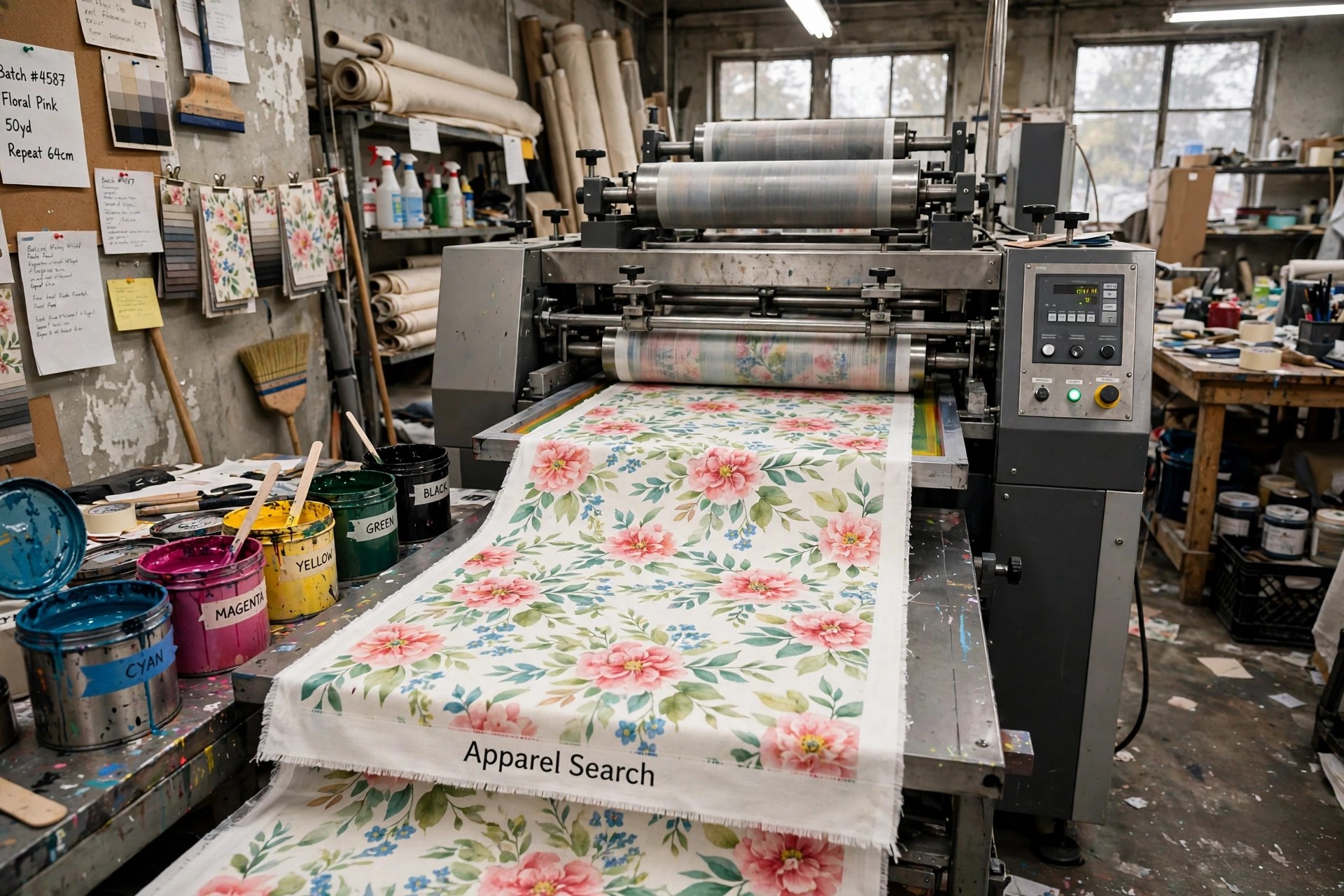
The printer's day is built around the printing line. Fabric arrives prepared — scoured, bleached or dyed to the ground shade the design expects — and is fed onto the machine under correct tension, because cloth that creeps or skews takes the design with it. On rotary lines the printer fits the cylindrical screens in colour order, sets the print paste supply to each screen, and runs a trial length to check registration before committing the bulk. On flatbed tables the work is slower and more manual, suited to short runs and delicate cloth; on digital lines the printer loads the profiled file and watches ink delivery and fabric transport instead of screens.
Once a run starts, the printer patrols it. Colour is checked against the standard under proper light at intervals, screens are watched for damage or blockage that prints as a repeating fault, and paste levels, squeegee pressure and machine speed are adjusted before a drift becomes a rejected roll. A fault in yardage printing repeats every revolution until somebody stops it — which is why the printer's vigilance, not the machine's speed, is what a printworks is really paying for.
Colour, Pastes and the Design Repeat
Behind the machine work sits colour craft. Each screen carries one colour of the design, separated from the artwork in advance, and the printer mixes or receives print pastes matched to the fibre: pigment systems that sit on the surface, reactive dyes that bond with cotton, disperse dyes for polyester. The wrong system prints beautifully and washes off; the right one survives the fabric's whole life. Trial lengths — strike-offs — are printed, fixed and assessed before bulk, and the approved strike-off becomes the run's contract.
The repeat is the textile printer's geometry. A design repeats at a set interval along the cloth, and screens, cylinders and digital files are all built to that interval so motifs join seamlessly roll after roll. The printer checks joins, half-drop offsets and motif direction, because cloth printed with an upside-down repeat or a visible join line is cloth a garment maker cannot cut around. Records of screens, pastes and settings are kept by design, so a reorder months later prints as the same fabric, not a close relative of it.
Fixation, Finishing and Quality Control
Printed colour is not finished colour until it is fixed. Depending on the dye system, yardage passes through steamers, bakers or dryers that bond the colour to the fibre, then through washing that removes unfixed dye and thickener, and drying that sets the final handle and dimensions. The printer works with the finishing stages as one process: an under-fixed print fails its wash test no matter how well it was laid down, and the printer who understands fixation prints differently — with the whole journey of the cloth in mind.
Quality control runs through everything. Printed yardage is inspected for misregistration, colour variation between rolls, screen marks, stains and repeat faults, and suspect lengths are marked, segregated or downgraded before they reach a customer whose cutting room would find the fault at far greater cost. The printer signs off rolls against the standard and the order, and that signature is why buyers trust a printworks with a whole season's key fabric.
Skills, Training and Career Path
Textile printing asks for a colourist's eye, mechanical confidence and stamina for shift-based production work around inks, chemicals and moving machinery, with the protective equipment and safety discipline that work requires. Accuracy under repetition — the fiftieth roll checked as carefully as the first — and clean record-keeping separate reliable printers from fast ones. Most printers train inside the printworks, starting on fabric handling, screen cleaning and paste mixing, and progress to running a line under supervision; textile technology and printing courses supply the dye chemistry and colour theory that shorten that climb.
Career paths lead to senior printer and print line supervisor roles, into colour matching and strike-off development, or toward the technical and quality side of a mill. Printers who prefer garments to yardage cross into clothing print shops — the related role described on the Printer — Printing Clothing page — while the broader cloth-printing occupation is also covered by the Fabric Printer description in this category. Business ownership is less common than in garment printing, because yardage lines are capital-heavy, but senior printworks staff move into production and technical management across the textile industry.
Common Questions
What does a textile printer print on?
Fabric yardage — rolls of cloth that garment and furnishing makers will cut later. The printer lays complete designs onto moving cloth by rotary or flatbed screen printing, or digitally, then the colour is fixed, washed and inspected by the roll.
How is textile printing different from printing clothing?
Textile printing decorates the cloth before it becomes a garment, in long production runs measured in metres. Clothing printing decorates garments that are already made — a design placed on the chest of a finished T-shirt, for example — usually in shorter, order-by-order runs.
What qualifications do textile printers need?
Most train on the job in a printworks, progressing from fabric handling and paste mixing to running a line. Textile technology or printing courses help, but employers mainly test colour judgment, machine aptitude and reliability across a long run.
More to Explore
Textile Printing Resources
References & Further Reading
More Job Description Categories
- Buying Job Descriptions
- Design Job Descriptions
- Marketing & PR Job Descriptions
- Miscellaneous Job Descriptions
- Planning & Allocation Job Descriptions
- Production & Sourcing Job Descriptions (current)
- Sales & Selling Job Descriptions
- Transportation & Warehouse Job Descriptions