VP of Production Job Description
End-to-end leadership of garment production — every line, factory and delivery the company makes
A vice president of production holds end-to-end responsibility for making a fashion company's clothing: every factory, line and contractor that cuts, sews, finishes and packs its garments answers, directly or through their managers, to this role. Where a production manager runs one site or department and a production director leads a division, the VP of production owns the whole production estate — owned factories and contract manufacturers together — and answers to the executive team for output, delivery, cost and quality of everything the company ships. It is the senior making role in the business, equal parts strategist and operator.
More Production Job Descriptions by Letter:
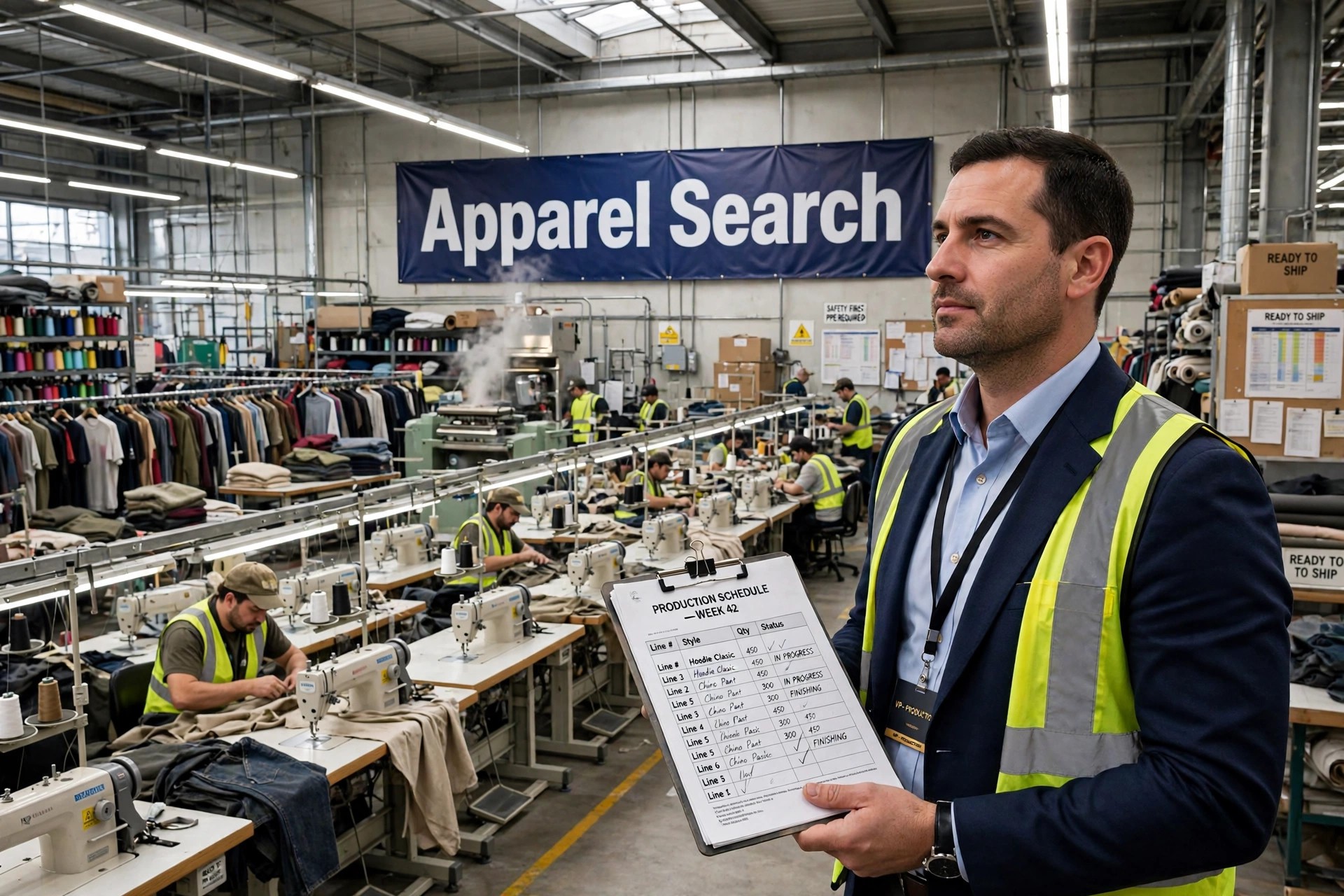
Owning Production Across Every Factory
The VP sets the production strategy the rest of the making organisation executes: which products are made in-house and which are placed with contractors, how capacity is balanced across sites and seasons, and where investment in lines, machinery and people will earn its return. Seasonal order books are translated at this level into a capacity position — enough sewing hours for peak, no idle lines in the trough — and the VP arbitrates when brands, categories or customers compete for the same factory weeks, deciding allocations on margin, delivery risk and strategic value rather than on who asks loudest.
Delivery performance is the VP's public scorecard. Buyers and retailers promise customers dates that production must keep, so the VP owns the order book's health: reviewing work in progress across all sites, intervening where a factory, a fabric delay or a quality problem threatens a season, and reporting honestly to the executive team while recovery is still possible. Cost sits in the same ledger — cost per garment, efficiency against standard minutes, overtime and freight premiums — and the VP is expected to know which sites earn their overhead and which consume it.
Leading the Production Organisation
The VP's direct reports are the people who run production day to day: factory managers, production directors and managers, planning and quality leadership. The job is exercised through them — setting targets, reviewing their numbers, walking their floors, and developing the next generation of plant leadership. Factory visits are working inspections, not ceremony: the VP reads a floor quickly, checks whether reported output matches the bundles on the lines, and asks the questions that reveal whether standards, safety and maintenance are real or performed for visitors.
Cross-functional weight is the other half of the role. Production sits between design and merchandising, who create the product, and sales, who promise it; the VP represents making reality in those rooms — what a style will cost to produce well, what a delivery date truly requires, what a late fabric decision does to a factory's season. Capital decisions land here too: new plants, line expansions, automation and the make-or-buy judgements that shape the company's cost base for years. When production fails publicly — a missed season, a recalled product — it is the VP who answers for it.
Skills and Abilities the Role Requires
Complete production literacy is the entry ticket: garment construction, factory economics, planning systems, quality systems and the behaviour of sewing lines under pressure, learned over years inside factories rather than from reports about them. On top of that craft base the role demands executive skills — financial fluency with budgets, costings and capital cases; negotiation with contractor owners and major suppliers; and judgement about people, since the VP's most consequential decisions are appointments to factory leadership.
The temperament is decisive under load. Production problems arrive in clusters, in season, with money attached, and the VP must triage calmly: which fire threatens a customer, which threatens a factory's workforce, which is noise. Communication runs in every direction — board-level summaries that stay honest, floor-level conversations that stay credible — and the VP who loses either audience loses the role's authority. Integrity about dates and numbers is the trait peers name first: the whole company plans on this person's word.
Qualifications, Training and Career Path
VPs of production almost always rise through the making organisation: machinist or technician roots for some, production coordination, planning or factory management for most, then production manager and director roles of widening scope — one line, one factory, several sites, a division. Employers look for that progression evidenced in output and delivery records, multi-site or contractor-network experience, and increasingly for formal grounding in operations, textiles or garment technology and in the systems modern production runs on.
From this chair the paths run to chief operating officer or general management, where production becomes one function among several; to group operations roles across brands or countries; or to deep specialist authority as the executive a company calls when production must be rebuilt. Some VPs move to the contractor side as owners or senior partners of manufacturing groups. The role is the summit of the production ladder described in this category — the point where knowing how garments are made becomes responsibility for whether the company makes them well, on time and at a cost it can sell.
Common Questions
What does a VP of production do?
They own garment production end to end: production strategy, capacity across owned factories and contractors, delivery performance, production cost and the factory leadership team. Every line and site that makes the company's clothing ultimately reports up to this role.
How is a VP of production different from a production director or manager?
Scope. A production manager runs a site or department, a director leads a division, and the VP owns the whole production estate — all factories and contractors together — and answers for it to the executive team.
What experience leads to a VP of production role?
A long production progression: coordination, planning or factory roles, then production manager and director posts of growing scope, with multi-site delivery records. Garment and factory knowledge is assumed; the VP adds financial, negotiation and leadership range.
More to Explore
- Fashion Employment Agencies
- Employment Search Engines
- Fashion Job Description Directory
- Fashion Directory
- Fashion Industry News
- Fashion Schools and Education
- Fashion Careers
- VP of Operations, Manufacturing Job Description
- VP of Operations, Sourcing Job Description
- VP of Sourcing Job Description
- VP of Quality Assurance Job Description
Production Resources
References & Further Reading
More Job Description Categories
- Buying Job Descriptions
- Design Job Descriptions
- Marketing & PR Job Descriptions
- Miscellaneous Job Descriptions
- Planning & Allocation Job Descriptions
- Production & Sourcing Job Descriptions (current)
- Sales & Selling Job Descriptions
- Transportation & Warehouse Job Descriptions