VP of Operations, Manufacturing Job Description
Running the plants themselves — capacity, equipment, workforce and factory performance
A vice president of operations, manufacturing is the executive who runs the factories as operating businesses: their capacity, equipment, workforce, safety and unit costs. The title is narrower than VP of production and deliberately so — where the VP of production owns everything the company makes, including goods placed with outside contractors, the VP of operations, manufacturing concentrates on the plants themselves, owned or directly managed, and on how well those plants convert labour, machines and materials into garments hour by hour. Plant managers report to this role, and factory performance is its language.
More Production Job Descriptions by Letter:
Capacity, Equipment and the Factory Network
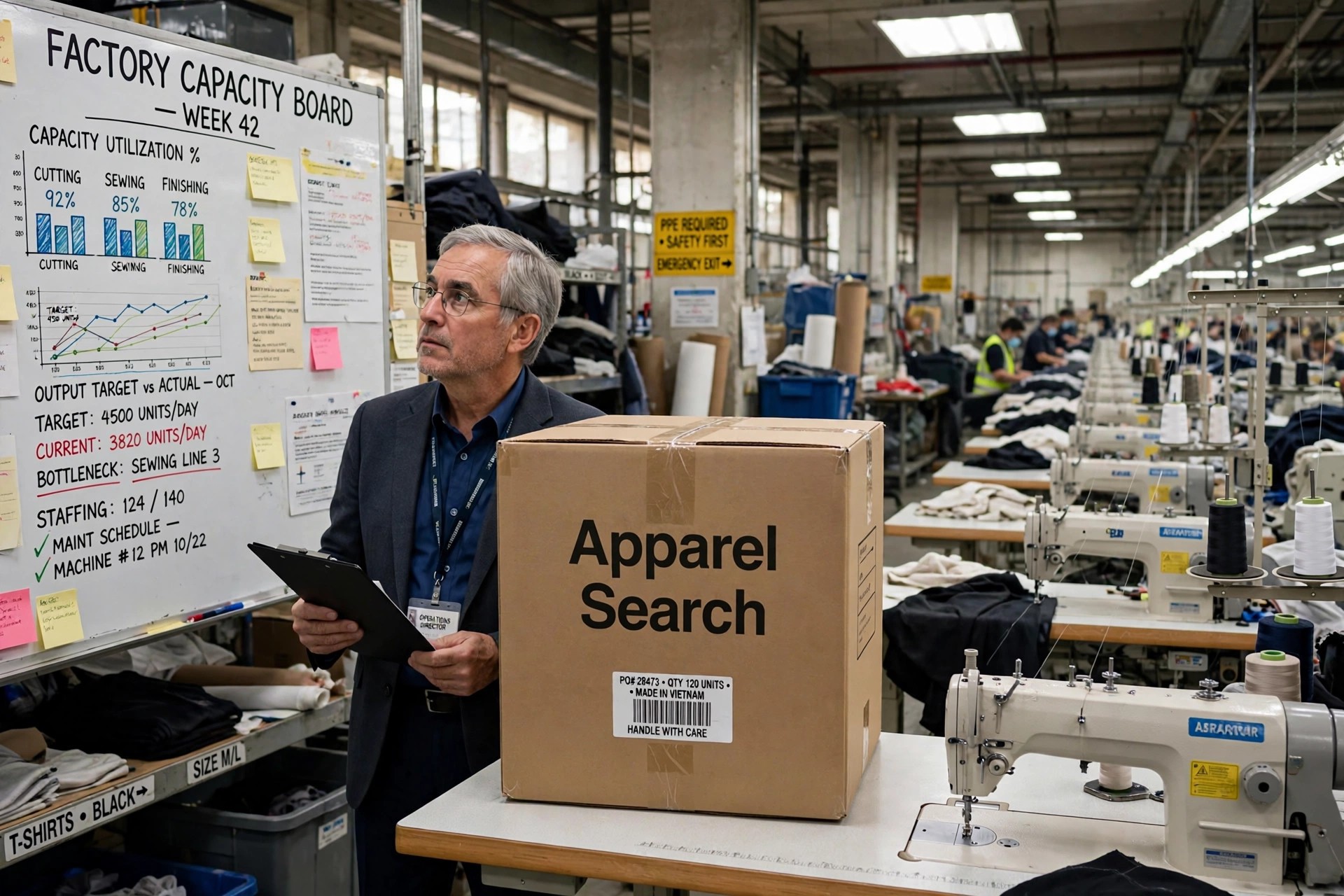
The VP's first responsibility is that the plants can do what the order book asks. Capacity planning at this level is physical: how many lines, of what machine mix, staffed by how many operators, producing how many standard minutes a week — and how that total flexes for peak season without carrying empty lines through the trough. When capacity must change, the VP builds the case: a new line, a second shift, an equipment programme, a plant consolidation, each costed against the garments it will produce and the seasons it must survive.
Equipment strategy follows from capacity. Sewing, cutting, pressing and finishing machinery is a long-lived asset base, and the VP owns its renewal: which machines are replaced, standardised or automated, how maintenance budgets are set, and what downtime the plants can tolerate before output suffers. Layout and flow belong here as well — the VP approves line configurations and factory layouts that determine how work moves, because a badly laid-out plant taxes every garment it makes for years, whatever its people do.
Workforce, Efficiency and Plant Performance
Factories are labour systems before they are machine systems, and the VP owns the workforce model: operator numbers and skill mix, training pipelines that turn new machinists into productive operators, absenteeism and retention, and the wage and incentive structures that keep experienced hands from leaving for the factory across the road. Safety and legal compliance in the plants — machine guarding, needle and knife discipline, building and fire standards — are non-delegable at this level; the VP sets the standards and audits them personally.
Performance management is the weekly rhythm: output against plan, efficiency against standard minutes, cost per garment, absenteeism, quality fall-out and on-time completion, compared plant by plant and line by line. The VP reads variance the way a doctor reads charts — a plant drifting on efficiency, a line whose quality is slipping — and intervenes through the plant manager with specific causes, not general exhortation. Lean and continuous-improvement programmes usually sit in this portfolio, judged strictly on whether the numbers move.
Skills and Abilities the Role Requires
Deep factory craft is assumed: work study and standard-minute thinking, line balancing, machine capability and garment construction understood well enough to challenge a plant manager's explanation. Industrial and operations disciplines carry equal weight — capacity mathematics, maintenance strategy, layout and flow, and the financial structure of a plant, where fixed overhead meets variable piece costs and small efficiency movements become large money.
The people skills are those of running large shift workforces through their managers: fairness and consistency across plants, credibility with supervisors who have run lines for decades, and the discipline to hold standards on safety and quality when output pressure argues otherwise. The VP also represents the plants upward — explaining to executives, in commercial terms, what factory reality permits — and downward, making strategy intelligible as targets a line can chase.
Qualifications, Training and Career Path
The route here runs through the plants: production supervision, work study or industrial engineering, plant or factory management, then multi-plant operations leadership. Employers weigh delivered plant results — efficiency gained, units grown, costs reduced, audits passed — more heavily than credentials, though operations management, engineering or textiles education and lean qualifications strengthen a candidacy, and experience across more than one factory culture is prized because the role standardises without flattening.
Next steps run to VP of production, where contractor production joins the owned plants in one portfolio, or to chief operating officer roles in manufacturing-led businesses. Some operations VPs move to the manufacturing groups themselves as managing directors of factory networks. Within this category the role pairs with its sourcing counterpart: one VP runs the plants the company owns, the other runs the network it buys from — and strong companies keep the two crafts distinct, because running machines and running suppliers are different disciplines.
Common Questions
What does a VP of operations, manufacturing do?
They run the company's factories as operations: plant capacity, equipment and maintenance strategy, workforce and safety, efficiency and cost per garment. Plant managers report to them, and factory performance is their scorecard.
How does this role differ from VP of production?
The VP of production owns everything the company makes, including contractor production. The VP of operations, manufacturing concentrates on the plants themselves — capacity, equipment, workforce and unit performance inside owned or directly managed factories.
What background do manufacturing operations VPs have?
Plant-side careers: supervision, work study or industrial engineering, factory management, then multi-plant leadership. Employers judge the record — efficiency, output, cost and audit results delivered across real factories.
More to Explore
- Fashion Job Description Directory
- Fashion Schools and Education
- Fashion Careers
- Employment Search Engines
- VP of Production Job Description
- VP of Operations, Sourcing Job Description
- VP of Sourcing Job Description
- VP of Quality Assurance Job Description
- Production Director Job Description
- Production Manager Job Description
Manufacturing Resources
Production Directory Pages by Letter
References & Further Reading
More Job Description Categories
- Buying Job Descriptions
- Design Job Descriptions
- Marketing & PR Job Descriptions
- Miscellaneous Job Descriptions
- Planning & Allocation Job Descriptions
- Production & Sourcing Job Descriptions (current)
- Sales & Selling Job Descriptions
- Transportation & Warehouse Job Descriptions