VP of Quality Assurance Job Description
Setting the quality standard for everything the company sells — systems, audits and prevention at executive level
A vice president of quality assurance is the executive accountable for the quality of everything a fashion company sells, however and wherever it was made. Quality managers run systems inside a division or factory network; the VP sets the policy those systems serve — the standards product must meet, the audit regime factories must pass, the testing that proves compliance — and owns the budget, the senior quality team and the company's quality reputation with its largest customers. When quality fails at scale, a chargeback, a recall, a lost retail account, this is the role that answers and the role expected to have prevented it.
More Production Job Descriptions by Letter:
Quality Policy, Standards and Audit at Company Level
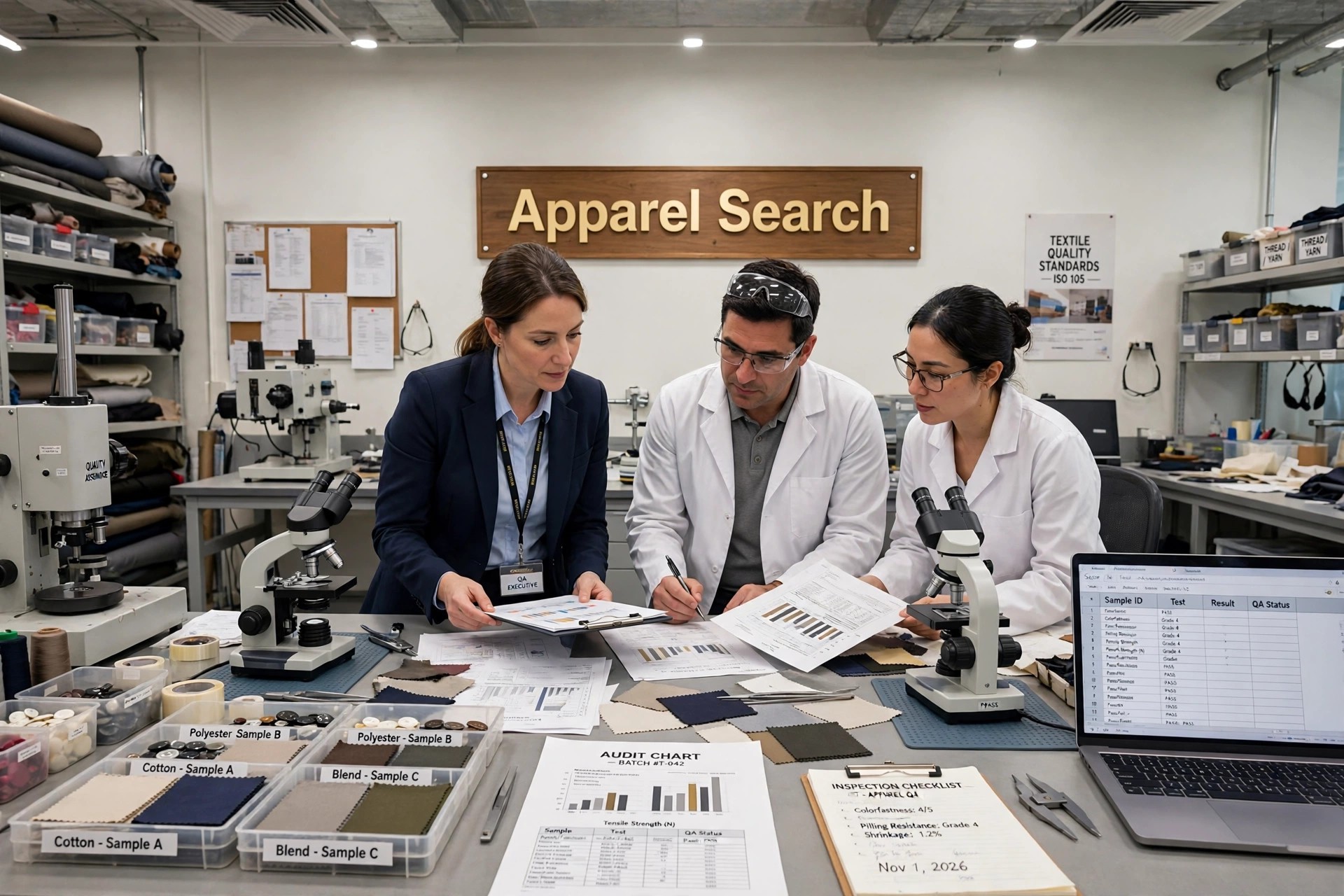
The VP owns the quality manual's authority: construction and measurement standards, tolerance policy, inspection and AQL regimes, fabric and product testing requirements including flammability and restricted-substances compliance, and the labelling and packaging standards customers audit against. Standards are commercial documents as much as technical ones — the VP calibrates them so the product is genuinely fit for its market without gold-plating costs competitors do not carry, and revises them as regulations, customer requirements and materials evolve.
Audit policy is the enforcement half. The VP designs the audit programme across owned factories and vendors — technical capability audits, quality-system audits, pre-production and inline monitoring policy — sets pass standards and consequences, and reviews the pattern of results for systemic weakness: a defect family appearing across vendors, a region whose audit scores flatter its shipments. Corrective-action governance sits here too, with escalation that reaches vendor selection itself when a factory cannot or will not improve.
Leading Quality Across the Business
The senior quality organisation reports to the VP: QA managers by division or region, laboratory leadership, vendor quality teams. The VP sets their structure, budget and priorities, and arbitrates the function's permanent tension — quality's standards against production's dates and sourcing's costs — at the level where the trade-off is owned rather than fought over shipment by shipment. Data is the arbitration language: defect rates, inspection pass rates, returns and chargeback costs, audit trends, reported in terms the executive team can weigh against margin.
Customer-facing quality is the outward half of the role. Major retail customers impose their own quality regimes, audits and scorecards, and the VP is the company's senior counterpart for them: hosting their quality leadership, responding to systemic complaints, negotiating corrective programmes, and protecting the accounts whose loss a quality failure could cause. Product recalls and safety incidents, rare and serious, are led from this office. New-market and new-category expansion also passes through here, because each new product type and sales channel imports quality obligations the VP must price and staff before launch.
Skills and Abilities the Role Requires
Technical authority is the foundation: garment and textile quality science, inspection and testing methods, audit practice and the regulations governing the company's markets, deep enough that the VP's standards judgements are not second-guessed by the specialists who execute them. That depth usually comes from years in quality roles — inspection, laboratory, QA management — across more than one product type or factory base.
Executive skills complete the role: building and defending a quality budget in cost terms executives respect; presenting failure honestly with its remedy and price; influencing sourcing and production peers whose incentives pull against prevention spending. The VP must also hold the line under commercial pressure — the shipment someone senior wants released — with the company's name, not personal stubbornness, as the argument. Reputation in this role is a long asset: customers and factories alike learn whether this office's word on quality can be trusted.
Qualifications, Training and Career Path
The typical path runs through the quality function itself: inspector or technologist beginnings for many, quality control management, then QA management over a division, region or vendor base, with scope widening to company level. Employers look for multi-category and multi-country quality leadership, laboratory and audit programme ownership, and fluency in the major customers' quality regimes. Textile or garment technology education, quality-management qualifications and auditor training support the experience record.
Beyond this chair, quality executives move into broader technical or operations leadership — VP of technical services, supply-chain quality roles across industries, or group compliance and responsibility posts where quality, safety and social audit converge. The role also caps the quality ladder described across this category: the technologist measures, the control manager inspects, the assurance manager systems, and the VP sets the policy, budget and accountability under which all of them work — prevention owned at the level where it can actually be funded.
Common Questions
What does a VP of quality assurance do?
They own quality at company level: the standards and testing policy for all products, the factory and vendor audit programme, the senior quality team and budget, and the company's quality performance with its major customers.
How is a VP of quality assurance different from a QA manager?
Scope and authority. A QA manager runs the quality system for a division, site or vendor group. The VP sets the policy every system follows, owns the budget and audit consequences, and answers to the executive team and key customers.
What happens when a major quality failure occurs?
The VP leads the response: containing affected product, finding the systemic cause, agreeing corrective action with factories and customers, and changing standards, audits or vendors so the failure cannot repeat.
More to Explore
Quality Resources
Production Directory Pages by Letter
References & Further Reading
More Job Description Categories
- Buying Job Descriptions
- Design Job Descriptions
- Marketing & PR Job Descriptions
- Miscellaneous Job Descriptions
- Planning & Allocation Job Descriptions
- Production & Sourcing Job Descriptions (current)
- Sales & Selling Job Descriptions
- Transportation & Warehouse Job Descriptions