Freight Forwarder Assistant Job Description
Support on the forwarding desk — bookings, documents, tracking and customer updates for clothing freight
A freight forwarder assistant supports the desk that moves clothing between countries and continents. Freight forwarders are the travel agents of cargo: importers and exporters hand them garments in one country and expect them delivered, documented and customs-ready in another, by sea, air or road. The assistant keeps that promise administratively real — entering the bookings, assembling the documents, tracking the consignments and telling customers the truth about where their freight is. It is the standard entry role into freight forwarding, and a thorough education in how the apparel trade physically works.
More Transportation & Warehouse Job Descriptions by Letter:
Bookings and Job Files: Where Every Shipment Starts
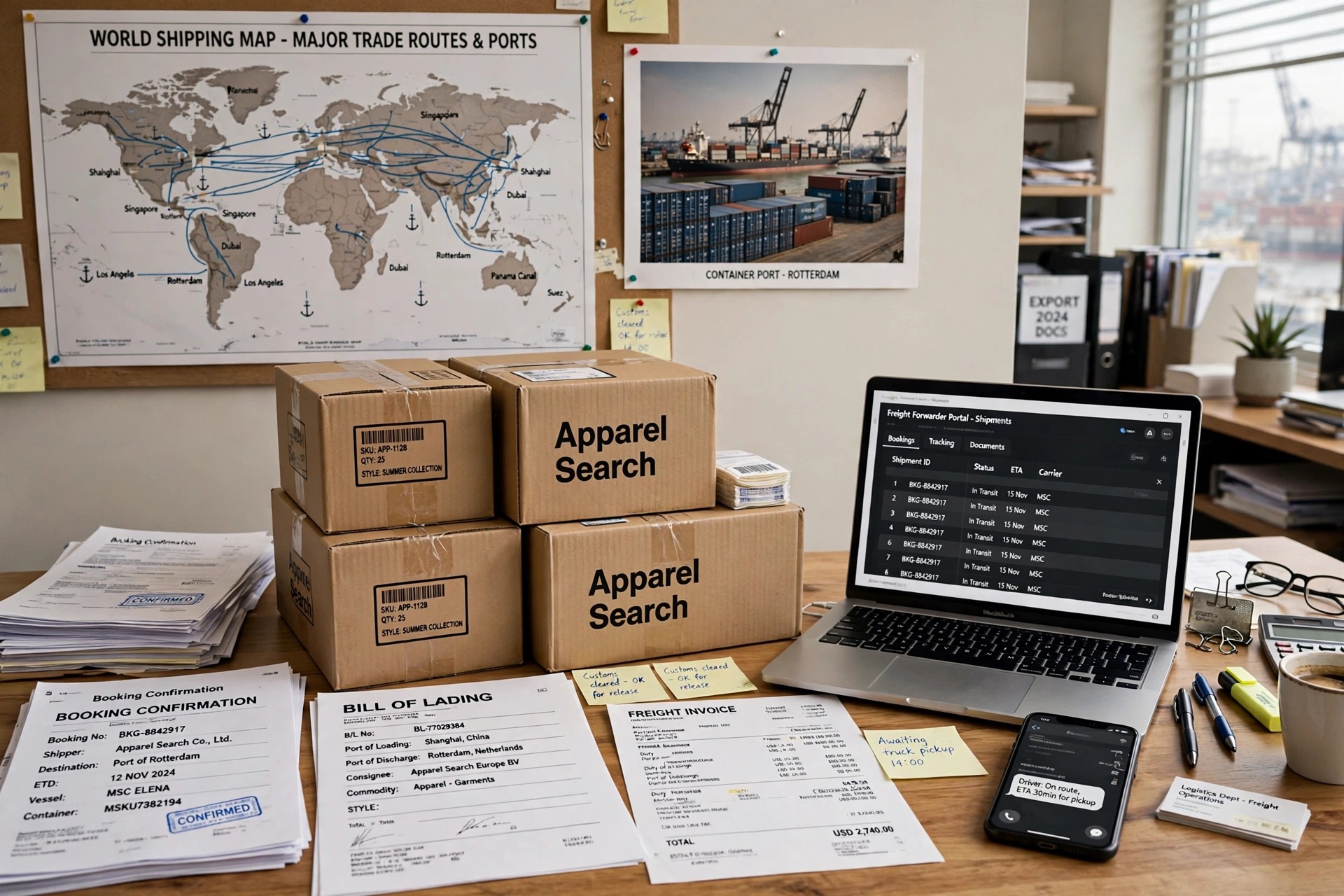
Each consignment begins as a booking and a job file. The assistant takes booking details from the customer or the senior forwarder — shipper and consignee, ready date, carton count, weight and volume, the service and routing required — and enters them into the forwarding system, raising the job file that will accumulate everything the shipment generates. Deadlines are set here: vessel cut-offs, airline acceptance times, document deadlines, each with its own penalty for being missed, and the assistant works the diary so none of them are discovered after the fact.
The file is also where instructions meet reality. A customer's garment shipment may need consolidation with others into a shared container, a particular carrier for a retailer's routing guide, or documents worded a specific way for a letter of credit. The assistant records those requirements on the job, flags anything missing — an unconfirmed ready date, weights that do not match the packing list — and chases the customer or the overseas agent for it while there is still time to fix it cheaply.
Documents: The Shipment on Paper
Freight travels twice: once physically, once on paper, and the paper must be right. The assistant prepares and checks the documents the forwarder issues and collects — house bills of lading and air waybills, commercial invoices and packing lists from the shipper, certificates of origin and any product-specific certificates, and the data the customs broker will need at destination. Names, addresses, marks, counts and weights must agree across every document, because a discrepancy that nobody catches becomes a held shipment, an amended bill fee, or a bank refusing documents under a letter of credit.
Accuracy is verifiable and the assistant learns the checks: does the bill of lading match the booking, does the invoice describe the goods as the tariff expects, are the consignee details exactly as the destination agent requires? Draft documents go to customers for approval before originals are issued, corrections are logged, and the final set is distributed — originals where the trade still demands paper, electronic records everywhere else — with copies filed so any question months later can be answered from the job file alone.
Tracking, Updates and Problem Days
Once freight moves, the assistant tracks it: vessel departures and arrivals, flight uplifts, container events and delivery bookings, updated in the system and communicated to customers before they have to ask. Apparel customers plan production, warehouse labour and store launches around these dates, so a proactive update that a vessel has slipped two days is worth more than a perfect explanation after the delivery fails. The assistant learns each customer's rhythm — who wants milestones, who wants only exceptions — and works to it.
Problem days are the real training. A container rolled to the next vessel, an airline offload at a transit hub, a customs hold at destination, a truck that missed its delivery slot: the assistant gathers the facts, informs the senior forwarder and the customer, books the alternative, and records the costs and the cause. Composure and speed both matter, and so does the written record — when the invoice is later queried, the file the assistant kept is the company's answer.
Skills, Qualifications and Career Path
Employers look for precise administration, confident computer skills, clear written and spoken communication, and the numeracy to work with weights, volumes, currencies and freight charges without losing a decimal. No single qualification is mandatory for entry; business, geography or language studies all help, and second languages are genuinely useful in a trade that talks daily to agents and carriers worldwide. What forwarder managers screen for hardest is reliability under deadline pressure, because cut-offs do not move for anyone.
Progression is structured by competence: from assistant to freight forwarder, handling a portfolio of customers and modes independently, then to senior forwarder, supervisor and the freight forwarding manager role described beside this page — the commercial and operational leadership of the forwarding business. The assistant years are where the document discipline and mode knowledge are built that every later grade depends on, which is why good forwarders are almost always grown, not hired in.
Common Questions
What does a freight forwarder assistant do?
Supports the forwarding desk for apparel freight: entering bookings and raising job files, preparing and checking shipping documents such as bills of lading and air waybills, tracking sea, air and road consignments, updating customers, and handling the invoices and records each shipment generates.
What skills does a freight forwarder assistant need?
Precise administration, computer and numeracy confidence for weights, volumes and charges, clear communication with customers, carriers and overseas agents, and reliability against immovable cut-off deadlines. Languages help in an international trade, though they are rarely required for entry.
How does the assistant differ from the freight forwarding manager?
The assistant works on shipments — bookings, documents, tracking — under the desk's direction. The manager leads the business commercially and operationally: pricing, carrier relations, teams and problem escalation. Assistant is the recognised route into forwarding; manager is where experienced forwarders arrive.
More to Explore
Freight Forwarding Resources
Transportation & Warehouse Directory Pages by Letter
References & Further Reading
More Job Description Categories
- Buying Job Descriptions
- Design Job Descriptions
- Marketing & PR Job Descriptions
- Miscellaneous Job Descriptions
- Planning & Allocation Job Descriptions
- Production & Sourcing Job Descriptions
- Sales & Selling Job Descriptions
- Transportation & Warehouse Job Descriptions (current)