Freight Forwarding Manager Job Description
Leading the forwarding business — pricing, carriers, service and the apparel calendar
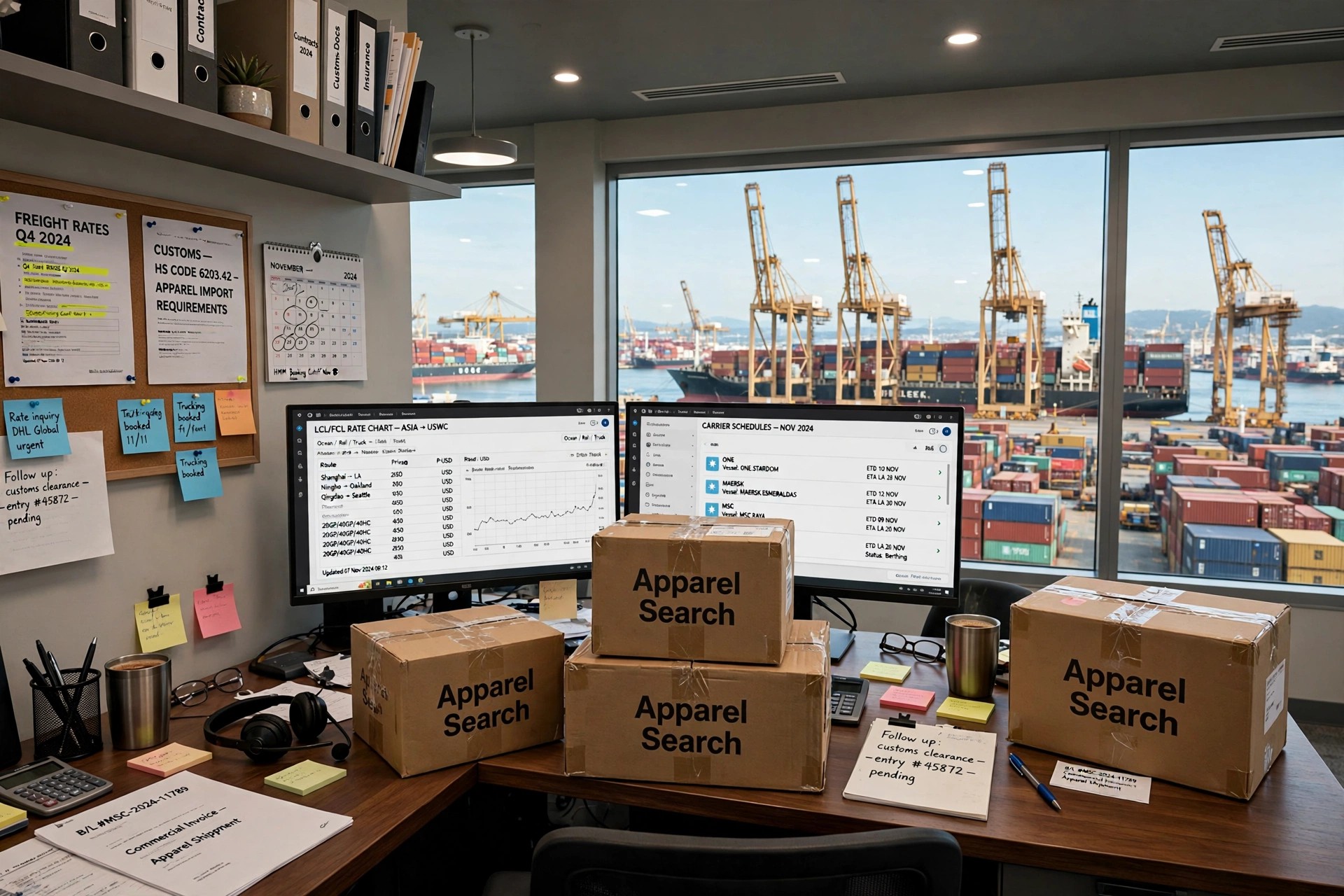
A freight forwarding manager leads the business that moves clothing around the world for importers and exporters. The role is equal parts commercial and operational: winning and keeping apparel customers with sharp, honest pricing; securing space with shipping lines and airlines through the trade's brutal peaks; running the teams who book, document and track the freight; and standing accountable when a season's key delivery is sitting on the wrong side of an ocean. Forwarding sells certainty about an uncertain process, and the manager is the person who prices, organises and defends that certainty.
More Transportation & Warehouse Job Descriptions by Letter:
The Commercial Side: Pricing, Quotes and Customers
Forwarding is bought on price and kept on service, and the manager owns both sides of that equation. Quotations for apparel customers combine ocean or air rates, origin and destination charges, trucking, customs interfaces and the forwarder's margin, and they must be built to survive reality: a quote that wins the booking and loses money on every container is a slow failure disguised as growth. The manager sets pricing policy, approves the significant quotes personally, and reviews which traffic the business actually wants — volume, lane balance and payment behaviour all shape a customer portfolio's real worth.
Apparel customers bring a distinctive rhythm: seasonal volume surges, launch dates that cannot slip, and margins that make freight cost a board-level topic. The manager meets that rhythm with honest counsel — where a cheaper routing is safe, where it is a false economy against a dated delivery, when air freight rescues a season and what that rescue costs. Customers renew with the forwarder whose manager told them the truth in the difficult month, and building that reputation across an account base is the role's central commercial work.
Carriers, Capacity and the Peak Problem
The manager's supply side is the carrier market. Relationships and volume commitments with shipping lines, airlines, hauliers and overseas agents decide what space the business can offer when the market tightens — and in apparel it tightens on a calendar, before the autumn and holiday seasons, when every importer ships at once. The manager forecasts customer volumes, secures allocations and equipment, watches rate and surcharge movements, and keeps alternative routings warm, because the week space runs out is the wrong week to meet a new carrier.
Within the operation, capacity decisions are daily: which bookings take the last container space, whose freight converts from sea to air at whose cost, which consolidation sails and which waits for volume. Those calls are made on customer value, contractual fairness and plain communication — a customer told early that freight will move on the next vessel can re-plan; one told at the dock cannot. The manager sets the policy the desk works to and takes the escalations personally when the stakes justify it.
Operations, Compliance Interfaces and Problem Freight
Under the commercial surface, the manager owns the operation's quality: booking accuracy, document standards, milestone tracking, invoicing and the job-file discipline that the assistant and forwarder grades work to. Key measures — on-time performance, document error rates, query response, cost recovery on disbursements — are reviewed like a factory's numbers, and recurring failures are fixed at the process, not blamed on the week. The manager also manages the overseas agent network whose destination handling is half the product the customer experiences.
Forwarding touches regulated ground without practising it. The manager ensures the business works correctly with customs brokers at both ends, that security and screening requirements for air freight are met, that dangerous or restricted items hidden in general cargo are refused, and that claims and cargo insurance questions are handled properly when freight is lost or damaged. When a shipment becomes a crisis — a vessel casualty, a port strike, a stranded launch delivery — the manager leads the response and the customer conversation, because that conversation is where the account is kept or lost.
Skills, Qualifications and Career Path
Freight forwarding managers are experienced forwarders first: years across sea and air operations, documentation and customer handling, usually including the assistant and forwarder grades described in this letter, before commercial responsibility is added. Industry training and qualifications in freight forwarding and logistics strengthen the record, and the role demands real numeracy — rates, currencies, surcharges and margins — alongside negotiation, team leadership and composure in the trade's frequent emergencies. Knowledge of the apparel calendar and product is a genuine specialism: garment volumes, hanging freight, retail routing guides and season deadlines differ from general cargo.
Two neighbouring roles should not be confused with this one. The freight forwarder assistant in this letter is the support grade on the desk the manager leads. The customs roles under C handle the border formalities that forwarding arranges but does not itself perform. From forwarding manager, progression runs to branch and regional leadership, national operations and commercial direction, and to heading the forwarding or logistics function inside large apparel groups.
Common Questions
What does a freight forwarding manager do?
Leads a freight forwarding operation for apparel customers: pricing and approving quotations, securing carrier and airline capacity through peak seasons, managing the forwarding teams and overseas agents, owning service quality and problem-shipment escalation, and keeping the business profitable.
What experience leads to freight forwarding manager?
Years inside forwarding — typically the assistant and forwarder grades across sea and air freight — with documentation, customer and carrier knowledge, plus the commercial skills of pricing, negotiation and margin management. Apparel-season experience is a valued specialism.
How does freight forwarding management differ from customs work?
The forwarder arranges the movement of freight and interfaces with customs processes at both ends, but does not file entries or give customs law advice — those belong to the customs broker and customs attorney under C in this category. The manager's accountability is transport: price, capacity, service and delivery.
More to Explore
Freight Forwarding Resources
Transportation & Warehouse Directory Pages by Letter
References & Further Reading
More Job Description Categories
- Buying Job Descriptions
- Design Job Descriptions
- Marketing & PR Job Descriptions
- Miscellaneous Job Descriptions
- Planning & Allocation Job Descriptions
- Production & Sourcing Job Descriptions
- Sales & Selling Job Descriptions
- Transportation & Warehouse Job Descriptions (current)