Packers Job Description
Folding, bagging, ticketing and boxing clothing for shipment — the packing bench of the apparel warehouse
Packers are the warehouse workers who turn picked clothing into shipments. Working at packing benches and shipping lines in apparel distribution centres and factory warehouses, they take garments that pickers have gathered for an order, check them, fold or hang them as the destination requires, bag and ticket them to each retailer's exact specification, and box them so a store can work the delivery straight onto its floor. It is detailed, physical, deadline-driven work — and it is the last quality check most garments receive before a customer sees them.
More Transportation & Warehouse Job Descriptions by Letter:
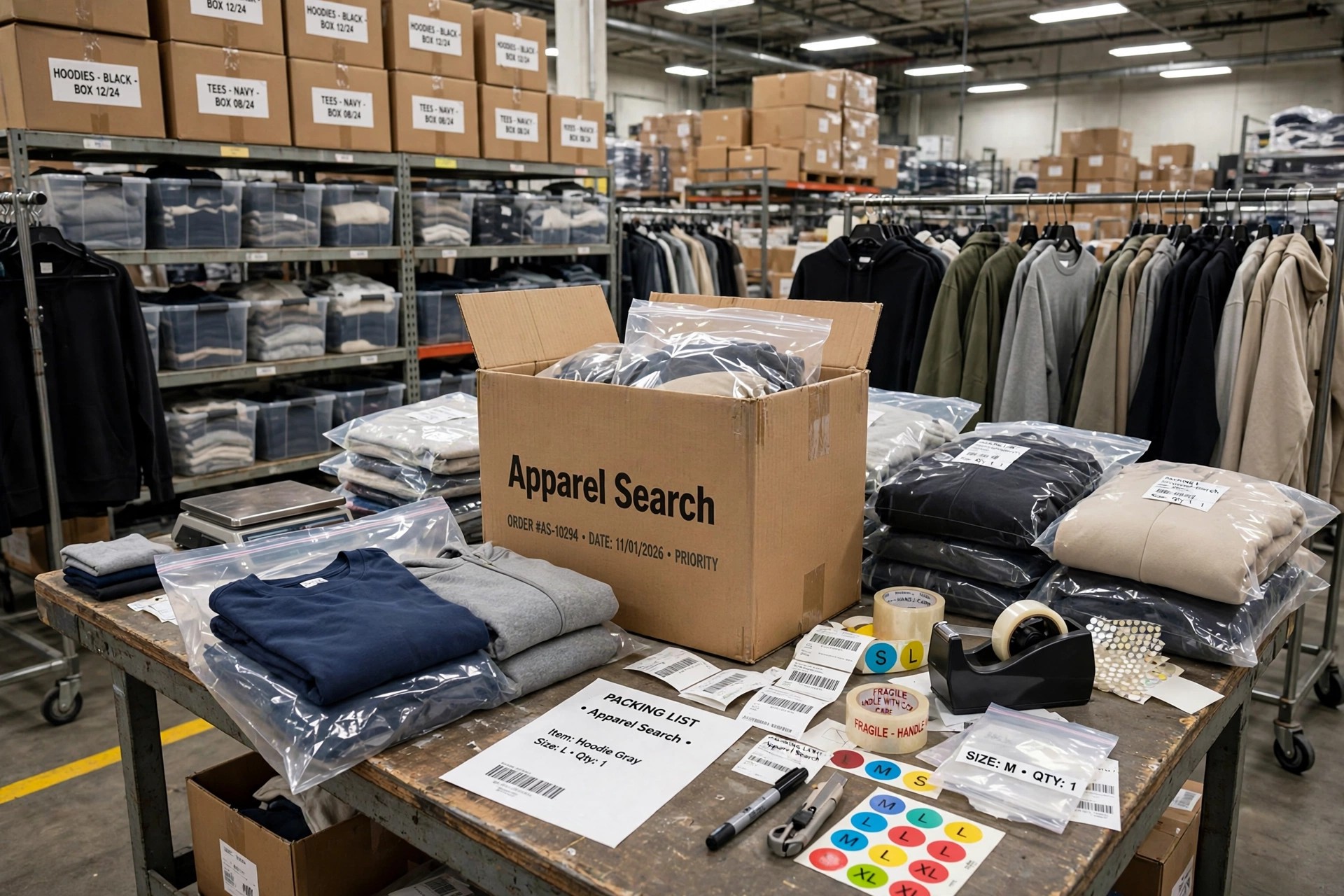
The Bench: Checking, Folding, Bagging and Boxing
The packer's first duty is verification. Each order arrives at the bench as picked garments with a packing list or a scanner instruction, and the packer matches garment to order — style, size, colour and quantity — before anything is folded. A wrong size packed is not a small mistake: it travels to a store, fails on the floor, and returns at the company's cost, with the retailer's chargeback behind it. Experienced packers develop a bench rhythm that builds the check into the handling itself, reading the ticket and the garment label as hands fold, rather than treating checking as a separate, skippable step.
Presentation is the second duty. Folded garments are folded to a standard — dimensions set by the carton and the retailer's packing guide — bagged in poly bags where the specification requires, and packed flat and ordered by size so the box opens logically at the store. Hanging garments are bagged on their hangers and boxed or railed for garment-on-hanger shipment. Tissue, inserts and brand presentation materials are added where the brand's standard calls for them. The packer is, in effect, the last person to dress the product before it is sold, and stores judge a supplier's professionalism by the state of its boxes.
Ticketing, Labelling and Retailer Specifications
Modern apparel packing is specification work. Each retailer publishes a vendor compliance guide covering how its goods must be ticketed and packed: price tickets and barcode labels in defined positions, size stickers on the bag, security tags where required, carton labels with store and purchase-order data, and strict rules on how styles, sizes and colours may be mixed inside one carton. The packer works from that guide order by order, switching specifications as the bench moves from one retailer's work to another's, because the same garment packed two ways is correct for one store group and a chargeback for the next.
Accuracy here is measured and audited. Stores scan cartons on arrival; mismatches between the carton label, the advance shipping notice and the contents are recorded against the supplier, and repeated failures cost packing operations their contracts and packers their standing. The role therefore suits people who find satisfaction in exactness under pace: the bench rewards a packer whose cartons pass audit after audit, and supervisors learn quickly whose work can be trusted with the strictest retailer's specification.
Pace, Peaks and the Shipping Deadline
Packing volume follows the warehouse's outbound waves and the carriers' collection times, and the packer's day bends around both. Work arrives in releases — a store group's orders dropped together, an e-commerce cut-off approaching — and the bench must clear each release in time for its truck. Seasonal peaks multiply everything: the autumn intake, the holiday shipping surge and sale-period replenishment can double or treble daily volume, and distribution centres staff the benches with temporary packers whom the experienced hands must absorb without letting the checking standard slip.
The work is physical in the ordinary warehouse way: standing for the shift, handling cartons, reaching across benches, repeating fold and bag motions thousands of times. Good employers rotate bench tasks, maintain benches at workable heights and treat repetitive-strain complaints as production information rather than weakness, because a packing line's real capacity is set by how long its people can sustain accurate work, not by how fast anyone can move for an hour.
Skills, Qualifications and Career Path
Packing is an entry route into apparel distribution: employers typically require no formal qualifications, and train new packers on the bench — folding standards, ticketing systems, scanner use and the retailers' guides. What they select for is reliability, attention to detail at pace, basic numeracy for counts and quantities, and the stamina for standing, physical work. Accuracy records matter more than speed records; a packer whose work passes audit is promoted ahead of a faster packer whose cartons come back.
From the bench, the paths are practical ones: to senior packer and quality-checking duties, to picking and other warehouse stations as a multi-skilled warehouse worker, to bench or shift leadership as a supervisor's deputy, and into the warehouse roles described elsewhere in this category — receiving, shipping and the assistant warehouse manager's team. Packing also teaches the product itself: few jobs in distribution handle as many garments, and the size, colour and quality knowledge packers absorb is valued across the warehouse.
Common Questions
What does a warehouse packer do in the apparel industry?
Checks picked garments against orders, folds or hangs them to standard, bags and tickets them to each retailer's specification — price tickets, barcode labels, size stickers, security tags — and boxes orders by store, size and colour so shops can work deliveries straight onto the floor.
What skills does a packer need?
Attention to detail at pace above all: matching style, size and colour to the packing list, working accurately to different retailers' ticketing guides, basic numeracy, scanner use, and the stamina for standing, physical bench work. Employers train the rest on the job.
Where can a packer progress?
To senior packer and quality-checking work, to multi-skilled warehouse worker across picking, receiving and shipping stations, and toward bench leadership and the warehouse supervisory ladder described in this category.
More to Explore
Packing and Warehouse Resources
Transportation & Warehouse Directory Pages by Letter
References & Further Reading
More Job Description Categories
- Buying Job Descriptions
- Design Job Descriptions
- Marketing & PR Job Descriptions
- Miscellaneous Job Descriptions
- Planning & Allocation Job Descriptions
- Production & Sourcing Job Descriptions
- Sales & Selling Job Descriptions
- Transportation & Warehouse Job Descriptions (current)