Levi Strauss & Co. History
Earlier company descriptions, brand line-ups, store counts and photographs from the history of Levi Strauss & Co., kept for historical reference.
← Back to the current Levi Strauss & Co. profile
The Company Description of Its Time
The company profile opens with a claim of range across time: they have been the innovation leader in apparel since 1873, the year they created the world's first blue jean. They did not stop there, the filing continues - they have had an impact on every decade since, from activewear for women in the early 20th century, to leading the casual businesswear revolution of the 1990s with the Dockers brand, to providing everyday values with the Levi Strauss Signature brand. Corporate citizenship is filed as an equal pillar: the company opened integrated factories in the American South before it was mandated by the government, was one of the first to create responsible product sourcing guidelines, and pioneered policies to help employees with HIV/AIDS. Headquarters are filed at San Francisco, California, with a mailing address of P.O. Box 7215, San Francisco, CA 94125.
Marks, Loops and Patches: 1886 to 1954
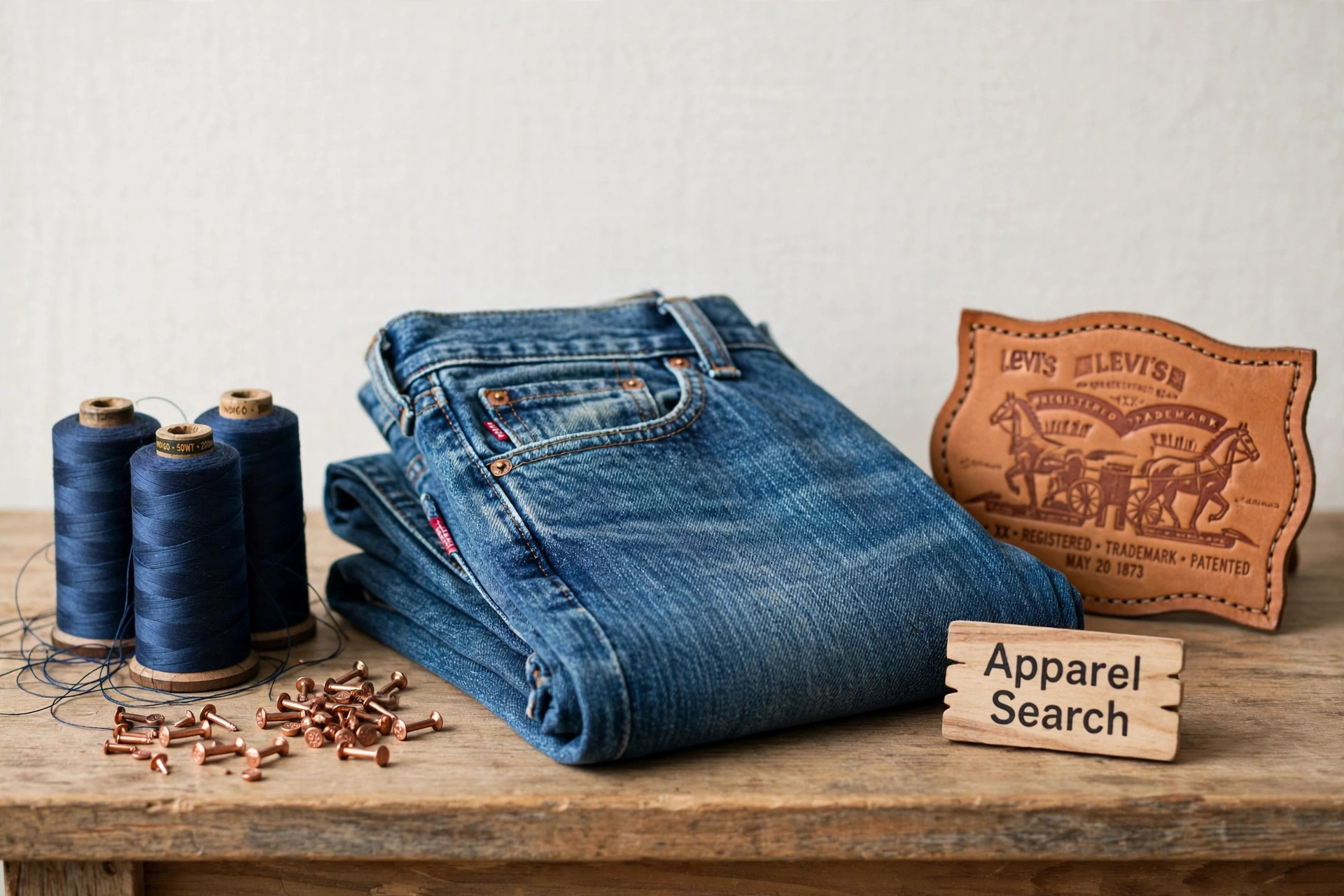
The middle chronology is a sequence of identifiers and fittings. In 1886 the Two Horse brand leather patch is first used on the waist overalls, demonstrating the strength of the pants and reinforcing the company's status as originator of patent riveted clothing ahead of the patent entering the public domain around 1890. Around 1890 lot numbers are first assigned, with 501 designating the famous copper-riveted waist overalls and a 201 jean made as a less expensive version; around 1901 the pants gain a second back pocket. Levi Strauss dies in 1902, his nephews take over, and in 1906 earthquake and fire destroy headquarters and factories, with a new factory built at 250 Valencia Street opening that November. The overalls win a Highest Award at the 1915 Panama-Pacific International Exposition, and by the mid-1910s the inseam becomes felled rather than mock felled.
Fitting changes follow fashion's. In 1922 belt loops are added while suspender buttons and the cinch are retained, and LS&CO. now buys its denim exclusively from Cone Mills; around 1927 Cone Mills develops the 10 oz. red selvage denim exclusively for the 501, woven on 29-inch-wide looms. Through the war years the chronology cross-refers to the conservation changes filed in detail on the Arcuate page of this cluster. After the war: in the late 1950s the leather patch is replaced by a heavy-duty card stock Two Horse patch, in 1954 a zippered version named 501Z is introduced as East Coast customers unfamiliar with the button fly begin buying the product, and in 1960 the word overalls is replaced by the word jeans in advertising and packaging - a name teenagers had adopted in the 1950s, the chronology notes, until it became the term used by all manufacturers.
Smithsonian, Television and Later Notes
The modern entries mix honour, media and construction. Around 1961 pre-shrunk jeans are introduced; in 1964 the jeans become part of the permanent collections of the Smithsonian Institution in Washington, D.C.; in 1966 the first television commercial for Levi's jeans airs, and the back-pocket rivets are replaced with bar tacking. The chronology records 1981's 501 jeans for women, the 1984 501 Blues advertising campaign launched at the Los Angeles summer Olympic Games, the vintage turn of 1992-1996 with the Capital E jean and then the Levi's Vintage Clothing line, the 1997 purchase of a circa-1890 pair of 501 jeans for $25,000, the 501's 125 years of originality in 1998, and the 130th anniversary of the invention of the blue jean in 2003.
The historical record page then appends its own later notes, kept here with their years attached: the 501 CT tapered jeans in 2014, the 700 Series and 300 Shaping Series in 2015, the death of Levi Strauss heir Bill Goldman in a plane crash near Sonoma on July 13, 2017, a smart jacket developed in partnership with Google released in 2017, the 720 High-Rise Super Skinny in 2018, and the August 2021 announcement that Levi's would purchase Beyond Yoga, to operate as a standalone division. The page also quotes, in full, the June 28, 1873 Pacific Rural Press notice of Davis's new pocket fastening - a period newspaper's voice inside the company chronology. Use this profile as the cluster's master timeline; the stitch, the Tab lettering, the founder's life and the women's line each have their own pages, and current company information belongs to the official Levi Strauss site in the References.
More to Explore on Apparel Search
- Fashion Industry Company Names
- Levi Strauss Definition
- Denim Definition
- Jeans Definition
- Women's Levi's Brand
- Men's Levis
- Big E Red Tab
- Little e Red Tab
- Arcuate Stitching
- Levi's Premium
- Made & Crafted
- Children's Levi's Brand
- Levi's Jean Fit Guide
- 501 CT Jeans
- 700 Series Stretch Denim Jeans
- 300 Shaping Series Jeans
- 720 High‑Rise Super Skinny Jeans
- Beyond Yoga
- Levis History of Women's Jeans
- Biography of Levi Strauss
- Levi Strauss News
- dENiZEN
- women's jeans
- men's jeans
- children's jeans
- vintage jeans
References & Further Reading
Looking for More Fashion Companies?
This profile is one filing in the Apparel Search company names directory. Browse the full A-to-Z listing on the Fashion Company Names directory, or shop by category in the Apparel Search shopping directory.