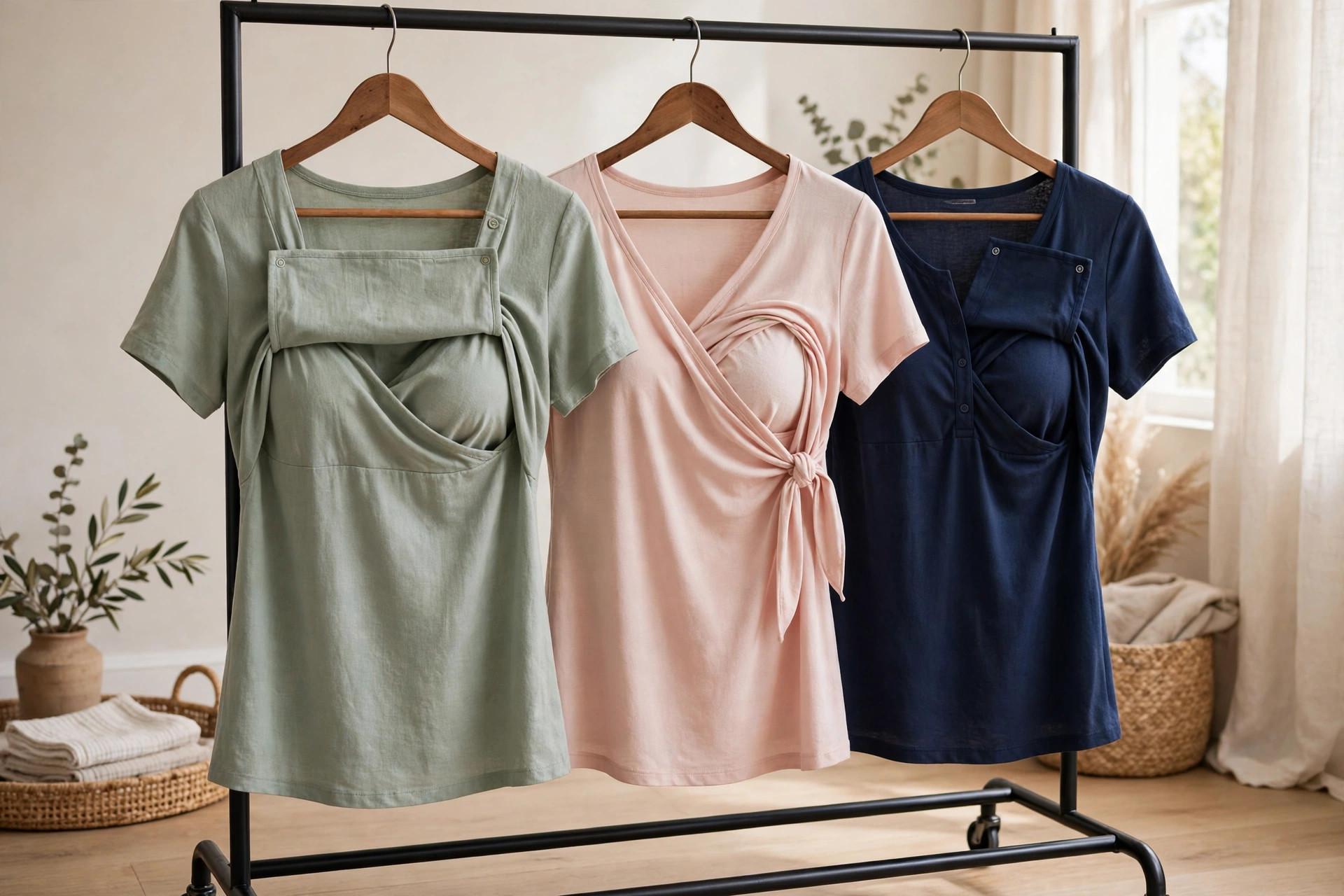
Nursing tops are tops engineered for breastfeeding access: a panel lifts, a layer pulls aside, a neckline crosses over, or clips release a cup — so a baby can feed without the wearer removing or hauling up the whole garment. Worn over a nursing bra or with support built in, they are the working wardrobe of the fourth trimester and however long feeding continues, designed to look like ordinary tops because that is the point.
The Four Access Designs
- Lift-up (double layer): an outer panel ends at an empire or mid-torso line; lift it and an inner layer with openings is beneath. The most discreet design — the outer panel doubles as coverage while feeding — and the most common.
- Pull-aside / crossover: a surplice-style V neckline in stretchy fabric pulls to one side. The simplest mechanism, nothing to break, and the style that most easily passes as a regular wrap top.
- Clip-down: straps or front panels unclip, sharing their hardware logic with nursing bras; common in nursing camisoles and tanks worn as layering pieces or sleepwear.
- Side-access and zip designs: openings concealed in side seams, princess seams, or under decorative details; zips appear on more structured and work-appropriate styles.
No mechanism wins outright. Lift-up gives the best coverage in public; crossover is the most foolproof with a sleeping baby and one hand occupied; clip-down camis anchor a layered wardrobe. Most feeding wardrobes end up with two mechanisms in rotation — which is fine, because the early weeks call for several tops in the wash cycle at any time anyway.
Nursing Top, Nursing Bra, or Both?
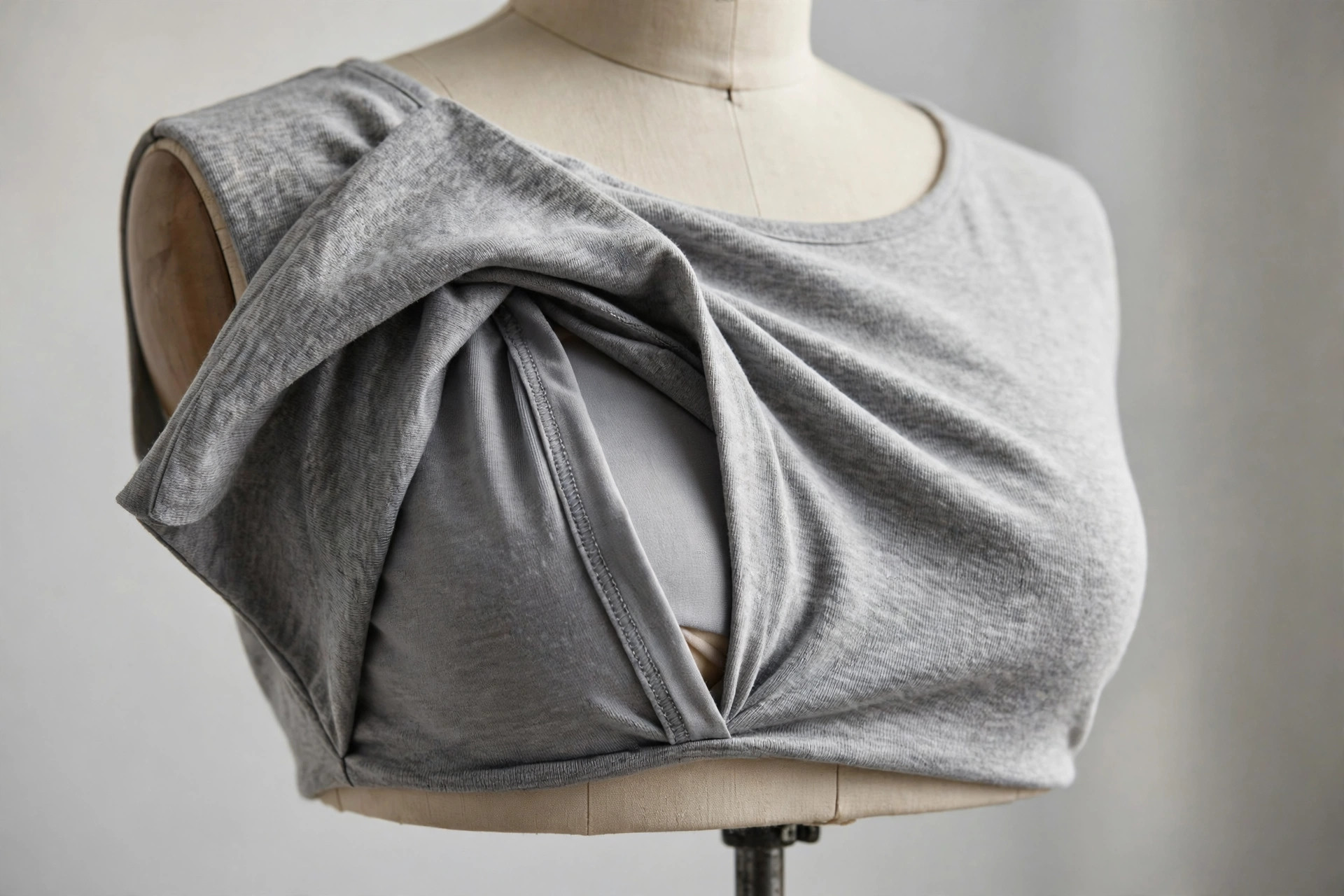
The two garments solve different halves of the job. A nursing bra provides support and its own access, and is the foundation. A nursing top provides the outer layer's access and coverage, and is worn over a nursing bra, over a plain bra whose access you manage, or — in the case of nursing camisoles and shelf-bra tops — as a two-in-one for home, sleep, and light support.
The practical wardrobe logic: nursing bras in rotation daily, nursing tops doing double duty as your actual clothes. That dual role is why nursing tops are cut like clothes rather than equipment — empire lines, wrap fronts, henleys, tees, and blouses — and why many continue in ordinary wear after feeding ends, the access panel simply becoming an unnoticed design detail. Buying nursing tops in the colors and shapes you would wear anyway is not vanity; it is the correct purchasing strategy for a garment category you may live in for a year or more.
Fit for the Fourth Trimester
Nursing-top fit has to solve a moving target: a postpartum midsection that changes weekly, a bust at its largest and fluctuating through the day, and access panels that must align where the baby actually is. Length matters first — a top that ends at the high hip will ride and pull against the access layer; mid-hip to tunic lengths are the reliable cuts. The access opening should sit at the bust, not drift toward the waist, which is a sign the body is too long or the size too large.
Fabric does heavy work here. Soft, stretchy knits — cotton-modal, bamboo blends, and quality jerseys — accommodate fluctuation and sit kindly against sensitive skin, while enough recovery in the knit keeps pull-aside necklines from staying pulled. Check the inner layer as carefully as the outer: openings should be generous enough to use one-handed and edged so they do not curl. And plan quantity honestly — milk, spit-up, and the general weather of new parenthood mean the wash cycle, not the shop rail, decides how many tops a wardrobe needs. Three is a floor; five is comfortable.
Care, and the Long Second Life
Nursing tops are washed more often than almost any garment you own, so buy and care accordingly. Machine wash cool to warm on gentle, with nursing pads and bra hooks kept in a wash bag so nothing snags the knit; close any clips or zips first. Air drying preserves the elastic edges that access panels depend on, though the shelf-bra camisoles of the world will forgive the dryer more readily than structured styles.
When feeding ends, the wardrobe does not retire. Crossover and lift-up tops in plain colors continue as ordinary clothing — the empire panel reads as a design seam, the wrap front as a wrap front. This second life is worth shopping for deliberately: a nursing top in a fabric and cut you genuinely like is worn for years, while the purely functional purchase is donated at six months. The wider family — maternity tops that convert, postpartum pieces, and the rest of the feeding wardrobe — is mapped in the maternity tops guide.
Shop for Nursing Tops
Common Questions
- How do nursing tops work?
- Each design hides an opening in plain sight. A lift-up top has an outer panel that raises to reveal an inner layer with openings; a crossover top pulls aside at the neckline; clip-down styles unfasten at the strap or front; and some tops conceal openings in side seams or under zips. All let a baby feed without removing the top.
- Do I need a nursing bra as well as nursing tops?
- Usually, yes — they do different jobs. The nursing bra supports and has its own access; the nursing top is the outer clothing layer with its own discreet opening, worn over the bra. Nursing camisoles with built-in shelf support can cover both roles at home, for sleep, and for lighter support.
- How many nursing tops do I need?
- More than instinct suggests, because the wash cycle rules the early months. Three is a working minimum; five gives a comfortable rotation accounting for milk leaks and spit-up. Two different access styles — say, lift-up for going out and crossover for home — cover most situations between them.
- When should I buy nursing tops?
- A first few in late pregnancy is the common pattern — maternity-cut nursing tops fit the end of pregnancy and the postpartum weeks, and you will want them ready in the hospital bag. Finalize the wardrobe after the first couple of weeks, when your size and preferred access style have settled.
- Can nursing tops be worn after breastfeeding ends?
- Yes, and the good ones are bought with that in mind. Crossover fronts read as wrap tops, lift-up panels read as empire-seam detailing, and plain nursing tees are simply tees. In neutral colors and quality fabric, a nursing top's second life as ordinary clothing can be longer than its first.
Swim, Active and Maternity Series
This guide is part of the Apparel Search Swim, Active and Maternity Series: practical guides to swimwear, workout clothing, and clothing for pregnancy and nursing.