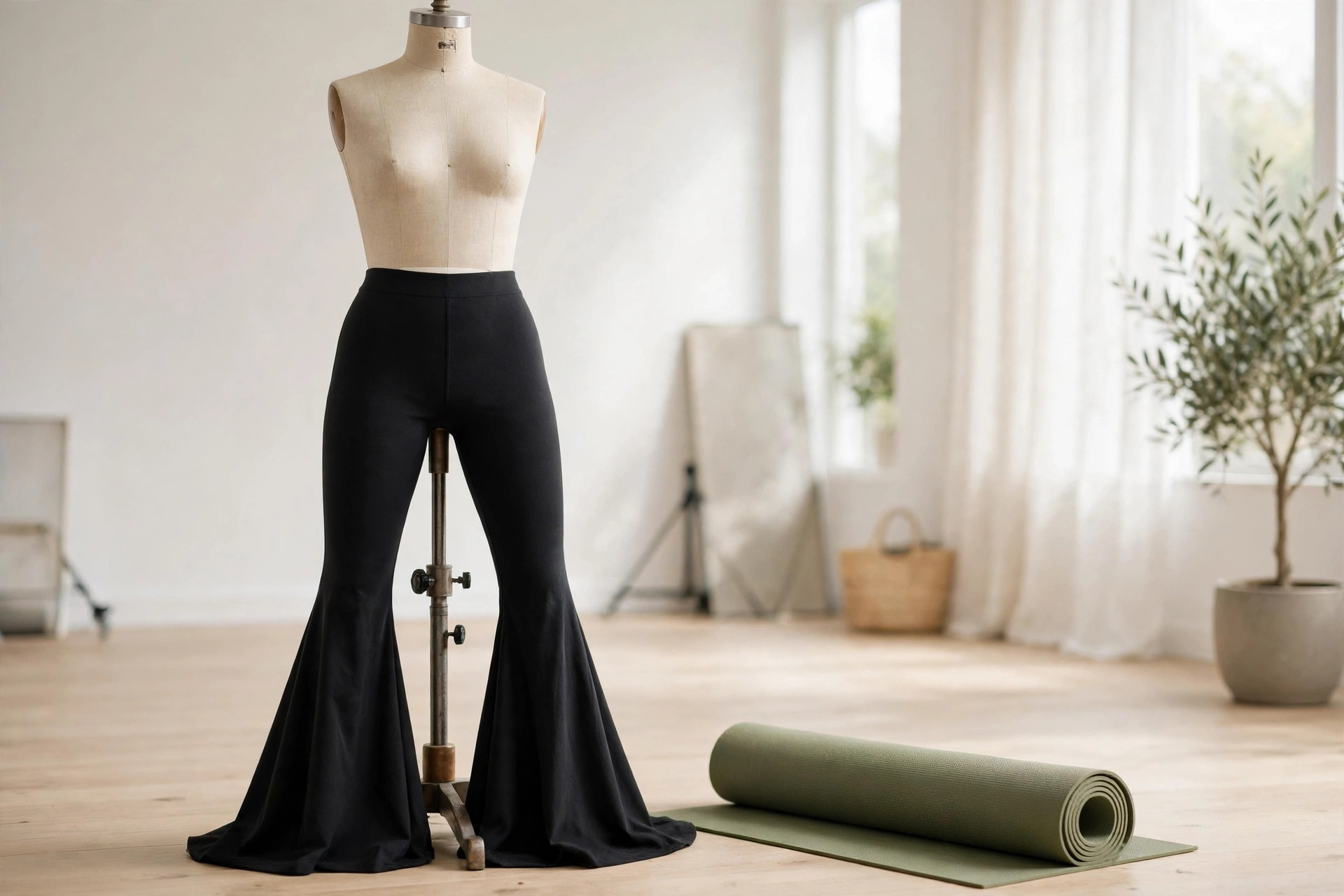
Flare leggings are leggings that fit close through the waist, hip, and thigh, then open into a flared, bell-shaped leg below the knee. They are the modern descendant of the yoga pant — same four-way-stretch knit, same pull-on comfort — recut with the wider flare and crossover waistbands that turned a studio basic into everyday clothing worn with everything from trainers to blazers.
Flare Leggings, Yoga Pants, and Bootcut: Sorting the Family
Three close relatives share the same knit ancestry. Yoga pants are the original: a fold-over or wide waistband and a gentle bootcut opening, sold for practice. Bootcut leggings open only slightly at the hem — a kick flare meant to balance proportions and sit over a shoe. Flare leggings commit: the leg opens into a real bell, often several inches wider than the knee, which changes both the silhouette and the styling — a flare reads as a trouser shape, a bootcut reads as a legging with an opinion.
The waistband is the other modern marker. The crossover (or V-front) waistband, whose front panels cross into a shallow V, became the signature of the current flare generation because it stays up without a drawstring and flatters the waist it crosses. Classic high-rise flat bands remain for purists. Either way, judge the garment as leggings first — squat-proof opacity and four-way stretch with recovery — and as a fashion flare second.
Inseam Is Everything: Length by Height and Shoe
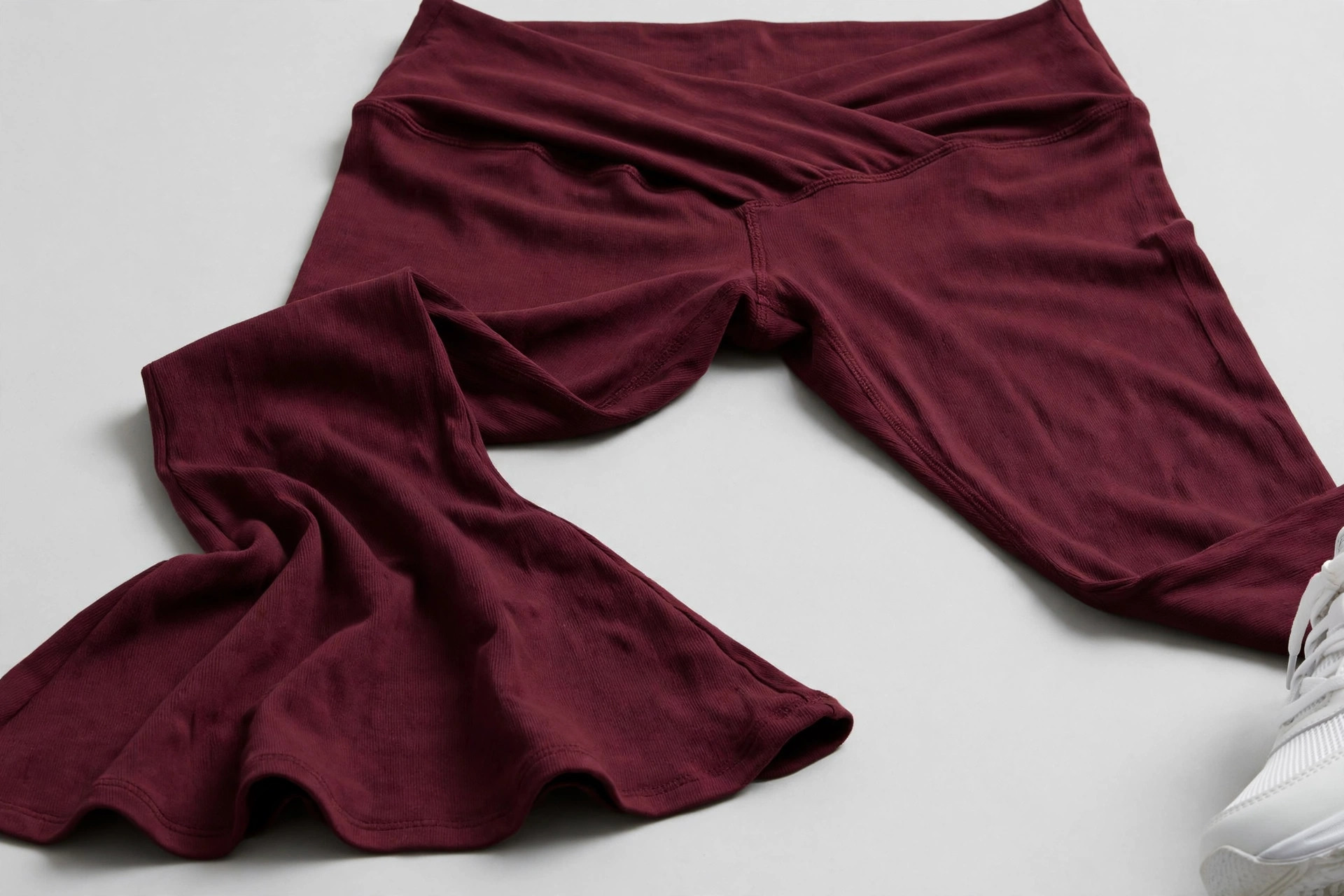
A flare only works at the right length: the hem should skim the top of the shoe and nearly brush the floor in the shoes you will actually wear. Too short and the bell ends awkwardly mid-shin, losing the long line that is the whole point; too long and the hem drags, frays, and collects wet pavement. Because flare leggings are sold by inseam more honestly than most trousers, use it:
- Petite (roughly 28–30 inch inseams): for shorter legs, or any height worn with flat trainers.
- Regular (roughly 31–33 inches): the middle range, suiting average heights with low shoes.
- Tall (roughly 34–36 inches): for long legs, or for wearing the flare over a heeled boot or platform trainer.
Decide the shoe first, then the inseam. A pair bought for flat sneakers will puddle over heels, and a pair bought for platforms will swing short above trainers. Many devotees own the same flare in two inseams rather than compromising — the leggings category's version of hemming.
Fabrics: Studio Knits and All-Day Knits
Two fabric families divide the shelf. Athletic knits — nylon or polyester with generous spandex — are brushed or slick performance fabrics built for actual yoga and training: sweat-wicking, squat-proof, and quick to recover their shape. Everyday knits lean softer and more matte — cotton blends and ribbed fabrics that read as clothing rather than kit, at the price of holding moisture and bagging sooner at the knee if the spandex content is thin.
Whichever family, run the opacity test under bright light in a deep squat or lunge position; heathered and light colors fail it most often. For studio use, also check the flare itself: a flare in a very light, drapey knit swings and wraps the ankle during practice, while a slightly firmer knit holds the bell shape. The women's leggings guide covers the wider fabric and construction map, from cotton to silk.
Styling and Care
The flare's long line is the styling engine: it balances volume on top, so oversized sweatshirts, cropped jackets, and long blazers all sit naturally above it. With trainers it reads athleisure; with heeled boots and a fitted top it passes as a soft trouser in most casual settings; the ribbed everyday versions take a tucked sweater best. Keep the top's hem in mind — the crossover V waistband was designed to be seen, and a cropped or tucked top shows it off.
Care is legging care: wash cool, inside out, with like fabrics; skip fabric softener, which coats performance knits and dulls their wicking; dry flat or on low. Flare hems drag closest to the ground of any garment you own, so check them for fraying and wash after wet-weather wear — a hem that has wicked up street water should not sit in the laundry basket. Hang by the waistband, not folded over a hanger at the knee, to keep the flare's line crisp.
Shop for Flare Leggings
Common Questions
- What is the difference between flare leggings and yoga pants?
- Ancestry aside, it is the leg and the waistband. Yoga pants open into a modest bootcut and traditionally carry a fold-over waistband. Flare leggings open into a pronounced bell below the knee and usually feature a high-rise or crossover V waistband, styling them as everyday trousers as much as studio wear.
- How long should flare leggings be?
- The hem should skim the top of your shoe and nearly brush the ground in the shoes you plan to wear. Buy by inseam — roughly 28–30 inches petite, 31–33 regular, 34–36 tall — and decide the shoe before the length, since a flare hemmed for trainers will drag over heels and vice versa.
- Can you work out in flare leggings?
- Yes, in the athletic-knit versions — they are yoga pants' direct descendants and are squat-proof, stretchy, and moisture-managing. Softer everyday and ribbed knits are better kept for all-day wear; they hold moisture and may bag at the knee during training. Check opacity in a deep squat before studio use.
- What shoes go with flare leggings?
- Trainers for the athleisure default, platform sneakers to lengthen the line further, and heeled boots or loafers when the flare is standing in for trousers. The rule is hem discipline: the flare should cover most of the shoe without pooling on the ground or swinging above the ankle.
- What is a crossover waistband on flare leggings?
- A waistband whose front is made of two panels that cross into a shallow V at the center front. It stays up without a drawstring, lies flatter than a shirred elastic band, and defines the waist visually. Crossover fronts are the signature of the current generation of flare leggings.
Swim, Active and Maternity Series
This guide is part of the Apparel Search Swim, Active and Maternity Series: practical guides to swimwear, workout clothing, and clothing for pregnancy and nursing.