Stitch 406 · Class 400 Multi-Thread Chain Stitch
Stitch 406 — Bottom Cover Stitch
Stitch 406 is the two-needle bottom cover stitch: two needle threads sew parallel rows on the face of the material while a single looper thread weaves between their loops on the underside, covering the underside — and only the underside — between the rows. It is the hemming stitch of the T-shirt: stretchy, flat, and finished on both sides in a single pass.
What Stitch 406 Is
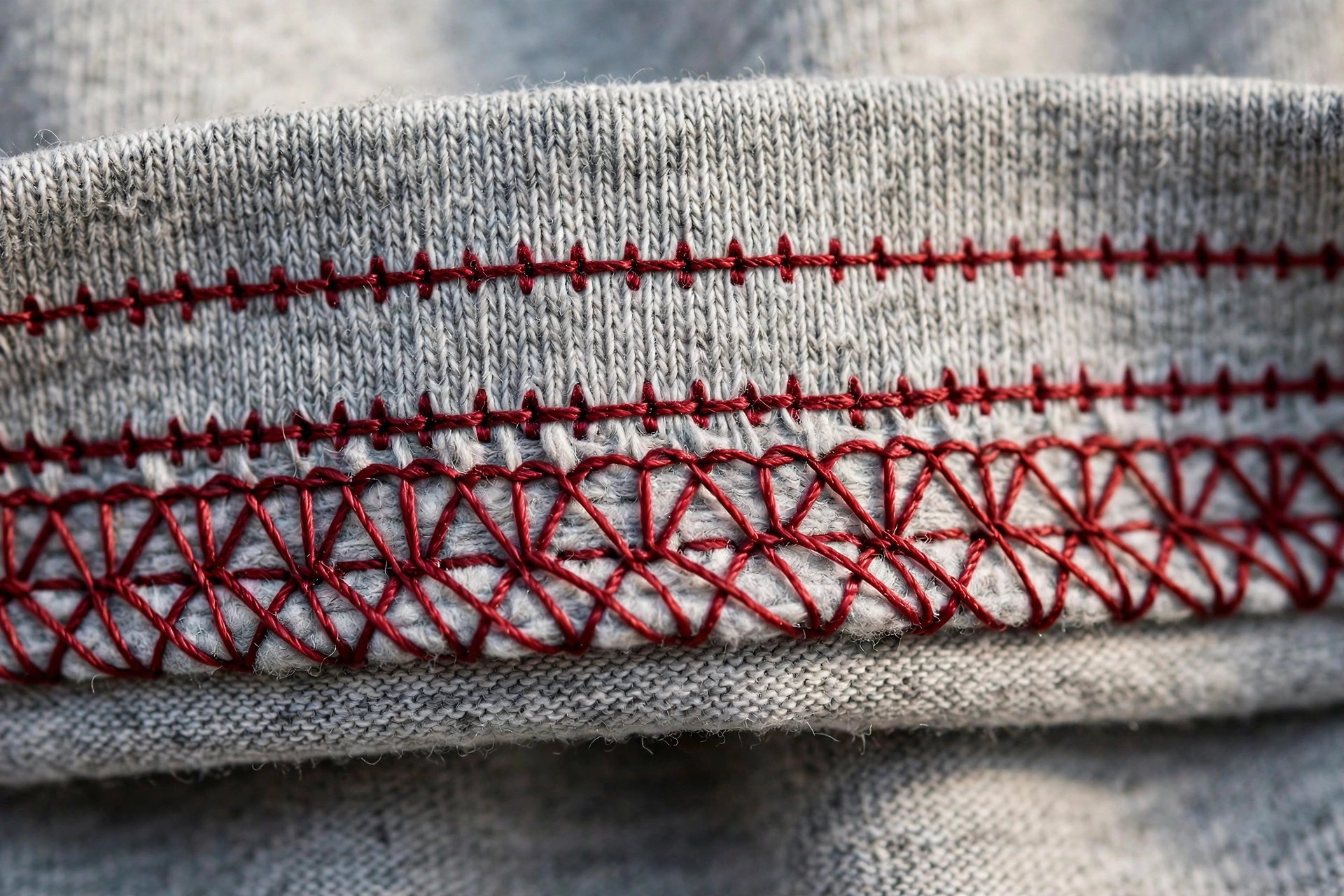
Stitch 406 belongs to the cover-stitch branch of Class 400. It is formed with three threads: two needle threads, A and A′, working side by side a fixed distance apart — the needle gauge, commonly around 4 to 6 millimetres on garment hems — and one looper thread, B, underneath. Each needle thread forms its own row of chain-stitch loops, exactly as in stitch 401; the difference is what the looper does with them. Instead of chaining along a single row, the 406 looper swings from row to row, passing through a loop of one needle thread, travelling across, and passing through a loop of the other, so its thread is laid back and forth across the underside in a zigzag web that links the two rows together.
The word bottom in its name is precise: the covering web lies on the bottom side only. The face of the work shows nothing but the two straight needle rows — which is why a 406 hem reads, from outside the garment, as two lines of plain stitching, while the inside carries all the engineering. The word cover is equally precise: the looper web spans the gap between the needle rows, so when the stitch is sewn over a folded hem, the web covers the hem's raw edge, holding it flat and finishing it in the same pass that sews the hem.
Because the looper web is a net of thread rather than a tight interlacing, a 406 seam stretches generously — Professor Kahn's guide calls 406 the bottom cover stitch, "a (greater) stretch chainstitch", and lists coverstitching where greater stretch is required among its uses. That stretch, plus the flat finish, is why 406 — and not any lock stitch — owns the hems of the knitwear world.
How Stitch 406 Forms
- Two needles, set side by side at the machine's needle gauge, carry threads A and A′ down through the material together — through a folded hem, for example, catching the turned-up edge beneath.
- As the needles rise, loops of both needle threads open below the material, one under each needle.
- The looper travels across beneath the material carrying thread B, passing through the loop of one needle thread, crossing the gap between the rows, and passing through the loop of the other — laying its thread diagonally across the underside.
- The material advances one stitch length; the needles descend again and their new loops pass through the looper's waiting loop, and the looper swings back the other way. Zigzag by zigzag, the looper web builds across the underside, interlooping with every needle loop and covering everything between the rows.
Formation diagram for stitch 406. Thread A is the needle thread; thread B is the looper thread. Illustration by Apparel Search.
The Threads
| Element | Detail |
|---|---|
| Thread count | 3 — two needle threads, one looper thread. |
| Needle threads (A and A′) | Form the two parallel rows seen on the face and the two lines of loops the looper works through underneath. The distance between them — the needle gauge — sets the width of the covered band. |
| Looper thread (B) | The covering thread: it never shows on the face. Underneath, it zigzags between the rows, interlooping with each needle loop and covering the material — typically a raw hem edge — that lies between them. |
| Typical threads | Soft spun polyester in all three positions for most knitwear; textured, woolly-feel threads in the looper where the web touches skin, so the underside stays soft; thread colours matched to the garment, since the face rows are on display. |
| Thread use | High — commonly eight to ten metres of combined thread per metre of stitching, most of it in the looper web. The generous thread supply is what the seam stretches with. |
What It Looks Like
On the face, stitch 406 is two perfectly parallel rows of straight stitching, evenly spaced at the needle gauge — the familiar twin lines around the bottom of a T-shirt and the ends of its sleeves. Nothing else shows; from the outside, a coverstitched hem looks almost plain.
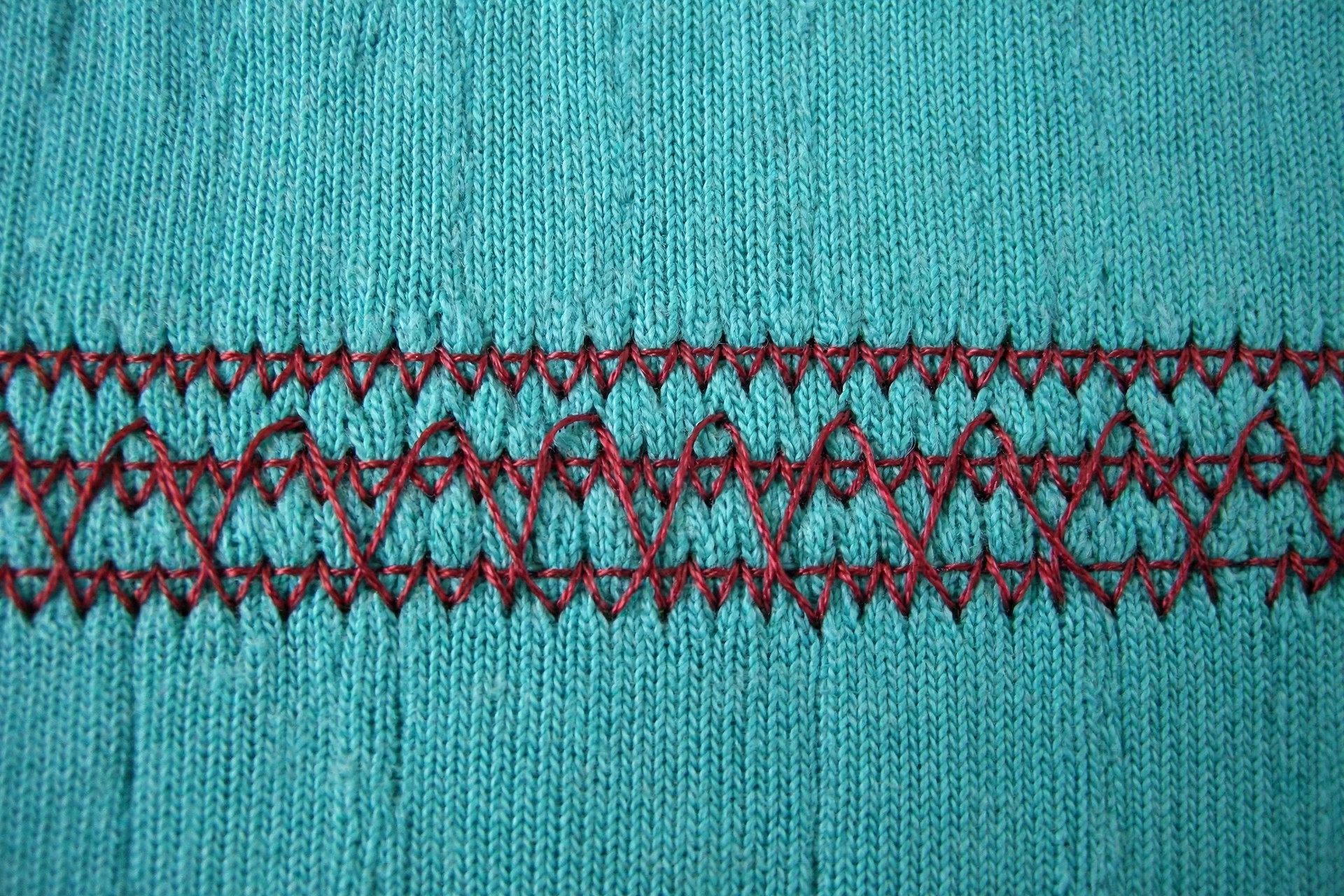
On the underside, the stitch is unmistakable: a zigzag web of looper thread runs between the two needle rows, each diagonal pass interlooping with the needle loops on both sides, and the whole web lies flat over whatever lies between the rows — in a hem, the folded raw edge, which disappears under the covering. The formation diagram above is drawn from this side, because the underside is where 406 does its work. If you want to identify the stitch on a garment, ignore the tidy face and turn the hem inside out: two rows plus a woven web underneath is 406.
Strengths and Limits
Strengths
- High stretch: the looper web extends like a net, so hems stretch with the knit and recover, instead of popping a tight thread.
- Hem and finish in one pass: the web covers the raw edge while the needles sew the hem — no separate overlocking or turning under needed.
- Lies flat and soft: no ridge on the face, no bulky underside, and a textured looper thread keeps the inside comfortable against skin.
- Two clean face rows give a professional, sporty finish that reads as quality on knitwear.
Limits
- It can unravel from the end, like every chain formation: hem ends must be secured, usually by crossing them into a side seam or tacking them down.
- Uses a great deal of thread, and needs a dedicated coverstitch machine — an ordinary lockstitch machine cannot form it.
- Skipped stitches are its known fault on very stretchy or slippery knits: one missed loop leaves a gap that opens under stretch, so machine setup matters.
Where Stitch 406 Is Used
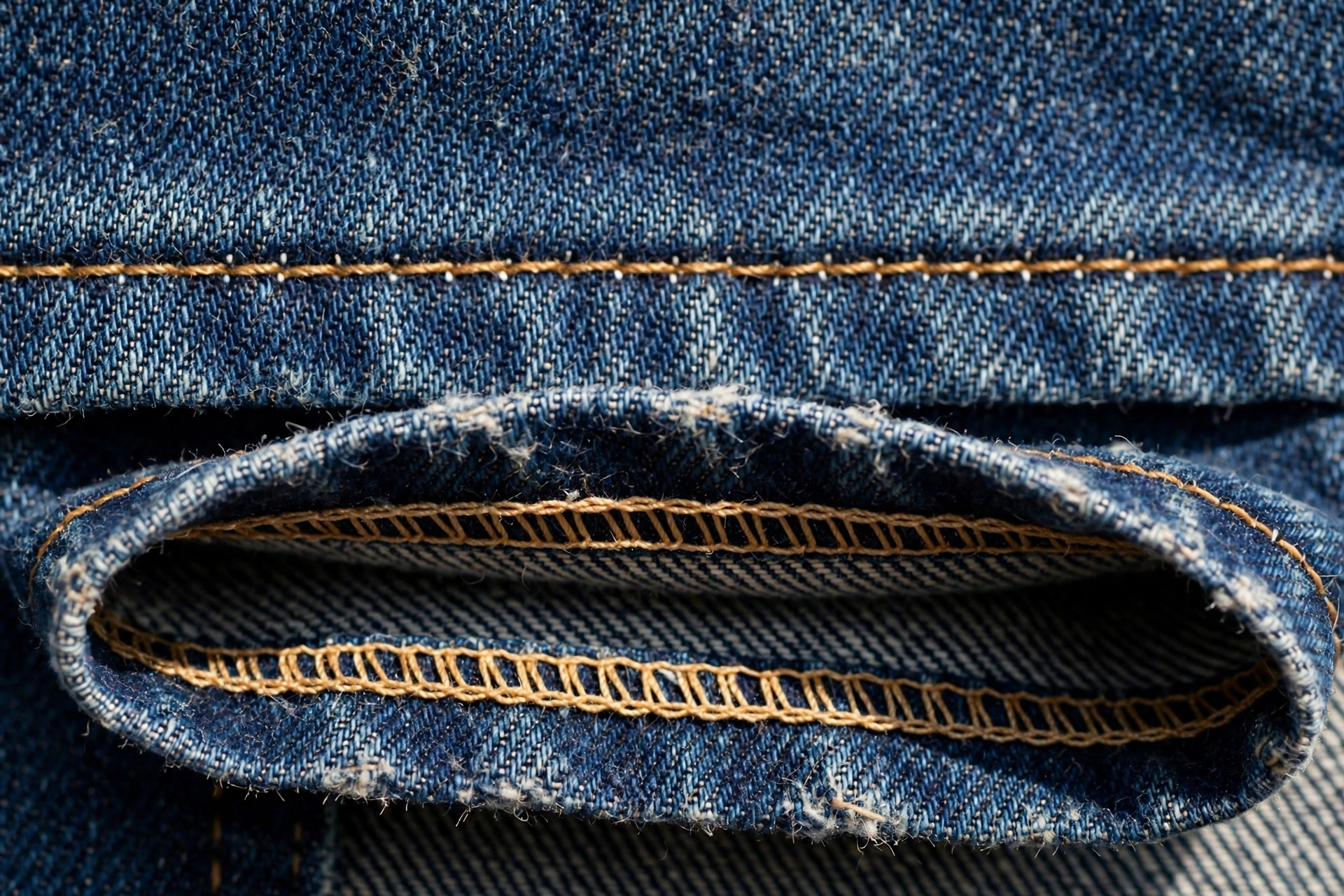
Stitch 406 is, above all, the hemming stitch of knitwear. The bottom hems and sleeve hems of T-shirts, polo shirts, sweatshirts, leggings and underwear are coverstitched with 406 throughout the industry, because it holds the folded hem, covers its raw edge, and stretches every time the garment is pulled on. Professor Kahn's guide adds knit seaming and coverstitching where greater stretch is required, and both show in practice: 406 flattens and finishes seam allowances on knit garments, sewing over an overlocked seam to hold it down flat.
The same one-pass covering makes 406 the standard stitch for attaching bindings around necklines and armholes, for applying elastic where a flat, stretchy attachment is wanted, and for sewing belt loops, where its two rows and covered underside make a strong, neat strap. Typical fabrics: cotton jersey, interlock, rib knits, French terry, fleece, elastane blends — the whole knit family — plus bindings and tapes in matching knits. For how the finished hem is pressed and presented, see our seam finishes and pressing guide; when the edge to be covered is wider than two rows can span, the class steps up to stitch 407.
Common Questions
Is the T-shirt hem stitch really class 400, not class 600?
Yes. Stitch 406 is a multi-thread chain stitch — Class 400 — because its looper covers the underside only. The Class 600 cover stitches (such as 602 and 605) add a separate covering thread on the top as well, so both faces show a web. Two face rows with the web underneath alone is 406.
What is the difference between stitch 406 and stitch 402?
Both use two needle threads and one looper. In 402 the looper simply chains the two rows together and the work tends to ridge up along the seam. In 406 the looper is laid across between the rows as a covering web, so the stitch lies flat and finishes the underside — which is why 406 hems and 402 seams.
Why did a loop pull out of my coverstitched hem?
406 is a chain formation, so a free looper end can run. The end of the hem was probably not secured. Feed the loose end back through to the underside with a hand needle and knot or tack it, and the rest of the hem will hold — the damage does not spread on its own unless the end keeps being pulled.
What needle spacing is normal for stitch 406?
For garment hems, gauges around 4 to 6 millimetres between the two needles are typical. Wider gauges cover a broader band and stretch further per stitch; narrower gauges suit bindings and lighter work. The gauge is a machine setup choice, not part of the stitch's identity — it is 406 at any spacing.
Sources & the photographic reference
The stitch and seam classifications on this page follow ASTM D-6193, Standard Practice for Stitches and Seams, explained here in Apparel Search's own words with original diagrams. For photographs of these stitches and seams, see the Garmenco guide's Class 400 page — Professor Bernard Kahn's photographic guide, which Apparel Search has recommended for years and continues to link as the photo reference for this classification. Our guide is the permanent on-site companion to it.
Related Stitches
 Stitch 401 — Chain Stitch
 Stitch 407 — Bottom Cover Stitch
 Stitch Class 400 — Multi-Thread Chain Stitch
More to Explore
Search Apparel Search
Stitch and seam classifications follow ASTM D-6193, Standard Practice for Stitches and Seams. Diagrams on these pages are original Apparel Search drawings.