Stitch 401 · Class 400 Multi-Thread Chain Stitch
Stitch 401 — Chain Stitch
Stitch 401 is the two-thread chain stitch: one needle thread and one looper thread, interlaced and interlooped on the underside of the material. From the top it looks like an ordinary straight stitch; turn the seam over and the threads form a chain. It is the workhorse seaming stitch of jeans, workwear and knitwear — faster and stretchier than a lock stitch, with no bobbin to change.
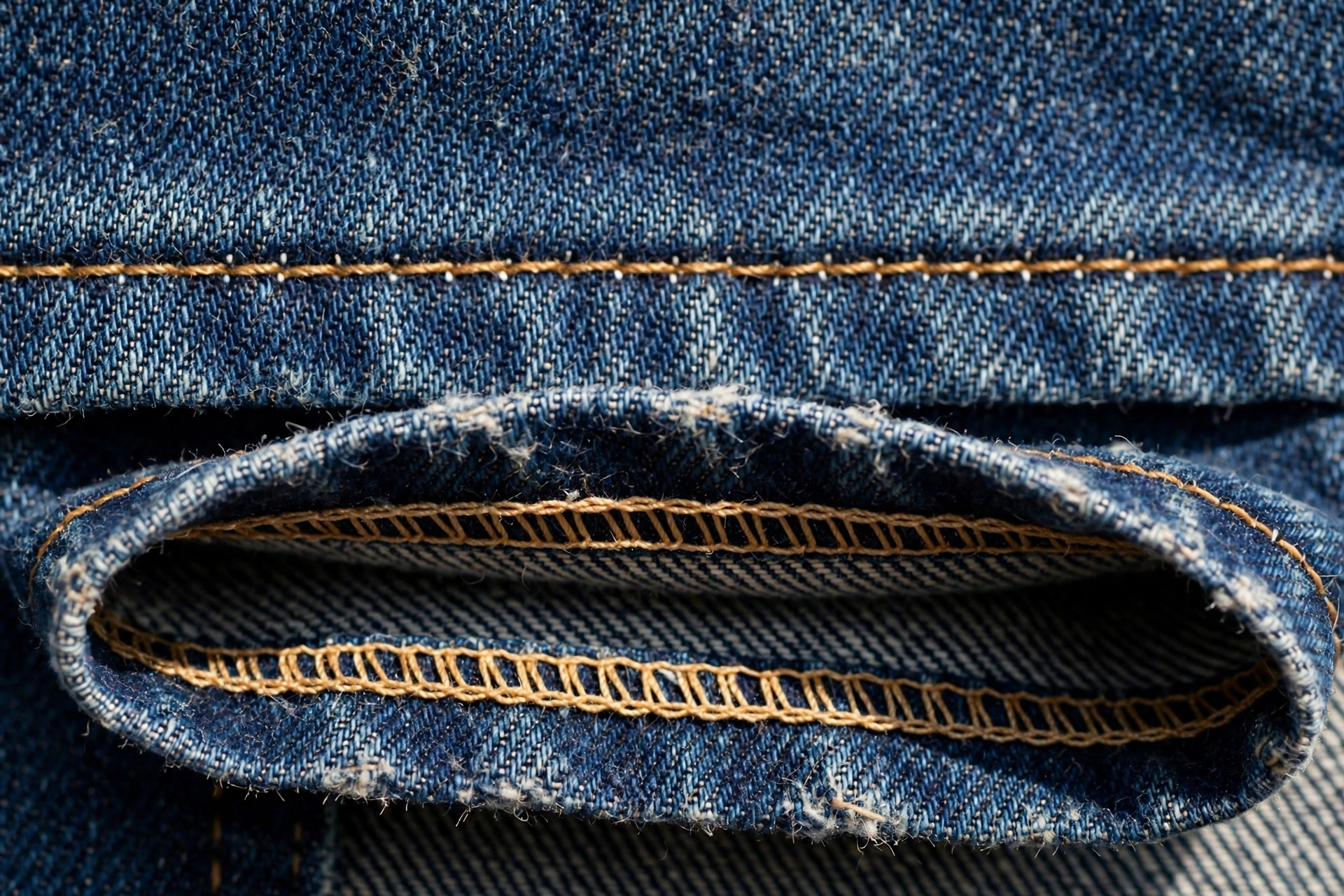
What Stitch 401 Is
Stitch 401 is the simplest member of Class 400 and the reference point for the whole family: one needle thread (thread A) and one looper thread (thread B). The needle carries its thread through the material; below the material, a looper passes its own thread through the needle thread's loop, and the needle's next loop passes in turn through the looper's loop. Loop through loop, the two threads build a continuous chain that lies against the underside of the seam, while the top of the seam shows only the needle thread's straight segments.
That construction explains both of 401's famous traits. Because the chain underneath holds a reserve of thread, a 401 seam can give a little along its length where a lock stitch seam cannot — enough to matter on a jeans inseam or a knit side seam. And because the seam is literally a chain, it can be unmade from the end: free the looper thread at the finishing end and pull, and the seam unzips stitch by stitch. Factories treat that as a feature to manage, not a flaw — ends are locked by bartacks, crossing seams or a few reverse stitches — and repairers quietly love it, because a 401 seam is the easiest factory seam in the world to open on purpose.
Stitch 401 is also the chain stitch of the roping effect: the slight waviness that develops along the outseam and hem of well-worn jeans. A chain stitch seam holds fractionally more thread than the fabric beneath it, and as the denim shrinks and relaxes in washing, the seam line puckers into soft rope-like waves. Denim makers who sew vintage-style jeans choose 401 for exactly this behaviour; a lock stitch hem stays flat and, to a denim eye, lifeless by comparison.
How Stitch 401 Forms
- The needle carries thread A down through the plies of material. As it begins to rise from its lowest point, a loop of thread A opens beside the needle, below the material.
- The looper, moving beneath the needle plate, enters that loop carrying looper thread B, and lays a loop of B across the path the needle will take on its next descent.
- The material advances by one stitch length. The needle descends again — through the material and through the waiting loop of thread B — so the new loop of A passes through the previous loop of B.
- The looper releases its held loop, the threads are drawn up, and the interlooping of A and B is pulled snug against the underside of the material. The cycle repeats, and the interloopings accumulate into the continuous chain that names the stitch.
Formation diagram for stitch 401. Thread A is the needle thread; thread B is the looper thread. Illustration by Apparel Search.
The Threads
| Element | Detail |
|---|---|
| Thread count | 2 — one needle thread, one looper thread. |
| Needle thread (A) | The only thread seen on the face: it forms the straight row of segments on top and dives through the material at every stitch to build the chain below. |
| Looper thread (B) | Never reaches the face. It works entirely underneath, passing through each needle loop and being passed through in turn, so the underside shows the two threads interlooped in a chain. |
| Typical threads | Core-spun polyester or polyester-cotton for most seams; heavy cotton or cotton-wrapped thread in the classic jeans palette for denim work, where the thread is part of the look. |
| Thread use | Noticeably higher than a lock stitch — roughly four to five metres of combined thread per metre of seam at normal stitch lengths. The extra thread is the price of the chain, and the source of the seam's give. |
What It Looks Like
On the top, stitch 401 is almost indistinguishable from the 301 lock stitch: a straight row of even thread segments lying along the seam line. Nothing on the face betrays the completely different machinery underneath.
On the underside, the stitch declares itself: a continuous chain of interlocking loops runs the length of the seam, each loop passing through the last. It looks like a row of fine crochet worked flat against the fabric. That chain is also the field test for the stitch — if the underside of a straight seam shows a chain rather than a second straight row, the seam is 401, not 301. On jeans, look at the inseam and the hem: the chain underneath is the signature of the chainstitch machines that sewed them.
Strengths and Limits
Strengths
- More stretch than a lock stitch: the chain's reserve thread lets seams give under load instead of popping.
- No bobbin: both threads feed from cones, so long seams — trouser inseams, drapery, bag closing — run without a single stop to change a bobbin.
- Strong across thick stacks: the formation tolerates the layered seams of denim and workwear, and twin-needle versions sew two rows at once.
- Easy to unpick deliberately: pull the looper thread from the finishing end and the seam opens cleanly for alteration or repair.
Limits
- It can unravel: if the looper thread breaks mid-seam or an end is left unsecured, the chain can run back from that point. Ends must be locked.
- Uses roughly twice the thread of a comparable lock stitch seam.
- The underside chain adds slight bulk and can ridge up on very light fabrics, where a flatter stitch serves better.
Where Stitch 401 Is Used
Stitch 401 is the default factory seaming stitch wherever its combination of speed, strength and give is wanted. Its most famous home is denim: the inseams and lap seams of jeans are chain-stitched, the outseam carries the roping effect described above, and classic jeans hems are sewn with 401 on dedicated chainstitch hemming machines. Professor Kahn's guide lists its typical uses as knit seaming and woven lap seams, and both are everyday sights: knit garments are seamed with 401 where the seam must move with the fabric, and lapped constructions — one ply laid over another, as in the flat-felled style seams of workwear — are sewn with single- and twin-needle 401.
Beyond jeans and knits, 401 closes long seams in shirts and trousers, sews waistbands, and — in its heavy bag-closing form — stitches shut sacks of coffee, grain and feed, where the unravelling trait is turned into the opening mechanism: pull the tail and the bag opens. Typical fabrics: denim first of all, then workwear twills, corduroy, jersey and interlock knits, shirtings and trouserings. The seam it most often sews is the plain superimposed seam and its lapped cousins — see Seam Class SS in this guide, and the chain stitch definition for the term itself.
Common Questions
How can I tell stitch 401 from stitch 301 on a finished garment?
Turn the seam over. A 301 lock stitch looks the same on both sides — a straight row of segments. A 401 seam shows a straight row on top but a chain of interlocking loops underneath. The underside never lies.
What is the roping effect on jeans?
It is the soft, wavy pucker that develops along a chain-stitched jeans seam or hem as the denim washes and relaxes. Stitch 401 holds slightly more thread than the fabric beneath it, so the seam line ripples into rope-like waves. Vintage-style denim is chain-stitched partly to earn this finish.
If chain stitch unravels, why do factories trust it?
Because the unravelling only starts from a free end or a break, and both are controlled: seam ends are bartacked, crossed by other seams, or sewn into hems, and a correctly formed 401 seam is strong in wear. In exchange, factories get stretch, speed and seams that never wait for a bobbin change.
Is stitch 401 the same as the chain stitch on a home machine?
The formation is the same idea — a needle thread looped with a second thread underneath — but most home machines cannot sew a true 401; it takes a looper, which home lockstitch machines do not have. Home coverstitch machines sew the related cover stitches 406 and 407.
Sources & the photographic reference
The stitch and seam classifications on this page follow ASTM D-6193, Standard Practice for Stitches and Seams, explained here in Apparel Search's own words with original diagrams. For photographs of these stitches and seams, see the Garmenco guide's Class 400 page — Professor Bernard Kahn's photographic guide, which Apparel Search has recommended for years and continues to link as the photo reference for this classification. Our guide is the permanent on-site companion to it.
Related Stitches
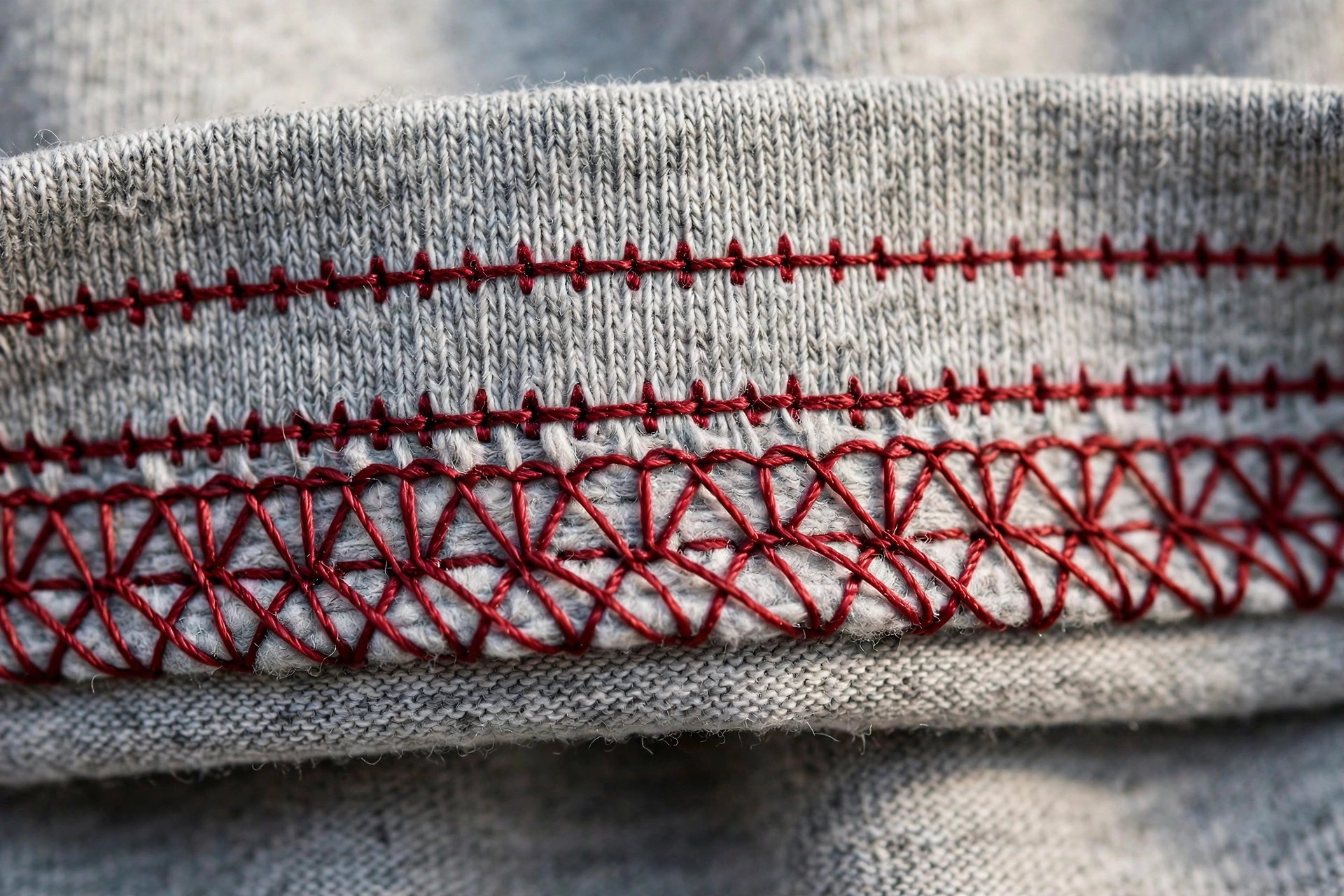 Stitch 406 — Bottom Cover StitchTwo needle rows, one covering looper: the T-shirt hem stitch.
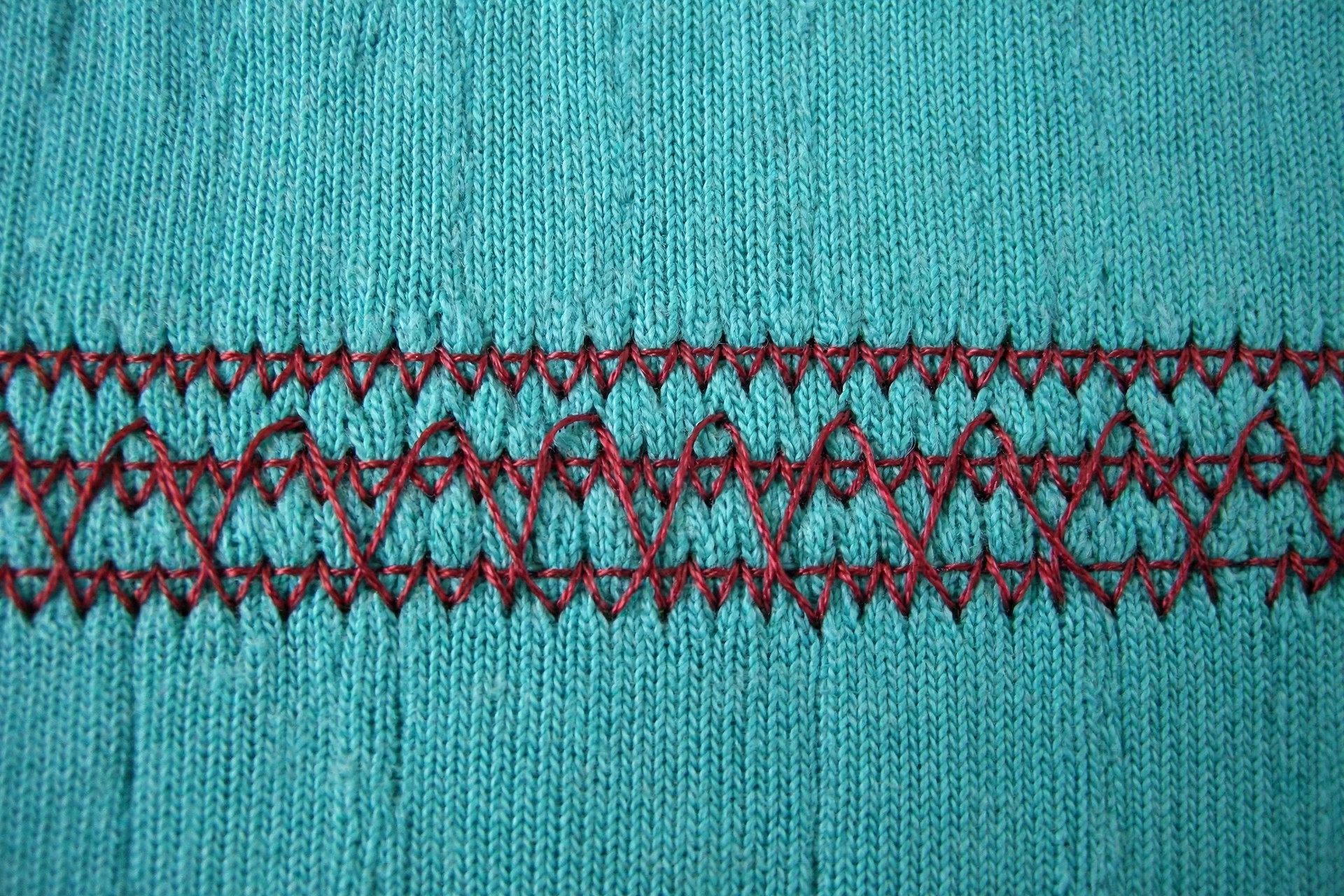 Stitch 407 — Bottom Cover StitchThree needle rows and the widest looper cover in the class.
 Stitch Class 400 — Multi-Thread Chain StitchThe whole class: how chain stitches form, and how the three types compare.
More to Explore
Search Apparel Search
Stitch and seam classifications follow ASTM D-6193, Standard Practice for Stitches and Seams. Diagrams on these pages are original Apparel Search drawings.