Stitch 407 · Class 400 Multi-Thread Chain Stitch
Stitch 407 — Bottom Cover Stitch
Stitch 407 is the three-needle bottom cover stitch: three needle threads sew parallel rows on the face while a single looper thread weaves across all three rows on the underside, covering a wider band than its two-needle sibling, stitch 406. Same family, same flat stretchy character — one more needle, and everything it covers gets wider.
What Stitch 407 Is
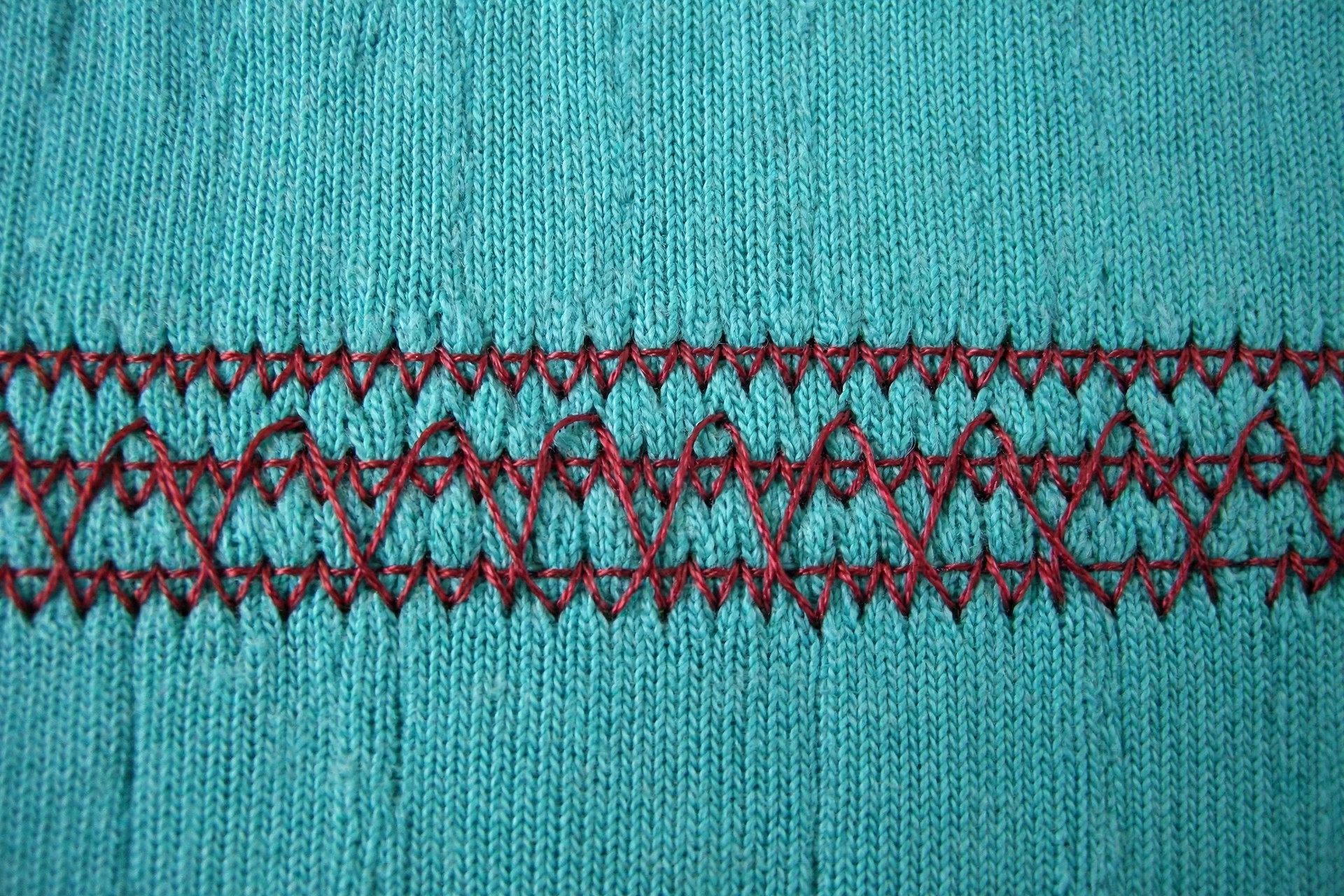
Stitch 407 is formed with four threads: three needle threads, A, A′ and A″, working side by side across the width of the stitch, and one looper thread, B, underneath. Each needle builds its own row of chain-stitch loops, as in stitch 401; the looper, instead of chaining along one row or zigzagging between two, weaves across all three — through the loop of the first needle thread, across the middle row, and through the loop of the third — so its thread is drawn against the underside in a web that spans the full width of the stitch. The standard's figure note for 407 records exactly this construction: three needle threads and one looper thread, their loops passed through the material and drawn against its underside.
Like 406, 407 is a bottom cover stitch: the web covers the underside only, and the face shows plain parallel rows — three of them. The practical meaning of the third row is width. A 407 stitch grips the material at three lines instead of two, spreads the load of a stretched seam across more thread and more penetration points, and covers an underside band roughly half again as wide as a comparable 406 — wide enough to swallow a broad hem allowance or a wide strip of elastic whole, holding it flat under the web.
Stitch 407 is the least common of the three types in this guide, and that is a matter of need, not merit. Most hems are narrow, and two rows cover them; 407 earns its place where the work is wide — wide elastics, wide bindings, wide hem turnings — or where a three-row face is wanted as a visible feature. Where it is specified, nothing narrower will do its job.
How Stitch 407 Forms
- Three needles, set side by side across the stitch width, carry threads A, A′ and A″ down through the material together — through a folded hem, a binding, or a strip of elastic laid under the fabric.
- As the needles rise, loops of all three needle threads open below the material, one under each needle.
- The looper travels the full width beneath the material carrying thread B, passing through the loop of the first needle thread, crossing the middle row — interlooping with its loops as it passes — and through the loop of the third needle thread, laying its thread across the whole underside.
- The material advances one stitch length, the needles descend and their new loops pass through the looper's waiting loop, and the looper weaves back the other way. Pass by pass, the web builds across all three rows, covering everything that lies beneath them.
Formation diagram for stitch 407. Thread A is the needle thread; thread B is the looper thread. Illustration by Apparel Search.
The Threads
| Element | Detail |
|---|---|
| Thread count | 4 — three needle threads, one looper thread. |
| Needle threads (A, A′ and A″) | Form the three parallel rows seen on the face and the three lines of loops underneath. Their combined span — set by the machine's needle gauge — fixes the width of the covered band. |
| Looper thread (B) | The covering thread, seen only on the underside: it weaves across all three rows, interlooping with the needle loops of each, and covers the material — a wide hem edge, elastic or binding — lying beneath the rows. |
| Typical threads | Soft spun polyester for the needles; textured, soft-hand thread in the looper where the wide web lies against the body, as on underwear elastic. Colours matched to the garment for the three face rows. |
| Thread use | The highest in this guide — the looper crosses a three-row width at every stitch. The heavy thread supply underwrites the stitch's stretch and its grip. |
What It Looks Like
On the face, stitch 407 shows three perfectly parallel rows of straight stitching. The three-row face is a recognised feature in its own right: on waistbands, bindings and sportswear it reads as a deliberate, technical finish, and specifiers sometimes choose 407 for the face alone.
On the underside, the looper web spans the full three-row width, its diagonals crossing the middle row as they travel from the first row to the third. Compared side by side with 406, everything is the same in kind and wider in extent: one more row of needle loops, a broader web, a broader covered band. The formation diagram above is drawn from the underside, where that width is visible. On a garment, three face rows plus the wide web beneath is a certain identification.
Strengths and Limits
Strengths
- Widest cover in the class: one pass covers a broad hem allowance, binding or elastic that two rows cannot span.
- Grip at three lines: load and stretch are shared across three needle rows, so wide attachments hold flatter and more evenly.
- High stretch, as with 406: the wide looper web extends and recovers with the fabric.
- A distinctive three-row face that doubles as a design feature on waistbands and sportswear.
Limits
- Needs a three-needle coverstitch setup and the most thread of any type in this class — wasted capacity on narrow work.
- Like all chain formations it can unravel from an unsecured end; wide webs give a pulled end more to undo.
- On light or narrow hems the third row is simply in the way — 406 is the right-sized tool there.
Where Stitch 407 Is Used
Stitch 407 is specified where cover work is wide. Its classic application is attaching elastic in knit underwear and sportswear: a wide waistband elastic is laid against the garment, and one pass of 407 — three rows gripping through fabric and elastic together, the looper web flattening everything underneath — fixes it flat, stretchy and finished. The same logic covers wide bindings and the hems of garments whose turnings are cut broad, where a 406 web would leave part of the raw edge uncovered.
It also appears as a flattening stitch over wide seam allowances in knitwear and as decorative-functional topstitching on waistbands, cuffs and athletic garments, where its three face rows are part of the design language. Typical fabrics: the knit family throughout — jersey, rib, interlock and elastane blends — and the elastics, bindings and tapes sewn to them. For narrower cover work, stitch 406 covers the everyday ground; for the seam constructions these stitches serve, see the edge-finishing family in this guide and our seam finishes and pressing guide.
Common Questions
What is the difference between stitch 407 and stitch 406?
Needle count and width. Stitch 406 uses two needle threads and covers the band between two rows; stitch 407 uses three needle threads and one looper, covering a band roughly half again as wide and showing three rows on the face. Both are bottom cover stitches with the web on the underside only.
Why is stitch 407 less common than 406?
Most cover work is narrow — an ordinary T-shirt hem needs only two rows, and 406 sews it with less thread and a simpler setup. Stitch 407 is kept for wide work: broad elastics, wide bindings and wide hem turnings, where its extra width is exactly what is needed.
Is stitch 407 a flatlock stitch?
No. Flatlock — the Class 600 flat seam, type 607 — joins two abutted edges so the seam lies completely flat with covering on both faces. Stitch 407 sews through overlapping material, such as a folded hem or an elastic laid under fabric, and covers the underside only.
Can a home coverstitch machine sew stitch 407?
Many can: home coverstitch machines commonly offer three needle positions and can be threaded for the three-needle, four-thread formation. Sewn at home it is used for the same wide work — waistband elastic, wide hems and bindings — as in the factory.
Sources & the photographic reference
The stitch and seam classifications on this page follow ASTM D-6193, Standard Practice for Stitches and Seams, explained here in Apparel Search's own words with original diagrams. For photographs of these stitches and seams, see the Garmenco guide's Class 400 page — Professor Bernard Kahn's photographic guide, which Apparel Search has recommended for years and continues to link as the photo reference for this classification. Our guide is the permanent on-site companion to it.
Related Stitches
 Stitch 401 — Chain Stitch
 Stitch 406 — Bottom Cover Stitch
 Stitch Class 400 — Multi-Thread Chain Stitch
More to Explore
Search Apparel Search
Stitch and seam classifications follow ASTM D-6193, Standard Practice for Stitches and Seams. Diagrams on these pages are original Apparel Search drawings.