How to Calculate Volumetric Weight for Your Shipment
Dimensional (dim) weight explained — the /6000 formula, a worked example, and the density rule that decides which weight you pay for
Large items with a light overall weight can be charged according to the space they take up on an aircraft. In those cases, volumetric weight — also called dimensional weight or dim weight — is used to calculate the shipment cost. It is the pricing mechanism that makes a container-load of puffy jackets cost real money to fly even though the scale barely notices them.
The working rule is simple: calculate the volumetric weight for every shipment you send, then compare it with its actual weight. The greater weight of the two is the one the freight company uses to work out the price it will charge you. This page gives the international formula, the procedure behind it, and the density rule that predicts which of the two weights will win.
Why Carriers Charge by Space, Not Just Weight
Volumetric weight, also known as dimensional weight, is used by postal companies and other freight industries and courier services around the world to invoice for the actual space that a parcel, package or pallet takes up in a vehicle or storage area. The reason is physical: a vehicle can quickly become full of bulky, lightweight articles long before it reaches its capacity in weight, which makes for inefficient use of space if those articles are billed by the kilogram alone.
Dim weight corrects that imbalance. By converting a shipment's volume into a weight equivalent, the carrier prices the two scarce resources of an aircraft or truck — lift capacity and hold space — on a single scale, and the shipper of air-filled cartons pays for the hold space those cartons actually consume.
The Formula and the Procedure
International volumetric weights are calculated using this formula: (Length x Width x Height in centimeters) / 6000 = Volumetric Weight in kilograms. The basic procedure behind it has three steps: find the smallest cuboid box that your consignment will fit in; find the volume of that notional box in cubic centimetres; divide the volume by 6000 — the answer is your volumetric weight in kilograms.
Two details in the procedure matter. First, the measurement is of the smallest box the goods fit in, not of the goods themselves: an irregular consignment is priced on its full rectangular footprint, including the air in its corners. Second, the same divisor logic extends from a single parcel to a pallet — measure the pallet's overall length, width and height (including the pallet and any overhang), and divide its volume by 6000 the same way. The Calculating Volume Freight page covers the underlying volume arithmetic, and the ocean-container counterpart, Verified Gross Mass (VGM), covers the weight a packed container must declare for sea carriage.
A Worked Example
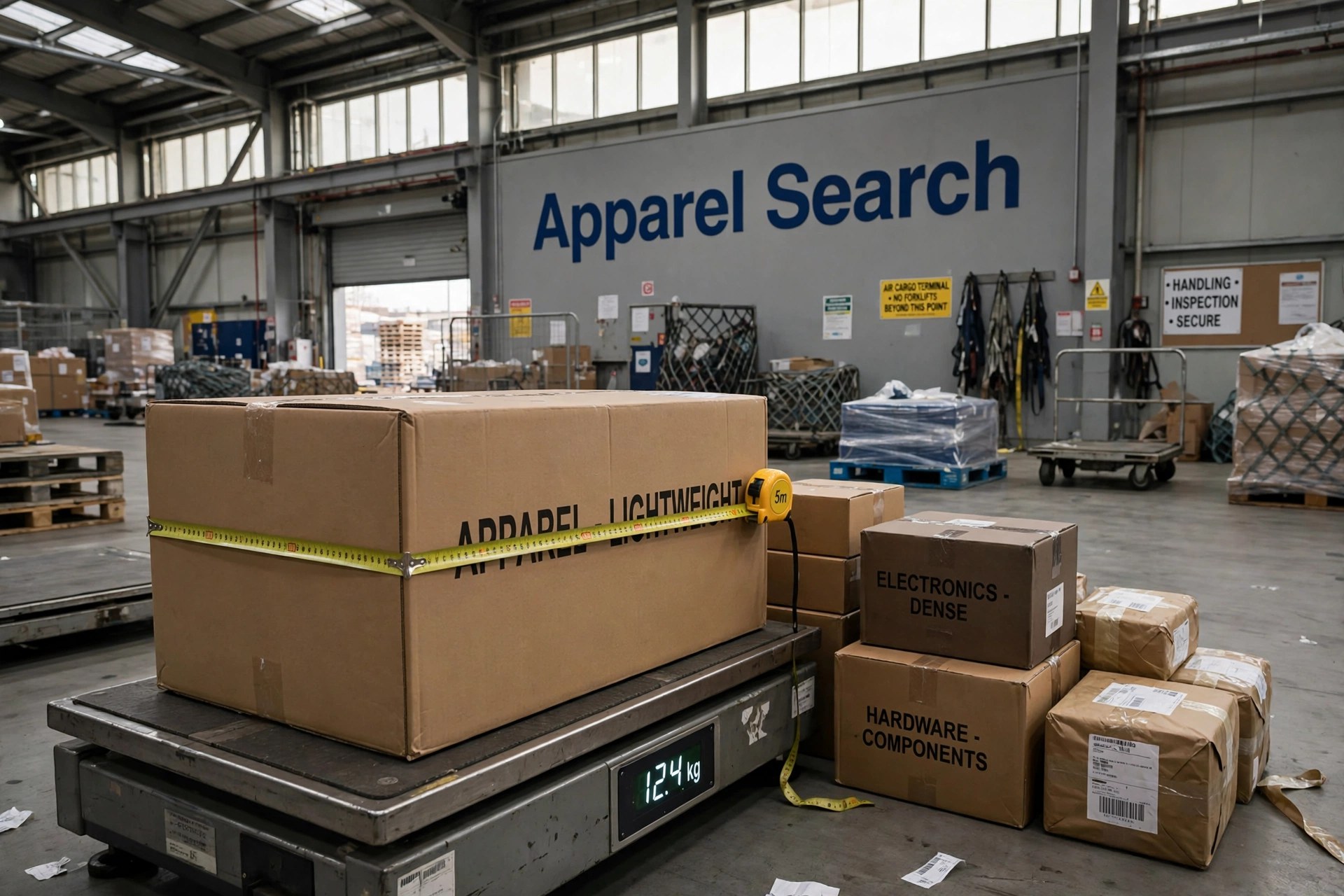
Take a carton of garments measuring 100 cm x 50 cm x 40 cm. Its volume is 100 x 50 x 40 = 200,000 cubic centimeters; divided by 6000, its volumetric weight is about 33.3 kg. If that carton actually weighs 12 kg on the scale, the carrier charges on 33.3 kg — the volumetric figure is greater, so it governs. Bulky apparel behaves exactly this way: the carton is mostly air and fabric loft.
Now take a dense carton of 40 cm x 30 cm x 20 cm: volume 24,000 cubic centimeters, divided by 6000 = 4 kg volumetric. If it actually weighs 9 kg — belts, hardware-heavy accessories or folded denim can do this — the carrier charges on the actual 9 kg. Same formula, opposite winner: the comparison, not the formula alone, sets the price.
The Density Rule of Thumb
The result of the /6000 calculation can be restated as a density test. If your consignment's density is one-sixth that of water or more, then its volumetric weight is less than its normal weight in kilograms, and you will be charged on actual weight. If its density is less than one-sixth that of water, its volumetric weight is more than its weight in kilograms, and you will be charged on volumetric weight.
In practical terms, 6000 cubic centimeters per kilogram means a shipment breaks even at a density of about 167 kilograms per cubic meter. Most loose-packed apparel ships well below that density, which is why dim weight, not scale weight, drives the freight bill on garment shipments — and why compressing garments, vacuum-packing where the product allows it, and right-sizing cartons to remove empty space all pay for themselves in lower chargeable weight.
Chargeable Weight: Always the Greater of the Two
Transport and postal companies charge based on the greater of the two calculations — actual weight and volumetric weight — shipment by shipment. That is why the recommendation is to calculate the volumetric weight for every shipment rather than assuming the scale figure applies: a product line that ships dense in winter (heavy coats, tightly packed) may ship bulky in summer (loose dresses, hats), and the governing weight can flip between seasons on the same route.
Before quoting a customer or approving a freight invoice, run both numbers. The Weight Calculators and the Container Load Calculator in the Apparel Industry Tools & Calculators set cover the companion arithmetic, and How Many Cartons Fit in a Container applies the same volume thinking to ocean containers, whose inside dimensions are charted on the Container Dimensions page.
More Shipping & Freight Guides
Common Questions
What is volumetric weight?
Volumetric weight — also called dimensional weight or dim weight — is a pricing weight calculated from a shipment's size rather than its scale weight: (length x width x height in centimeters) divided by 6000 gives kilograms. Postal, courier and freight carriers use it to charge for the vehicle or storage space a bulky, lightweight shipment occupies.
When does volumetric weight apply instead of actual weight?
The carrier compares the two and charges on the greater. Volumetric weight wins when the shipment's density is less than one-sixth that of water (about 167 kg per cubic meter) — typical of loose-packed apparel — while denser shipments are charged on their actual weight.
How do I calculate volumetric weight for a pallet?
Use the same procedure as for a parcel: take the smallest cuboid that contains the consignment — for a pallet, its overall length, width and height including the pallet itself — multiply to get cubic centimeters, and divide by 6000 for the volumetric weight in kilograms.
References & Further Reading
- Dimensional Weight — Wikipedia
- DHL Dim Weight Calculator (DHL) — named here without a link, because the tool address previously published for it no longer works.