Product Development & Tech Packs · Documents
Spec Sheets & Points of Measure
The table of measurements every finished garment must match: how points of measure are defined, taken, graded across sizes and held to tolerance.
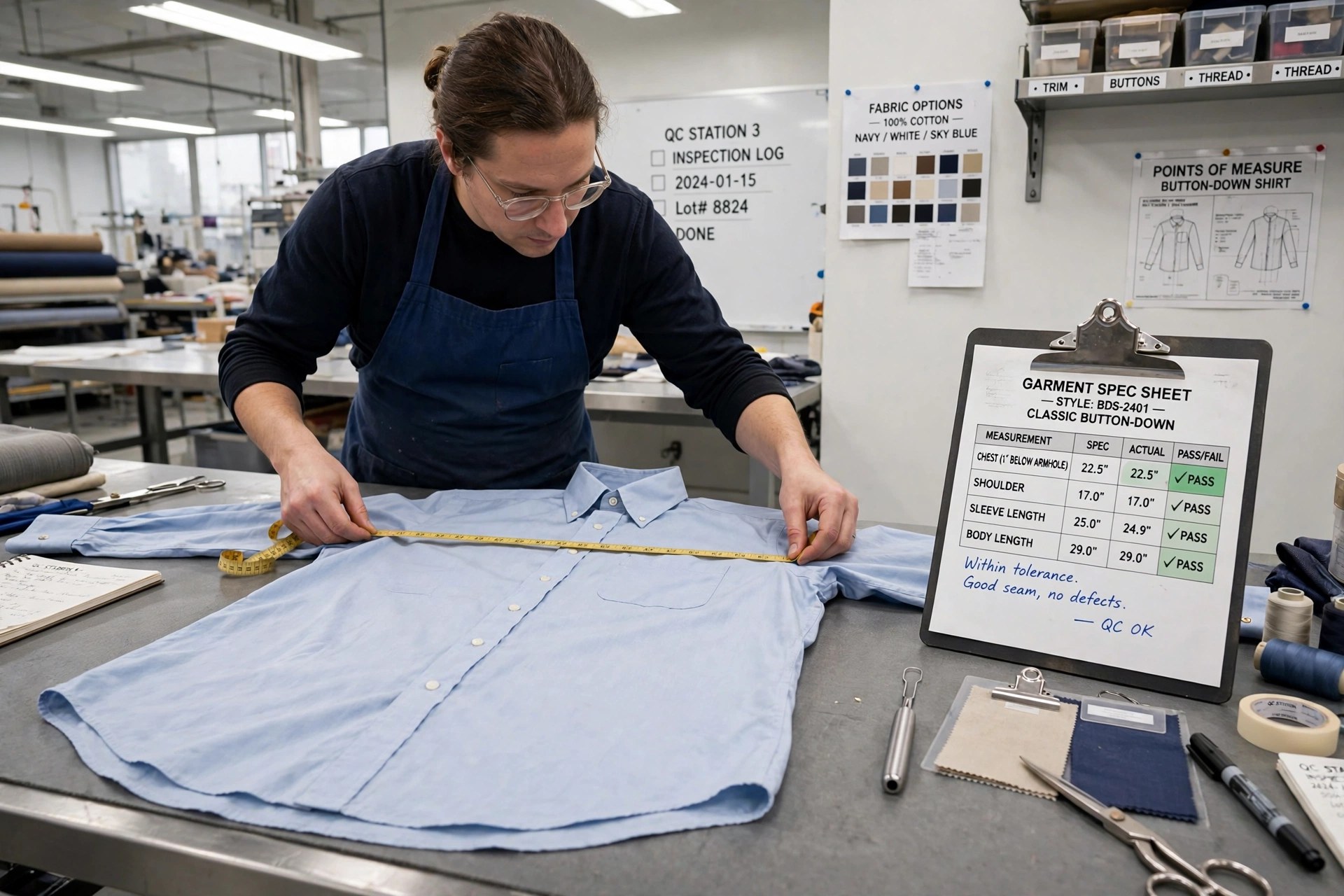
A garment can be beautifully designed and correctly sewn and still be wrong — if it is the wrong size. The spec sheet is the document that prevents that: the table of measurements the finished garment must match, point by point, size by size, with the tolerance allowed on each. This page of the Apparel Product Development Guide explains points of measure, how they are measured, how specs are graded across sizes, and how samples and production are judged against them.
Point of Measure, Defined
A point of measure (POM) is one defined measurement of a garment, taken in one defined way: "chest width — measured flat, 1 inch (2.5 cm) below the armhole, edge to edge" is a POM. A spec sheet is the full set of POMs for a style, with a target value and tolerance for each, for the base size and, by grade rule, every other size.
Anatomy of a Spec Sheet
Each line of a spec sheet carries a POM code, a description of the point, the method note that fixes how it is taken (flat or on the round, relaxed or extended, from which seam or point), the base-size target, the tolerance plus-and-minus, and the grade — the amount the measurement changes from size to size. Core POMs for a top include chest, waist and hem width, front and back length, shoulder, sleeve length and bicep, armhole, and neck width and drop; bottoms carry waist, hip, thigh, knee, leg opening, front and back rise, and inseam and outseam. The list is product-specific: a spec sheet measures everything that defines fit and appearance, and nothing it cannot define repeatably.
How POMs Are Measured
Measurements are only useful if two people measuring the same garment get the same number, so method notes matter as much as targets. Garments are measured flat on a table, smoothed without stretching (unless the POM specifies extended measurement for stretch fabrics), with widths taken edge to edge and either recorded as the flat width or doubled as the full circumference — the sheet must say which. Lengths follow stated landmarks: high point shoulder for front length, center back from the neck seam for back length. The Apparel Search guide to how size charts are built covers the body-measurement side of the same discipline.

Graded Specs: From Base Size to Size Run
Only the base size is usually measured and fitted directly. The other sizes are produced by grading: each POM grows or shrinks by its grade rule — chest by a larger step than neck width, lengths by less than widths, and so on, following the logic of the size system the brand uses. The graded spec is what the factory patterns and the QC team work from for every size. The principles and the pitfalls are covered in Pattern Grading Explained in the Sizing & Fit Guide.
Tolerances: The Allowed Difference
No sewn garment measures exactly to target, so every POM carries a tolerance — commonly a quarter to a half inch (roughly 0.6–1.3 cm) on larger points of measure and less on small, critical ones, varying with the product, fabric and market. Tolerances are not sloppiness; they are the honest recognition of what cutting and sewing can repeat, agreed in advance so that "in spec" and "out of spec" are facts, not arguments. Points that define fit — chest, waist, length — are usually held tighter than points that do not.
The Spec Sheet at Work
The spec sheet lives inside the tech pack, and it works hardest at two moments. During sampling, every sample is measured on arrival and its results recorded POM by POM beside the targets; the fit comments that follow are largely explanations of the out-of-tolerance lines. During production, inspectors measure finished garments the same way — including at fit sessions on the base size — and a style whose bulk output drifts out of spec is stopped against this document, not against a memory of the approved sample.
Spec Sheet Mistakes That Cause Fights
- Missing method notes — a chest measured "on the round" by one party and "flat" by another differs by a factor of two.
- Tolerances copied from another product, tighter than the fabric and construction can hold.
- Grading the sample corrections into the base size but never updating the graded sizes.
- Measuring stretch garments without stating whether values are relaxed or extended.
More in the Product Development Guide
Common Questions
What is a POM in garment manufacturing?
POM stands for point of measure: one precisely defined garment measurement, such as chest width measured flat one inch below the armhole. A spec sheet is the complete set of POMs for a style, each with a target value, a measurement method, a tolerance and a grade rule.
What is the difference between a spec sheet and a tech pack?
The spec sheet is the measurement section of the tech pack. The tech pack is the full package — drawings, materials, colors, construction, artwork, labels and revisions — and the spec sheet inside it is the part that fixes sizes and fit numerically.
What is a tolerance on a spec sheet?
A tolerance is the allowed plus-or-minus difference between the target measurement and the actual garment, agreed in advance. It reflects what cutting and sewing can realistically repeat; a garment measuring within tolerance passes, and one outside it is a defect against the spec.
What is a graded spec?
A graded spec gives the measurements for every size in the range, produced by applying grade rules — the amount each point of measure grows or shrinks between sizes — to the fitted base size. Factories pattern and inspect all sizes from the graded spec, not from the base size alone.
Back to the Apparel Product Development Guide
The Apparel Product Development Guide hub walks the whole path — concept, specification, materials and color approval, sampling, costing and the handover to production — with a map of every guide in this cluster.