Dress Code
Miscellaneous Definitions — the rules that govern what to wear, from white tie to casual, from Apparel Search
Search Apparel Search
At a Glance
Definition: A dress code is a set of rules or expectations about what clothing is appropriate or required in a particular setting, which may apply by law, to employees and students, to customers of a venue, or at a social occasion.
Category: Miscellaneous Definitions
A dress code is the point where clothing stops being purely personal choice and becomes a shared rule. Codes may apply by law, to employees, pupils and students — sometimes as a uniform, sometimes varying by day, as with Casual Friday — to customers of nightclubs, casinos, shops and restaurants, and at parties and in social life generally, where the named levels run from formal white tie down to plain casual. For the invitation and workplace codes in full, see Dress Codes Explained and the business formal attire guide. This page covers what clothing communicates, where codes apply, the formality ladder, minimum-covering rules such as “no shoes, no shirt, no service”, and the reverse codes that set a maximum instead of a minimum.
On This Page
The Messages Clothing Sends
Clothing, like other aspects of human physical appearance, has various social aspects. Wearing a specific type of clothing, or wearing clothing in a particular manner, can have the deliberate purpose — or the desirable or undesirable side-effect — of being interpreted in terms of class, income, belief and attitude. Expensive clothes are a clear example: an observer sees the expensive result, but may be wrong about why it is there. The wearer may be rich, may like to spend as much as can be afforded or even more, may spend a large part of income on clothing, or may simply have managed to obtain the clothing cheaper than usual. All four factors apply in reverse for cheap clothes, and similarly for other goods such as a house or a car.
Clothing can also state or claim identity, and it can establish, maintain or defy social group norms. A dress code exists wherever a setting tries to control those messages in advance, telling people which signals are wanted and which are barred before they arrive. That is why codes feel simultaneously practical and symbolic: they regulate garments, but what they are really regulating is what the garments say.
Where Dress Codes Apply
Dress codes apply in several distinct ways. They apply by law in some places. They apply to employees, pupils and students, sometimes as a uniform and sometimes depending on the day — see Casual Friday and business casual attire. They apply to customers, for example at a disco, nightclub or casino, or as more relaxed rules such as shoes required and not bare chested in shops and restaurants. They apply at special parties, where sometimes a special kind of clothes is the theme of the party, and they apply in social life in general, where an invitation’s wording quietly sets the standard.
Enforcement sits with the institution. A school or a military institution may require specified uniforms, and if it allows the wearing of plain clothes it may place restrictions on their use. At the door of a venue, a bouncer may judge visitors’ clothing and refuse entrance to those not clad according to specified or intuited requirements — an establishment may, for example, not allow the wearing of sport shoes. See also shoe etiquette, where footwear alone carries the code.
From White Tie to Casual
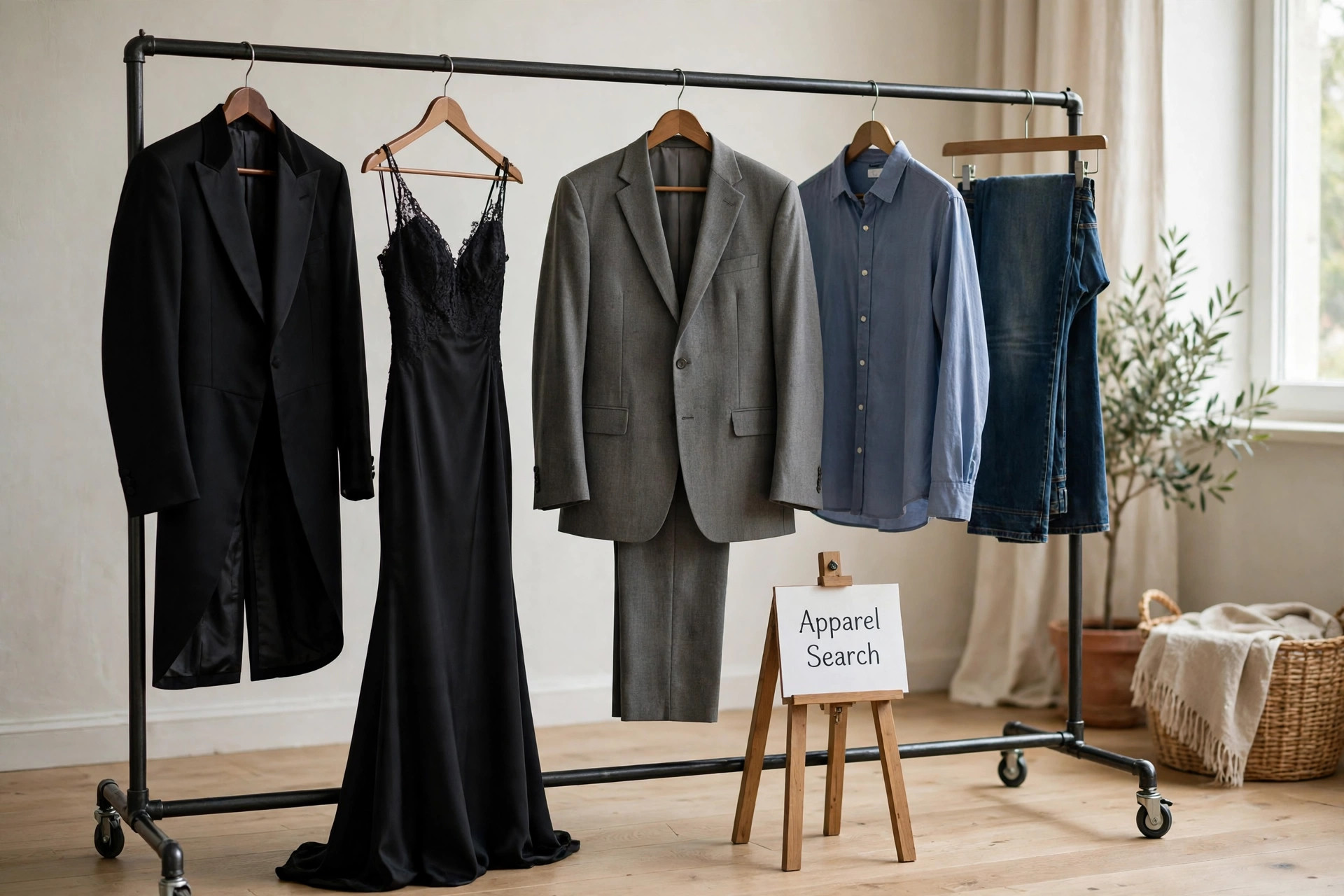
The named levels of formality form the best-known dress code vocabulary. A formal or white tie dress code typically means tail-coats for men and full-length evening dresses for women. Semi-formal has a much less precise definition, but typically means an evening jacket and tie for men, known as black tie, and a dress for women. Lounge suit — in effect the business dress level, close to business casual — typically means not wearing jeans or track suits, but wearing instead collared shirts and more relaxed country trousers, not black, including things such as corduroy. Casual typically just means clothing for the torso, legs and shoes: a floor rather than a style. Dress Codes Compared sets the workplace levels side by side, and the Business Casual & Work Outfits hub shows the middle code as complete outfits.
Misreading the level has social costs, and setting a code can lead to great embarrassment. In one famous example, UK Chancellor of the Exchequer Gordon Brown asked the Bank of England’s board to wear lounge suits to their annual dinner, a highly prestigious occasion, as an act of modernism — they usually wore white tie. He had not reckoned with their determination not to give in: at dinner he was the only person not dressed in white tie, to his humiliation and the glee of the UK broadsheets. The lesson generalises: the host who lowers a code takes the risk that everyone else keeps the old one.
Legal Minimums and “No Shoes, No Shirt, No Service”
Dress codes usually set forth a lower bound on body covering, and law often stands behind the bound. Almost universally, nudity in a public place is illegal, except in special nudist areas, which exist in fairly many countries — though among some peoples full nudity is accepted or the norm. For women, bare breasts are also often illegal; in a non-public place nudity tends to be forbidden if another person is unwillingly confronted with it. Wearing only underwear is sometimes also illegal, and in some countries even less bare skin may already be illegal, especially for women. Cross-dressing may also be illegal, especially a man wearing women’s clothing, and in Tonga it is illegal for men to appear in public without a shirt.
Commerce has its own version of the minimum. Whereas in much of Europe, and in particular in Italy, dressing well is standard behaviour, in America the norm is a more dressed-down appearance, and the aphorism “no shoes, no shirt, no service” captures the commonly promulgated dress code, appearing on signs at commercial establishments such as restaurants and shopping malls. Another common saying claims “this store is not a beach”, recited almost automatically by store employees meeting someone who does not meet minimum standards of covering, modesty or decency. Many stores and restaurants on or near beaches have such codes but do not enforce them — the Sunnyside Cafe at the Sunnyside Bathing Pavilion in Toronto, Canada, often does not enforce its “shirts, shoes” code — and the slogan is so prevalent in some settings that it has become a target of mockery, deliberate disregard by groups such as bare-footers, and even song: Kenny Chesney sings “No Shirt, No Shoes, No Problems”.
Inverse Dress Codes
Codes can also run in reverse. Reverse dress codes, sometimes referred to as “undress codes”, set forth an upper bound, rather than a lower bound, on body covering. An example is the one commonly enforced in modern communal bathing facilities: in Schwaben Quellen no clothing of any kind is allowed. Other, less strict undress codes are common in public pools, especially indoor pools, in which shoes and shirts are not allowed. The undress code is an exact reversal of the ubiquitous “no shoes, no shirt, no service” code that exists almost everywhere outside the public bathing environment. Places where nudism is practised may be “clothing optional”, or nudity may be compulsory, with exceptions.
Two narrower senses complete the picture. Transparent or semi-transparent clothing can play with the boundaries of dress codes regarding modesty, as in a wet T-shirt contest. And in UK gay jargon, “dress code” has meant people who dress in a militaristic manner, with dress code nights in nightclubs and elsewhere deemed to target people who have militaristic fetishes — a reminder that the same phrase can name both a rule about clothes and a style of wearing them.
Gender, Deficiencies and Deliberate Violations
Various traditions suggest that certain items of clothing intrinsically suit different gender roles. The wearing of skirts and trousers has given rise to common phrases expressing implied restrictions and disapproval of offending behaviour — ancient Greeks, for example, often considered the wearing of trousers by Persian men a sign of effeminacy. Extreme flouting of conventions in this area may earn the label “cross-dressing”.
Below the level of codes sit deficiencies and mismatches. Clothing deficiencies may reduce functionality or be unaesthetic, but can also be considered socially improper: possible deficiencies in the clothing itself include stains, faded colour, smell, tears, broken seams, thin spots, holes, missing buttons and broken zippers — one or more safety pins may temporarily alleviate some of these. Clothing can also be inappropriate relative to the wearer (too large or too small, or not corresponding to the wearer’s sex, age or peer group), worn in unacceptable ways (unbuttoned, unzipped, backward, inside-out, mis-matched socks, or a bra wrongly positioned), made transparent by wetness, varied too little from day to day, or mismatched to the occasion — too bright for a funeral or job interview, too sombre for a festive occasion, insufficiently modest, too formal, or disruptive of a command chain, as where a teacher must keep a much stricter code than the students. An accident during the day, such as a button falling off, is more forgivable than putting on clothing like that on a new day, and for poor people deficiencies that are difficult or expensive to fix are not really improper, just sad but understandable.
Some of these faux pas occur intentionally, for reasons of fashion or personal preference. The teenage boys of rap duo Kris Kross wore all of their clothes backwards and extremely baggy; a common deliberate violation is pulling down the pants to show the underpants, and mooning is the deliberate baring of the buttocks as a gesture of teasing or contempt. The trend in underwear has itself moved toward underwear that looks less like underwear — more like bathing suits or beach shorts — which weakens the taboo the violation depends on, while deliberately showing bra straps has also become fashionable for women. Stripping down to underwear as a fashion statement, protest or attention-getter even has a name, underwearing: Tommy Hilfiger ran large billboard advertisements showing mixed-gender groups wearing only their underwear in public, anti-fur protesters have adopted “I’d rather be in my underwear than wear fur”, and freshpair.com created “National Underwear Day”, with large numbers of models walking through Times Square in nothing but their underwear. The backlash against covering norms is itself traditional — during the 2001 anthrax attacks, large numbers of people stripped to their underwear in parking lots for hosing down by fire departments, in front of TV news crews, while others were unwilling to violate fully internalised norms even where a stripdown could save their lives.
Common Questions
What is a dress code?
A dress code is a set of expectations or rules about what clothing is appropriate or required in a setting. Dress codes may apply by law, for employees and students — sometimes as a uniform — for customers of venues such as nightclubs, shops and restaurants, and at parties and social occasions.
What do formal dress code terms mean?
A formal or white tie dress code typically means tail-coats for men and full-length evening dresses for women. Semi-formal typically means an evening jacket and tie for men, known as black tie, and a dress for women, while lounge suit or business dress means collared shirts and trousers rather than jeans or track suits.
What does “no shoes, no shirt, no service” mean?
The aphorism “no shoes, no shirt, no service” captures a commonly promulgated dress code in America, appearing on signs at commercial establishments such as restaurants and shopping malls. It sets a minimum standard of body covering and footwear for customers to be served.