Women's Stretch Pants Guide
Stretch pants are trousers woven or knitted with elastane so the fabric gives with the body — and the quality question is never the stretch, but the recovery.
Shop Women's Stretch Pants Now
Shop Women's Stretch Pants on Amazon Shop Women's Stretch Pants on eBayThe Amazon and eBay links on this page are affiliate links. If you make a purchase through them, Apparel Search may earn a commission.
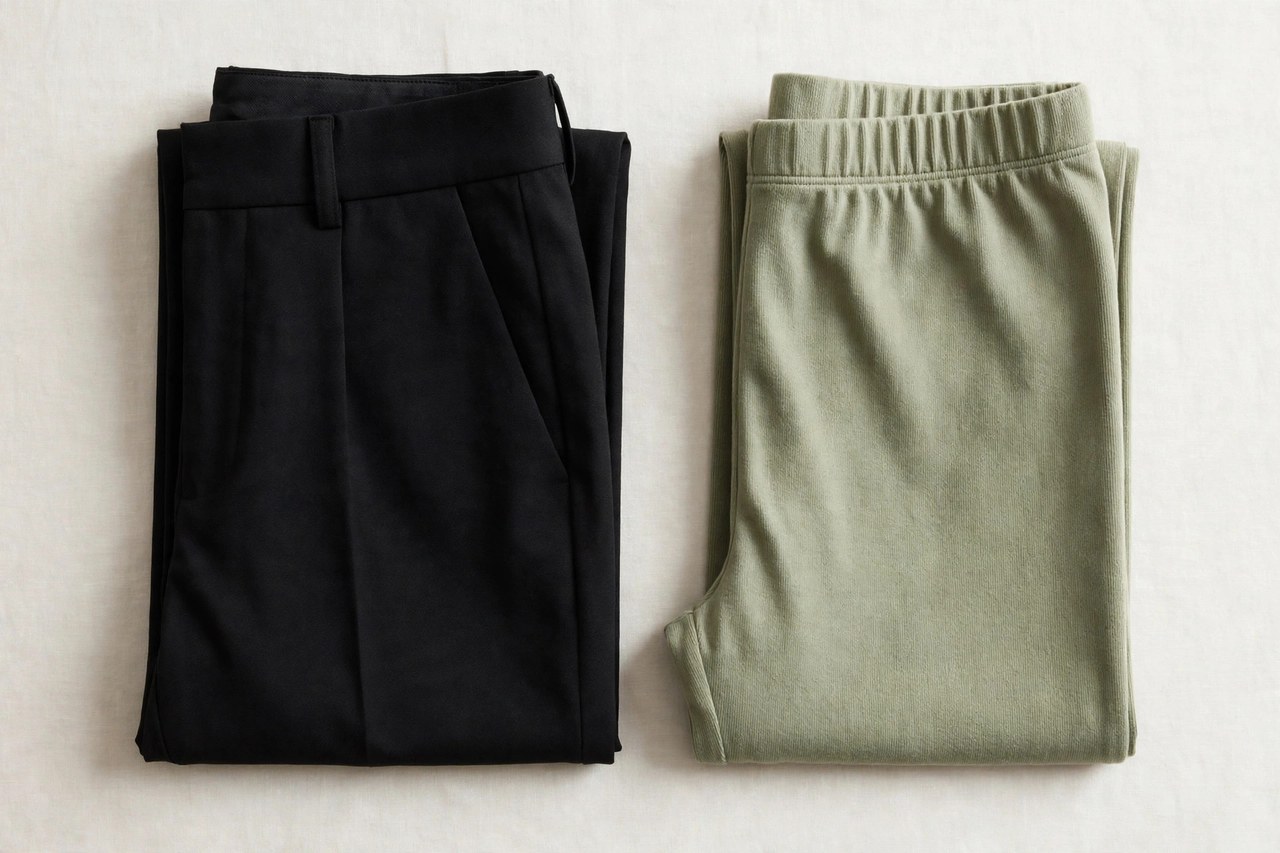
Stretch pants are pants built from fabric with elastic in it — almost always a small percentage of elastane, also sold as spandex or Lycra, blended into cotton, polyester, rayon or wool. That few percent of elastic yarn changes everything about how a trouser fits and moves: the knee bends without pulling, the waistband gives after lunch, the seat survives a day of sitting. Nearly every modern women's trouser contains some stretch; this guide is about the pants where stretch is the defining feature.
The category spans tailored stretch trousers sharp enough for work, pull-on stretch pants that behave like leggings with ambitions, and casual stretch chinos and jeans-adjacent styles. The buying questions are consistent across all of them: how much stretch, in which directions, cut in which silhouette, and above all whether the fabric recovers — springs back to its cut — or slowly bags into the shape of your knees. This guide takes those questions in order.
How Much Stretch, and Which Way
Most tailored stretch pants carry one to three percent elastane, enough for comfort ease without changing the trouser's tailored character. Comfort knits and pull-on styles run higher, and athletic-adjacent pants higher still. Percentage alone does not predict feel: a firm weave with two percent elastane can feel more supportive than a loose knit with five. Direction matters as much as amount. Two-way stretch gives across the body, the direction trousers need for sitting and stride; four-way stretch adds lengthwise give, valuable in high-movement and travel pants.
Recovery is the property to test in the shop. Stretch the knee or seat fabric firmly, release, and watch: good fabric returns completely and immediately, mediocre fabric returns slowly, and poor fabric stays slightly extended — that slight extension, multiplied by a hundred sittings, is the baggy knee and sagging seat of a cheap stretch pant by month two. Brand language like 'shape retention' and added polyester in the blend are honest clues, since synthetics help a fabric hold its form where natural fibers alone relax.
Cuts: Tailored, Pull-On and In Between
Tailored stretch trousers keep the full trouser architecture — fly, waistband, pockets, crease — and add ease invisibly; they are the office answer and the hardest to distinguish from non-stretch pants, which is their virtue. Pull-on stretch pants replace the fly with a wide elastic or knit waistband and a slim cut, and live or die by fabric weight: in a substantial ponte or bengaline they read as trousers, while in a thin jersey they are leggings wearing a title they have not earned.
Between them sit stretch chinos, five-pocket stretch twills and jegging-adjacent styles that borrow jeans' details with a trouser's comfort. Inseam and rise choices follow ordinary trouser logic, with one stretch-specific warning: a slim stretch pant should fit smoothly at purchase without relying on maximum stretch to close, because a garment worn at its extension limit shows strain lines, wears its elastic out early, and is uncomfortable by afternoon no matter how good it looked at nine.
Fit Checks Specific to Stretch
Fit stretch pants by movement, not by mirror. Sit, climb a step, bend and take a long stride in the fitting room: the waistband should stay placed without a belt's rescue, the knee should bend without the whole legging-tightening effect, and the fabric should recover when you stand. Check the seat in a three-way mirror for the horizontal strain lines that mean the size, not the style, is wrong, and check that pockets lie flat; gaping pockets on a stretch pant announce an over-stretched fit to everyone behind you.
Account for the first-wear give: most stretch pants relax by roughly half a size in the first hours of wear, so a pair that is merely comfortable in the shop can be loose by lunch, while a pair that is snug but not strained at purchase often settles into the correct fit. This is the opposite of the rule for rigid trousers, and it is the single most useful sizing fact in the category. When between sizes in a pull-on style, take the smaller; in a tailored style with a fly, take the one that closes without effort.
Washing: Protecting the Elastic
Elastane's enemies are heat and harsh chemistry. Wash stretch pants inside out in cool or warm — never hot — water, skip chlorine bleach, and go easy on fabric softener, which coats elastic fibers and dulls their snap. Tumble drying on high is the fastest way to age a stretch pant; line drying or a low, brief tumble keeps the recovery alive for years instead of months. Iron, if needed, on low and never directly on a waistband's elastic.
Rotate pairs rather than wearing one favorite daily, because elastane recovers best with a rest day between wearings — the same principle as elastic in footwear. Retire a pair when the knees stay bagged after washing or the waistband no longer returns, since no alteration restores dead elastic. Treated with moderate care, a well-made stretch pant keeps the fit that sold it, which is the entire reason the category exists: comfort that does not come at the price of shape.
Related Women's Guides
More to Explore on Apparel Search
Women’s Clothes Guide by Letter: Women's Apparel Directory N · Women's Clothes Directory O · Women's Clothing Directory P · Women's Apparel Directory Q · Women's Fashion Directory R · Women's Clothes Directory T
More to Explore on Apparel Search
Looking for Women's Clothing Stores?
This guide helps you choose women's stretch pants. To browse where to buy, visit our women's clothing store directory, where you can find retailers that carry them.