Women's Unitards Guide
A unitard is a one-piece garment combining a leotard top with attached leggings, covering torso and legs in a single stretch piece, made for dance, gymnastics, yoga and performance.
Shop Women's Unitards Now
Shop Women's Unitards on Amazon Shop Women's Unitards on eBayThe Amazon and eBay links on this page are affiliate links. If you make a purchase through them, Apparel Search may earn a commission.
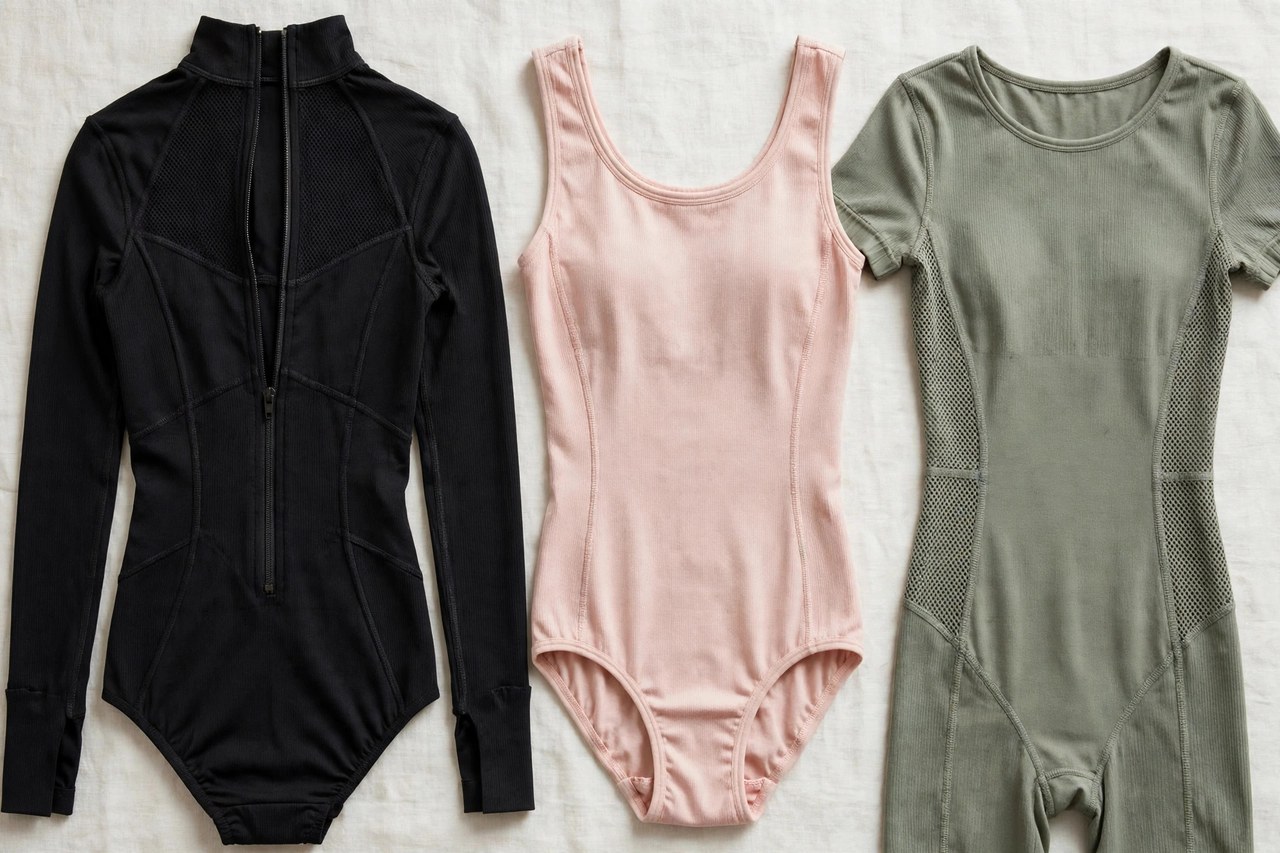
A unitard is a one-piece garment combining a leotard top with attached leggings, covering torso and legs in a single stretch piece, made for dance, gymnastics, yoga and performance. Because a unitard joins two garments, its fit problem is doubled: torso length and leg length must both be right in one size, so this guide concentrates on girth measurement, stretch percentage, seam placement and neckline and leg-length variants.
This guide covers unitards in the order a careful buyer needs it: what the product is made from, how it is constructed, how it should fit, how to choose it for real use, and how to care for it so it lasts. Apparel Search has published guides to women's clothing for decades, and this rebuilt page keeps the subject focused — measurable details, named materials and checks you can perform in a shop or on a parcel's arrival, rather than general fashion language.
Fabrics and Construction
Unitards are knitted from high-stretch performance fabrics — nylon or polyester blended with 15 to 25 percent elastane — because a one-piece garment must stretch in two directions at once: along the torso for movement and around the body for a close fit. Cotton-blend unitards exist for class and practice wear, softer and less compressive, while fully synthetic versions manage moisture for performance and rehearsal under lights.
Construction decides comfort at the seams: flatlock stitching where panels join, a lined front or shelf support in some styles, reinforced gusset construction, and bindings at neckline and leg openings that are elasticated enough to stay placed without cutting in. The girth measurement — around the torso from shoulder, under the body and back to the shoulder — is the unitard's deciding size, ahead of bust, waist or hip taken alone. Zips, where fitted, run down the back or front and must lie flat under movement — a wavy zip line signals the torso length is wrong.
Girth, Length and Sizing
Size a unitard by girth first: the loop measurement from one shoulder, down the front, under the body and up the back to the same shoulder, because a garment that is short in the body cannot be fixed by any other measurement being right. Then check leg length against inseam — full-length, capri and shorts-leg unitards place the leg opening differently — and bust and hip for panel fit.
Stretch forgives width but not length: a unitard that fits around the body can still pull at the shoulders or ride at the legs if its torso is short, and one too long wrinkles at the waist and sags at the gusset. Between sizes, dancers and gymnasts usually take the size whose girth range they sit inside rather than at the edge of, and try the garment through a full stretch, bend and reach before deciding.
Choosing by Discipline
Choose unitards by measurable criteria in a fixed order: girth size, fabric stretch and opacity — a unitard must stay opaque at full stretch, which lighter knits fail — neckline and back style for the discipline's rules, leg length, and only then colour. Dance and performance styles add options like mesh panels, rhinestone decoration and attached skirts, each of which changes washing as well as looks. In practice, rank these checks in the order your own use demands — frequency of wear first, then weather, washing facilities and budget — because that order differs by wardrobe, and it is the real reason two careful buyers can correctly choose differently from the same rail.
Judge price by specification: elastane percentage and knit density explain most of the spread, along with seam finishing and whether fronts are lined. Squat and stretch-test any unitard on arrival — thin patches at hip and knee, and any show-through at stretch, are returnable faults best caught before the tags come off and the garment meets a studio floor.
Washing and Storage
Wash unitards cool, inside out, with similar colours, and keep fabric softener away from them: softener coats elastane and performance yarns, reducing both stretch recovery and moisture management. Hand washing extends the life of decorated and mesh-panel styles, and all unitards should be dried in air and shade, never tumble heat.
Store unitards folded, not hung, because hanging lets the garment's own weight stretch the torso over time. Retire a unitard when the knit loses recovery and bags at knee or seat, when opacity fails at stretch, or when leg and neck bindings stop holding — in a one-piece stretch garment, recovery is the whole product.
Related Women's Guides
More to Explore on Apparel Search
Women’s Clothes Guide by Letter: Women's Clothing Directory G · Women's Clothing Directory H · Women's Fashion Directory I · Women's Apparel Directory J · Women's Fashion Directory K · Women's Fashion Directory L · Women's Fashion Directory M · N · O · P · Q · R · S · T · V · W · X · Y · Z
Looking for Women's Clothing Stores?
This guide helps you choose women's unitards. To browse where to buy, visit our women's clothing store directory, where you can find retailers that carry them.