Jump Boots (Paratrooper Boots)
Footwear Definitions — the paratrooper's fully laced combat boot, from landing brace to parade badge from Apparel Search
Search Apparel Search
At a Glance
Definition: Jump boots, also known as paratrooper boots, are a type of combat boot associated with paratroopers assigned to parachute units, fully laced from the instep to the top for ankle support and generally made of smooth leather with toe-caps and heel counters.
Also known as: Paratrooper boots
Category: Footwear Definitions
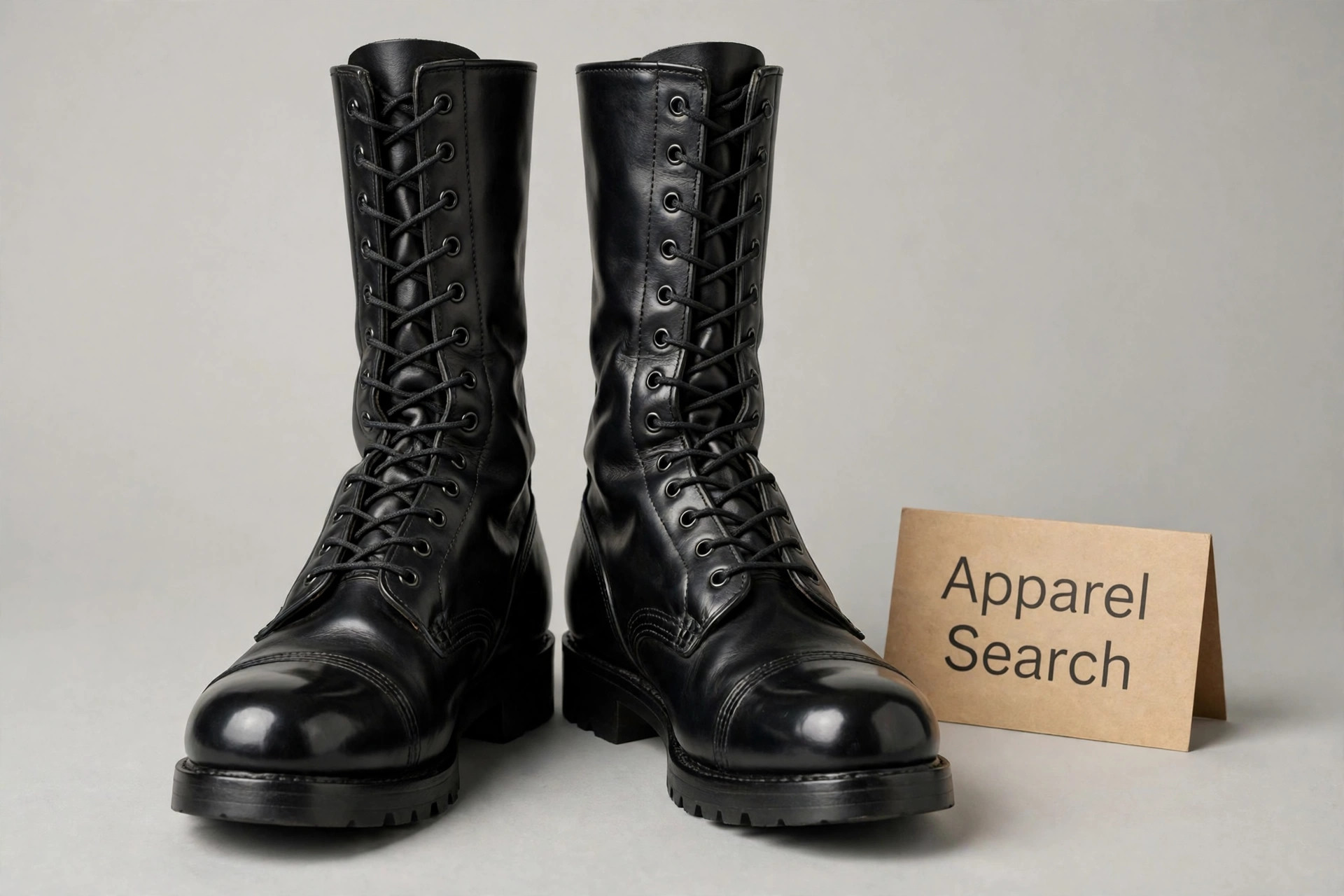
Jump boots, also known as paratrooper boots, are a type of combat boot typically associated with soldiers called paratroopers, assigned to parachute units. They are fully laced from the instep to the top and give more support to the ankle, whereas ordinary combat boots during World War II were laced just above the ankle and had to be worn with leggings or puttees to prevent mud and dirt from entering the shoe. Generally made of smooth leather with toe-caps and heel counters, they were designed for the hardest moment in a paratrooper's work — the landing. This page explains that design, and how a piece of combat equipment became a guarded badge of Airborne qualification.
An Ankle Built for Landing
A paratrooper's dangerous moment is not the jump but the landing, when the ankle takes the full force of a body arriving under canopy, often on rough ground and carrying equipment. The jump boot answers that moment directly. Lacing that runs fully from the instep to the top of the shaft lets the boot be drawn tight along the whole ankle, bracing the joint against rolling in a way a boot laced only just above the ankle cannot.
The older pattern made the contrast plain. Ordinary World War II combat boots stopped their support at the ankle and needed separate leggings or puttees wrapped around the lower leg to keep mud and dirt from entering the shoe — a two-piece solution the jump boot replaced with one taller, fully laced piece of leather. Many modern pairs also have side zips for easy removal, a concession that keeps the laced support while sparing the wearer a full unlacing at the end of the day.
Construction: Smooth Leather, Toe-Caps and Heel Counters
Jump boots are generally made of smooth leather with toe-caps and heel counters — reinforced pieces at the front and back of the boot that hold its shape under hard use. Those smooth, reinforced surfaces accept a high polish, or “spit-shine”, to a mirror gloss. In a working boot that finish is incidental; in the jump boot's modern role it has become central, because a parade surface has to be capable of taking the shine in the first place. The construction therefore serves both lives of the boot: reinforcement where a landing stresses the leather, and a smooth face where a dress uniform demands one.
From Combat Equipment to Parade Badge
Modern service has quietly changed the boot's job. Nearly all combat boots are now fully laced, so the jump boot's functional advantage has been absorbed into general issue, and what remains distinctive is the finish. That makes the modern jump boot mainly a dress and parade boot, worn where appearance carries meaning — alongside the other specialised service boots in these definitions, such as tanker boots, jungle boots and Wellington boots.
The meaning is specific enough to be guarded by custom. The boots signal Airborne qualification — the wings earned in parachute training — and although wearing them is not prohibited by regulation, soldiers who do not possess an Airborne qualification are expected not to wear them. In that respect the jump boot completes a familiar military arc: a design invented for a hard physical problem, standardised by success, and finally kept as an emblem of the unit that needed it first, in the long line of service boots that runs back to the Hessian boot.
Common Questions
How do jump boots differ from ordinary combat boots?
Jump boots are fully laced from the instep to the top and give more support to the ankle, whereas ordinary combat boots during World War II were laced just above the ankle and had to be worn with leggings or puttees to keep mud and dirt out.
Why do jump boots take such a high polish?
Jump boots are generally made of smooth leather with toe-caps and heel counters that accept a high polish or spit-shine. In modern times they are mainly worn as dress and parade boots, where the shine is the point.
Can any soldier wear jump boots?
Although not prohibited by regulation, jump boots should not be worn by soldiers who do not possess an Airborne qualification. The boots are a badge of the parachute units as much as a piece of equipment.