Combat Boots
Clothing Definitions — definitions of garments and clothing terms from Apparel Search
Combat boots are military boots designed to be worn by soldiers during actual combat or combat training, as opposed to during parades and other ceremonial duties. Soldiers have worn boots in battle for much of recorded history — early specialized boots included the hobnail boots of the Roman legions. Modern combat boots are designed to provide a combination of grip, ankle stability and foot protection suitable to a rugged environment, normally made of hardened and chemically treated leather and often waterproof. This page explains the design's main choices, the variants made for special troops and environments — tanker, jump, jungle, desert and cold weather boots — and the style's second life in civilian subcultures.
Combat boots are military boots designed to be worn by soldiers during actual combat or combat training as opposed to during parades and other ceremonial duties. Soldiers have worn boots in battle for much of recorded history; early specialized boots included the hobnail boots of the Roman legions.
Modern combat boots are designed to provide a combination of grip, ankle stability, and foot protection suitable to a rugged environment. They are normally made of hardened and/or chemically-treated leather and can be waterproof. Variations on the basic lace up combat boot have been designed for special types of troops (tanker boots, jump boots) and special environments (jungle boots, desert boots, cold weather boots). Recent combat boots are beginning to integrate kevlar and nomex within their side panels to provide better protection and ventilation for the skin of the soldiers who wear them.
Combat boots are also popular in the goth, punk, heavy metal, industrial, skinhead, and BDSM subcultures.
| The above article is licensed under the GNU Free Documentation License. From Wikipedia, the free encyclopedia (https://en.wikipedia.org/wiki/combat_boot). Modified by Apparel Search 1/18/06 |
Photos
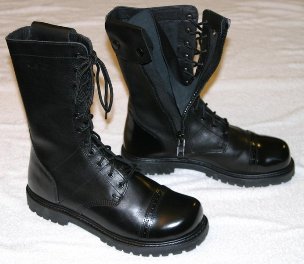
Design Trade-offs in the Combat Boot
Every feature of a combat boot negotiates between protection and mobility. A high, stiff shaft stabilizes the ankle on rough ground and keeps out stones and brush, but costs flexibility and weight on a long march. A deep-lugged sole grips mud and rock, yet a sole that grips too hard in a vehicle or on shipboard becomes a hazard, which is why tanker boots use straps rather than laces that could snag, and smooth soles suited to their workplace. Jump boots add reinforced toe caps and extra ankle support for parachute landings, where the impact arrives through the feet.
The boot's civilian afterlife followed the same practical reputation. Combat boots became popular in goth, punk, heavy metal, industrial and other subcultures, where the military boot's durability and uncompromising look were the appeal. The Dr. Martens boot, covered separately in these definitions, made a parallel journey from work boot to subculture uniform — evidence that a design proven under hard use carries authority wherever it is worn.
Common Questions
What are combat boots?
Combat boots are military boots designed for wear during actual combat or combat training rather than parade or ceremonial duty. They are built to give grip, ankle stability and foot protection in rugged environments, normally in hardened, treated leather.
What variants of combat boots exist?
Variations on the basic lace-up boot have been designed for special types of troops — tanker boots and jump boots among them — and for special environments, including jungle boots, desert boots and cold weather boots, each trading materials and construction for its conditions.
What are modern combat boots made of?
Traditional combat boots are hardened and chemically treated leather, and can be waterproof. Recent combat boots are beginning to integrate kevlar and nomex within their side panels to provide better protection and ventilation for the wearer's skin.
More to Explore
- boots
- combat boots
- leather
- waterproof
- tanker boots
- jump boots
- jungle boots
- cold weather boots
- kevlar
- nomex
- goth
- punk
- Doc Martens
- Wellington Boots
- Thigh High Boots
- Kinky Boots
- Hessian Boots
- Cowboy Boots
- Sandals Definition
- Shoe Definition
- Clogs
- Clothing Definitions
- Shoe Fetish
- GNU Free Documentation License
- https://en.wikipedia.org/wiki/combat_boot