Jungle Boot
Footwear Definitions — the combat boot built to drain and dry in hot, wet country from Apparel Search
Search Apparel Search
At a Glance
Definition: Jungle boots are a type of combat boot designed for use in jungle warfare or hot, wet and humid environments where a standard leather combat boot would be uncomfortable or unsuitable, with vent holes on the inner side near the middle of the boot and uppers mixing leather with cotton and nylon.
Category: Footwear Definitions
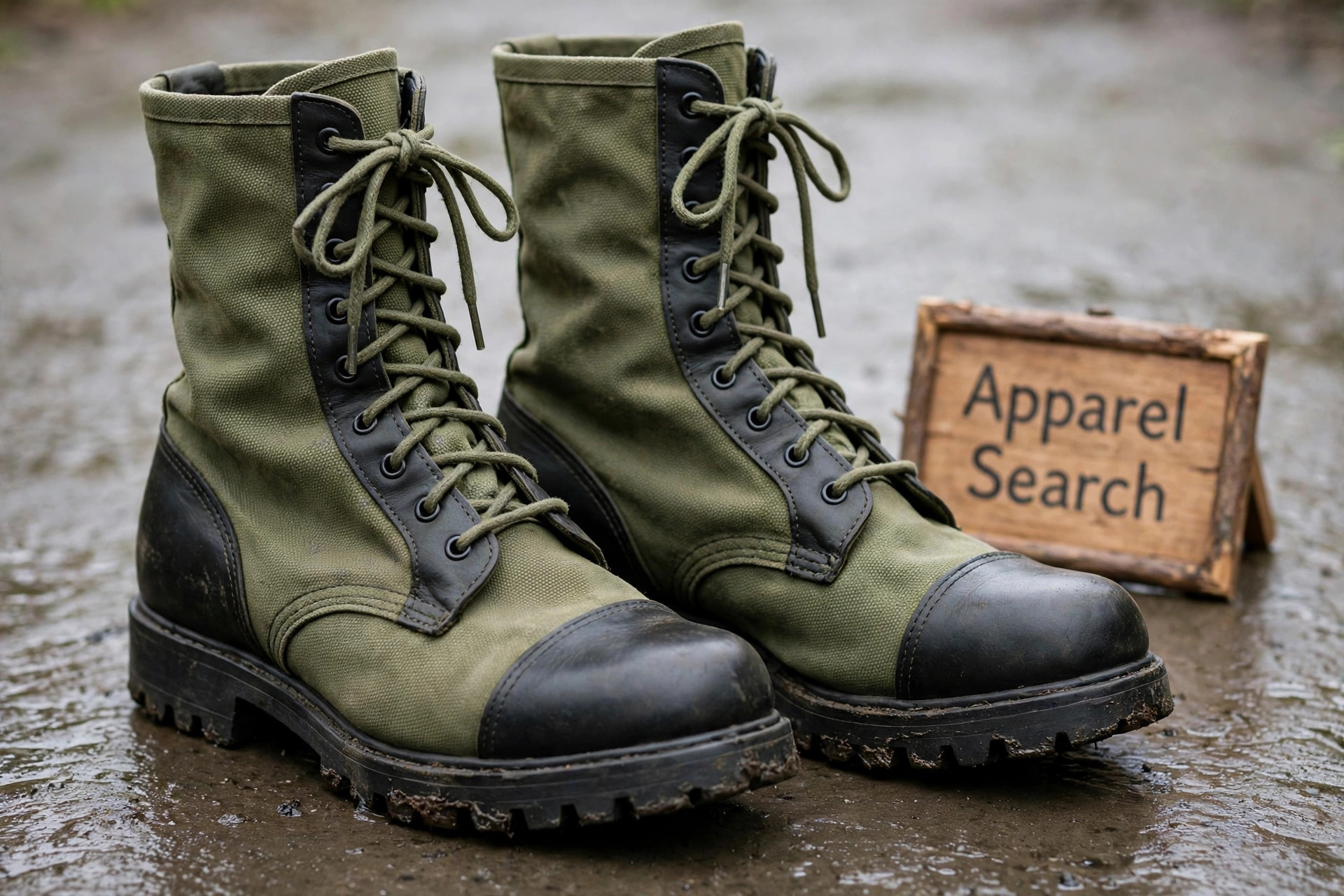
Jungle boots are a type of combat boot designed for use in jungle warfare or in hot, wet and humid environments, where a standard leather combat boot would be uncomfortable or unsuitable. They have vent holes on the inner side near the middle of the boot to aid ventilation, and their best-known form — the boot the US Armed Forces issued during the Vietnam War — mixes leather at the toe, heel and eyelets with cotton and nylon for the neck of the boot. This page explains why a boot for the wettest ground on earth is built to let water through, the armoured sole beneath it, and how the design went on to shape the desert boot.
Designed to Get Wet and Dry Out
Every feature of the jungle boot accepts a fact that standard boot design fights: in the jungle, the foot will get wet, so the boot's job is to drain, ventilate and keep working anyway. An all-leather boot in hot, wet, humid conditions stays waterlogged, rots at the seams and cooks the foot. The jungle pattern answers with a hybrid upper — leather kept where abrasion and structure demand it, at the toe, heel and eyelets, and cotton and nylon cloth for the neck of the boot, which dries fast and lets the leg move.
The two vent holes on the leather, on the inner side of the boot near the middle, are drain ports as much as ventilation: water that enters over the top or through the cloth exits at the instep rather than pooling under the foot. Where the jump boot seals and braces, the jungle boot opens and drains — the two designs are opposite answers to opposite ground, which is why both exist in the same army's uniform system.
The Sole: Tread and Steel Plate
The underside carries the boot's other war. The Vietnam-era US jungle boot had a direct-moulded rubber sole, in either a Vibram style tread or a Panama-style tread, and a stainless steel plate installed inside the sole to protect the wearer from punji stake traps — sharpened stakes hidden for the unwary step. The tread's work was grip and mud-shedding on saturated ground; the plate's work was armour, turning the most vulnerable surface of the soldier, the sole of the foot, into the one place a stake could not pass.
Makers and Versions
Altama Footwear and Wellco Footwear are two American combat boot companies that manufactured the US military jungle boot in both its original Vietnam War configuration — green cotton and nylon upper, conventional eyelets — and in an updated version with a black cotton, nylon and Cordura upper and a hook and eyelet lacing system. The same makers also produced the desert boot that the jungle boot helped to inspire, so the two patterns' histories run through the same factories as well as the same army.
From Jungle to Desert — and the 2005 Change
The US military jungle boot helped design the famed desert combat boot worn by many American soldiers during Operation Desert Storm in 1991, Operation Enduring Freedom in Afghanistan in 2001 and Operation Iraqi Freedom in 2003 — the later design trading drainage for sand exclusion and heat management. Despite the desert boot's introduction at the time of Desert Storm, many American military personnel were still issued jungle boots, because there were not enough desert boots to issue to all the personnel in the Middle East.
As of 2005, the United States Marine Corps had removed the old black jungle boots from front-line military service and replaced them with a new combat boot called the Jungle Desert Boot, after the Marines adopted the new MARPAT digital camouflage uniforms in 2002 and were called in to fight in deserts in those years. The pattern remains the reference design for the environment it was named for, where drainage, light weight and rot resistance still have to be found in one boot.
Common Questions
Why do jungle boots have holes in them?
Jungle boots have two vent holes on the leather on the inner side of the boot near the middle to aid ventilation. In hot, wet conditions the vents let water drain out and air move, instead of sealing the foot in with the water.
What protected soldiers from punji stakes?
The Vietnam-era United States jungle boot had a stainless steel plate installed inside the boot's sole to protect the wearer from punji stake traps, under a direct-moulded rubber sole in either a Vibram style tread or a Panama-style tread.
Did the jungle boot lead to the desert boot?
Yes. The United States military jungle boot helped design the famed desert combat boot worn during Operation Desert Storm in 1991, Operation Enduring Freedom in 2001 and Operation Iraqi Freedom in 2003, though many personnel were still issued jungle boots in Desert Storm because desert boots were in short supply.