Fashion Careers by State — Page 2
The regional view — comparing America's fashion job markets, with the complete state index
Page 1 of this by-state series introduced the state-by-state method: learn a state's real fashion industry first, then search inside it. This page 2 takes the wider view a relocation or a regional search needs. America's fashion employment clusters into regional patterns — a Northeast of footwear headquarters, premium retail and textile heritage; a South of headquarters surprises, distribution muscle and resort and costume economies; a Midwest of retail giants, workwear and national logistics; and a West of design, outdoor industry and Pacific trade — and knowing which pattern fits your ambitions is how you choose where to point a career.
Below, the four regions are compared on the functions and specialties each actually hires, and the complete index of all 51 state and District guides follows, grouped by region so the series works from either entry point — page 1 lists the same guides A to Z. Read the region that interests you, open its states' guides, and build your search state by state from there.
Fashion Careers by State — Series
- Page 1: Fashion Careers by State
- Page 2: Fashion Careers by State — Page 2
Fashion Jobs in the Northeast
Fashion Jobs in the South
- Fashion Jobs in Alabama
- Fashion Jobs in Arkansas
- Fashion Jobs in Delaware
- Fashion Jobs in District of Columbia
- Fashion Jobs in Florida
- Fashion Jobs in Georgia
- Fashion Jobs in Kentucky
- Fashion Jobs in Louisiana
- Fashion Jobs in Maryland
- Fashion Jobs in Mississippi
- Fashion Jobs in North Carolina
- Fashion Jobs in Oklahoma
- Fashion Jobs in South Carolina
- Fashion Jobs in Tennessee
- Fashion Jobs in Texas
- Fashion Jobs in Virginia
- Fashion Jobs in West Virginia
Fashion Jobs in the Midwest
Fashion Jobs in the West
- Fashion Jobs in Arizona
- Fashion Jobs in Colorado
- Fashion Jobs in Idaho
- Fashion Jobs in Montana
- Fashion Jobs in Nevada
- Fashion Jobs in New Mexico
- Fashion Jobs in Utah
- Fashion Jobs in Wyoming
- Fashion Jobs in Alaska
- Fashion Jobs in California
- Fashion Jobs in Hawaii
- Fashion Jobs in Oregon
- Fashion Jobs in Washington
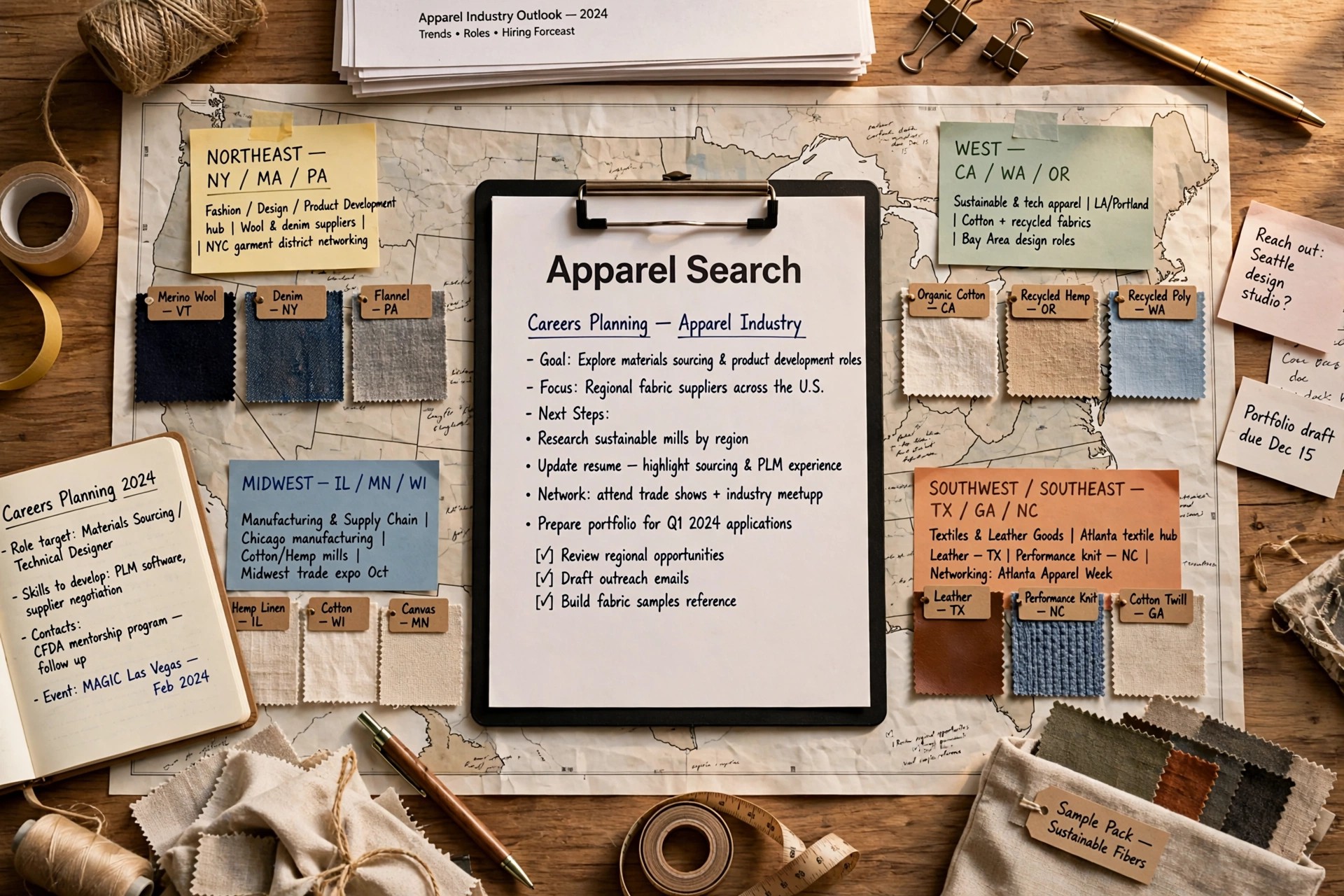
The Northeast and the South: Heritage, Headquarters and Seasons
The Northeast concentrates credentials: Boston's footwear headquarters and factories, Fairfield County's premium and brand offices, Maine's L.L.Bean ecosystem, Massachusetts and Rhode Island's textile and jewelry heritage, and the premium retail of the Boston–Washington corridor. Its careers reward technical and heritage knowledge — footwear construction, classic American product, luxury clienteling — and its state guides (Connecticut, Maine, Massachusetts and their neighbors in the wider series) show a region where small states hold outsized specialties. The mid-Atlantic adds uniform and institutional scale around the capital and tax-free and port retail in Delaware and Maryland.
The South is the industry's growth story: Atlanta's Carter's and AmericasMart, Arkansas's Walmart and Dillard's headquarters, Florida's Miami trade and winter resort economy, Kentucky's Louisville logistics, Louisiana's costume culture, and distribution muscle from Georgia to Texas in the series' later pages. Southern fashion careers often offer earlier responsibility in growing markets, distinctive specialties (childrenswear in Atlanta, swim in Miami, equestrian in Kentucky), and headquarters ladders in Bentonville and Atlanta that rival the coasts in their categories.
The Midwest and the West: Scale, Workwear and the Outdoor World
The Midwest runs America's clothing at scale: Target's Minneapolis product machine, Chicago's complete market, Michigan's Carhartt and Wolverine headquarters, Indiana and Ohio-style distribution geography, and workwear and uniform economies serving the industrial and farm belt. Midwestern fashion careers are product-serious and operations-deep — owned brands, work clothing, footwear and the logistics that move everything — and its state guides emphasize evidence and craft over trend fluency. Store and field leadership ladders across the region's chains are among the country's most reliable fashion careers.
The West holds the industry's creative and outdoor poles: Los Angeles design and production, California's surf and Bay Area commerce, Colorado and Utah-style outdoor industry clusters in the series' western pages, Pacific Northwest headquarters towns, and resort economies from Aspen to Jackson to Hawaii and Alaska's seasonal extremes. Western searches reward specialty depth — a fabric, a sport, a category — and the region's guides stress product fluency earned by participation: the West hires people who live in the clothing they sell and make.
Planning a Regional Search or a Move
Work in three passes. First, the region: decide which pattern — Northeast credentials, Southern growth, Midwest scale, Western specialty — matches the career you want, using the comparisons above and the regional notes in each state guide. Second, the anchor: every region has anchor employers and cities (a headquarters, a market, a corridor) that concentrate your function's jobs; the state guides name them, and your applications should cluster there rather than scattering across a map. Third, the season: time the move to the market's hiring rhythm — autumn for distribution and Florida's winter build-up, spring for summer resorts, market weeks for showroom towns.
The regional index below lists every state guide in the series; page 1 of the series carries the same guides in a single A–Z index, with the state-by-state method explained in full. Together the two pages are the doorway — the careers themselves are in the state guides, and in the job descriptions they link to. Choose deliberately, prepare specifically, and let the geography of this industry work for you instead of surprising you.
Worked Example: Building a Two-State Plan
Regional planning pays in the metros that ignore state lines. A Kansas City candidate reads the Kansas and Missouri guides together: footwear and Plaza prestige on one side, suburban growth and logistics on the other, one application list ranked by commute rather than by state pride. A Washington-area candidate reads Maryland, Virginia (in the wider series) and the District itself as three distinct markets sharing one customer — brand headquarters in Baltimore, institutional scale in DC, suburban retail in both states. The two-state plan, built from two state guides, is the practical unit of most real fashion careers in border metros.
Common Questions
What is the difference between page 1 and page 2 of this series?
Page 1 explains the state-by-state search method and how each state guide is structured; page 2 gives the regional comparison of US fashion markets for relocations and regional searches. Both pages carry the complete index of all 51 state guides.
Which US region is best for fashion careers?
It depends on function: the Northeast for footwear and premium heritage, the South for headquarters growth and resort and trade specialties, the Midwest for owned-brand product, workwear and logistics scale, and the West for design, production and outdoor industry roles.
How should I use the state index on this page?
Open the guide for each state in the region you are targeting, note its anchor employers, specialties and hiring seasons, then search with that state's terms and channels — the guides are written to be used in that order.