Private Label Designer Job Description
Designing a retailer's own brands — clothing created exclusively for one store or retail group, under its labels and at its prices
A private label designer designs clothing that will be sold under a retailer's own brand — private label — rather than under a manufacturer's label. Department stores, supermarket clothing ranges, catalogue retailers and online retailers all run own-brand collections that exist only in their stores, and those ranges need designers who work inside the retailer's world: its customer, its price architecture, its fit blocks and its label identity. The garment may be made by any of several factories, but the brand it carries belongs to the shop that sells it, and the designer answers to that shop's buyers and merchandisers. This page explains the own-brand design desk.
More Design Job Descriptions by Letter:
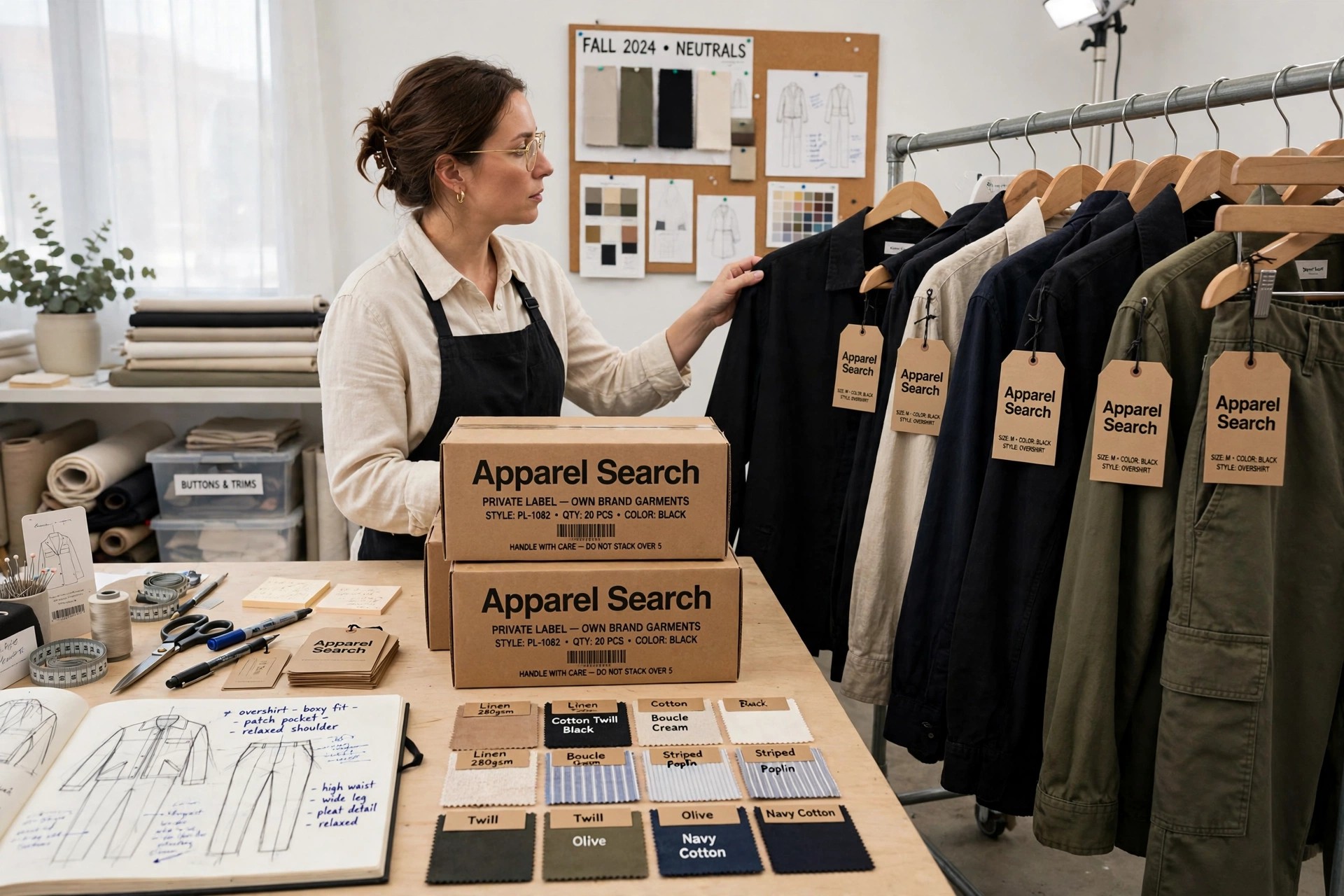
What a Private Label Designer Does
The design cycle starts from the retailer's range plan rather than from a designer's free collection. Buyers and merchandisers set the shape of the season — how many dresses, at which price points, for which of the retailer's labels — because most large retailers run several own brands at once, each aimed at a different customer or price tier. The private label designer designs within and across those labels: translating the season's trends into styles the store's actual customers will buy, at costs that protect the retailer's margin, and in fabrics and colours the store's other departments can coordinate with, so the shop floor reads as one story.
From sketch, the work runs through the familiar development chain with a retailer accent. Styles are presented at internal range reviews where buyers challenge price, fit and sales potential; samples are made by the factories the retailer sources from, fitted on the retailer's own fit models and blocks, and corrected until they match the standard the label promises. The designer writes and maintains the specification for each style, approves fabrics, colours and trims, checks pre-production samples, and guards consistency across suppliers — because two factories making the same own-brand shirt must deliver the same shirt, and the customer must never be able to tell which factory made hers.
Labels, Exclusivity and the Retailer's Customer
Private label design is design inside somebody else's brand identity, and understanding that identity is the desk's special discipline. Each label in the retailer's portfolio has a handwriting — one may be classic and quality-led, another younger and price-driven — and the designer must hold those handwritings distinct while designing both in the same week. Exclusivity is the commercial point: own-brand product cannot be comparison-shopped against the same garment in a rival store, so the designer builds recognisable label signatures — a fit reputation, a fabric quality, a recurring detail — that give customers a reason to return to that store rather than to the brand names it also stocks.
The work environment is a retail head office as much as a design studio: the designer sits with buyers, merchandisers and technologists, attends trade and comp-shop trips to study competitors' own brands, and spends sample-review days in fitting rooms rather than at a drawing board. Deadlines follow the retail calendar — range launches, catalogue and online photography dates, store delivery windows — and a style that misses its window may lose its slot entirely, however good it is. Designers who enjoy that commercial closeness, seeing their garments on rails and in sales reports within months, find private label one of the most satisfying desks in the trade.
Skills and Abilities the Role Requires
Range and customer judgement come first: the ability to design what a defined retail customer will buy at a stated price, in coordinated stories, label by label. That requires strong commercial sketching and CAD, clear specification writing for multiple factories, and fit literacy on the retailer's blocks. Cost engineering is a daily skill — hitting a target retail price backwards through margin, duty and freight to a factory cost, then designing the garment that cost can honestly make — and designers who treat that arithmetic as part of the creative work, not an insult to it, are the ones retailers promote.
The supporting skills are collaborative and organisational. Own-brand ranges are team products: the designer negotiates with buyers over style counts, with merchandisers over quantities and colours, with technologists over construction and testing, and with suppliers across time zones over samples that must arrive right and on time. Presenting a range persuasively at review, defending a style with sales evidence from previous seasons, and accepting a buyer's cut without losing the range's coherence are professional skills as real as drawing. Record-keeping matters too: an own-brand archive of proven styles is a working asset the whole team mines each season.
Qualifications, Training and Career Path
Private label designers usually hold fashion design qualifications and reach the desk through assistant designer posts inside retailers or inside the manufacturers and importers who supply retailers' own brands — both sides teach the same lessons about price, fit and range discipline. Portfolios that succeed show commercial ranges at stated price points for a named type of customer, with coordinated stories and evidence of designing core product — shirts, knitwear, dresses that sell in volume — as confidently as statement pieces. Experience of fitting and of factory sampling, even at junior level, is valued because the desk spends so much of its life in development rather than in first sketches.
Progression runs to senior private label designer and to design management of a label or a whole own-brand division, with movement between retailers common as designers carry their customer knowledge from one store group to another. The skills also transfer into product development and design roles with importers and manufacturers supplying own-brand programmes. It is a career with a clear commercial logic: the designer who can make a retailer's own label the reason customers walk through its doors holds one of the most defensible jobs in fashion design.
Common Questions
What is private label clothing?
Clothing designed and made to be sold under a retailer's own brand rather than a manufacturer's label. The retailer controls the design, fit, price and branding, factories produce the garments, and the range is exclusive to that retailer's stores and website.
How is a private label designer different from a fashion designer for a brand?
The customer and the label belong to a retailer. The designer works inside the store's price architecture, fit blocks and label identities, designs coordinated ranges with its buyers and merchandisers, and is judged on the own-brand range's sales in that retailer's stores.
How do you become a private label designer?
Train in fashion design, then build commercial range experience as an assistant designer with a retailer or with a supplier that makes own-brand clothing for retailers, showing portfolios of coordinated, realistically priced ranges for a defined customer.