Trainer Job Description
Standing in front of the room — delivering the training that makes store and head-office teams better at their jobs
A trainer's job is the session itself. Where programmes are designed and scheduled by others, the trainer is the person in the room — or on the video call — turning a subject into learning for a group of fashion industry staff: new starters on induction day, store teams learning a new range, managers practising a difficult conversation, a whole estate being taught a new till system before it goes live. In fashion, trainers are usually retail trainers teaching service, selling and product knowledge across a store estate, or brand product trainers teaching store staff what makes a collection worth its price.
More Miscellaneous Job Descriptions by Letter:
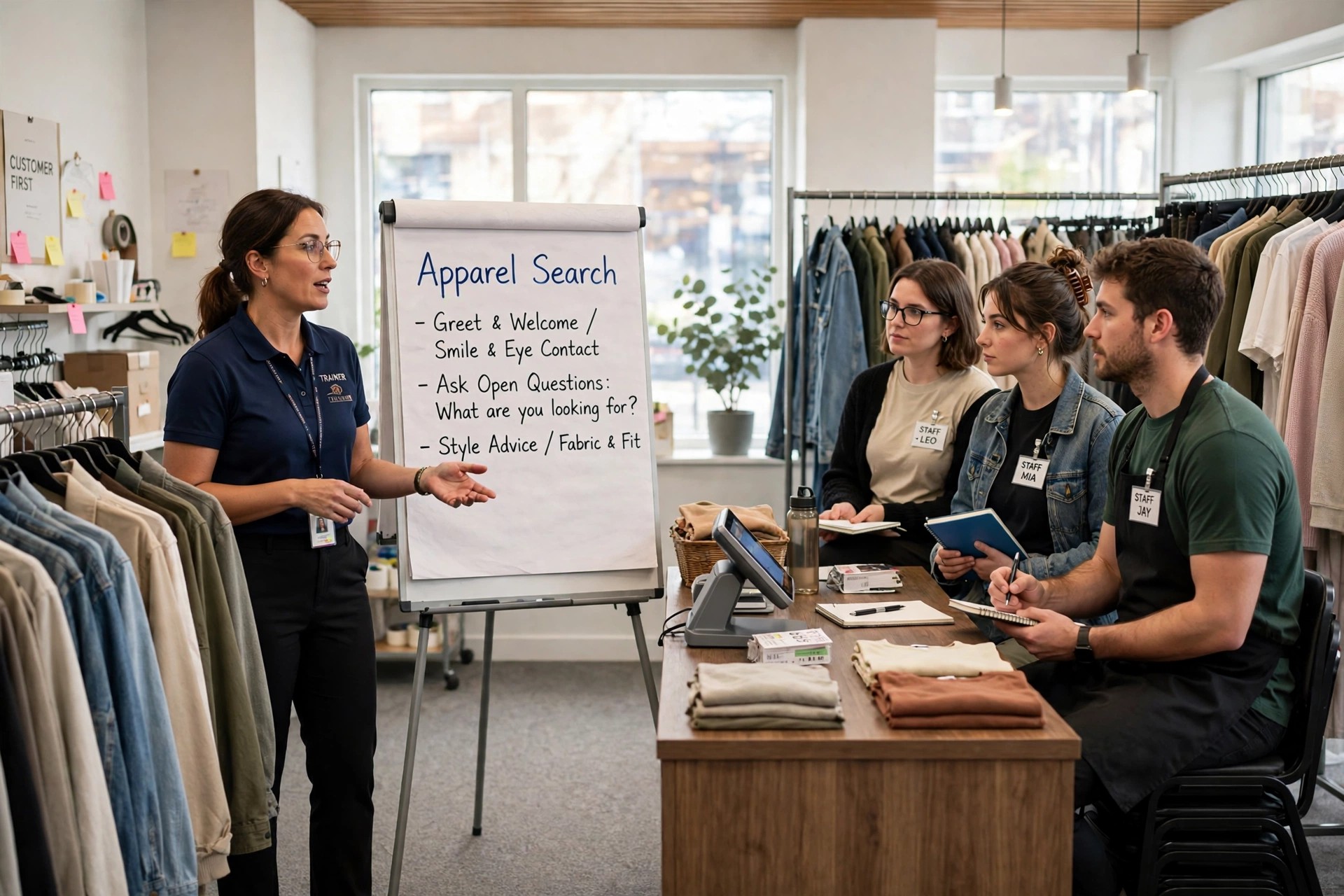
Delivering Training Sessions
Delivery is a performance with a purpose. The trainer opens sessions that earn attention in the first five minutes, teaches through demonstration, practice and discussion rather than lecture — staff learn selling by selling to each other, systems by using them, product by handling and wearing it — and reads the room constantly, speeding up for the quick group, re-teaching differently for the group that has not got it yet. Sessions are run to time and to the session plan, with the trainer managing everything from latecomers and sceptics to the projector, the sample garments and the coffee, while keeping the learning objectives visibly intact.
The subjects vary with the employer's calendar. Inductions welcome new starters into the company's standards and story; product training lands each season with the new range — fabrics, fits, features and the talking points that sell them; service and sales programmes work on greeting, fitting-room practice, complaint handling and the measures the business trades on; systems and compliance training covers tills, stock software, safety and policy. Brand trainers carry the same work into other companies' stores, teaching the staff of retail accounts to sell one brand's product with conviction inside a shop that stocks twenty.
Coaching, Assessment and Follow-Up
Classroom delivery is only half the craft. Trainers assess whether learning happened — through observed practice, knowledge checks, role-play standards and follow-up visits to stores where new skills either appear in real behaviour or evaporate. Coaching in store is where the trainer's retail experience earns its keep: watching an associate with a real customer, giving feedback that is specific and usable, demonstrating the better version, and agreeing what to practise before the next visit. Managers are coached too, because a store's training survives only if its own manager reinforces it after the trainer leaves.
Trainers also close the loop with the people who design programmes. Every session generates evidence — the question nobody could answer, the product feature staff found unbelievable, the process step that fails in every store — and the trainer reports it faithfully so materials, products and procedures improve. Attendance and completion records, evaluation forms and assessment results are kept accurately, since businesses audit training for compliance subjects and judge programmes by their numbers.
Skills and Abilities the Role Requires
Presence comes first: the ability to hold a room of tired store staff on a wet Tuesday, with energy, humour and structure, and to make the subject feel worth their attention. It is built on genuine subject mastery — trainers are former associates, managers and product specialists who know the work from inside, and groups detect a trainer who has never done the job within minutes. Communication must flex constantly: the same content pitched to a sixteen-year-old Saturday starter, a flagship's senior team and a room of store managers in one week.
Practical teaching skills follow: questioning that draws out rather than catches out, feedback that corrects without humiliating, group management that keeps dominant voices balanced and quiet ones included, and comfort with the blended toolkit of modern training — slides, video, e-learning modules and live virtual sessions alongside the flip chart. Organisation underpins delivery on the road: samples, kits, rooms and rosters arranged across an estate, week after week. Patience and belief in people are the temperament underneath it all — the trainer's raw material is other people's improvement, and it rarely arrives on schedule.
Qualifications, Training and Career Path
Trainers are appointed from experience: strong store associates and supervisors, store managers with a coaching record, and product specialists become retail and product trainers, usually with the employer's train-the-trainer training in delivery technique and session design. Formal qualifications in training, coaching or adult education — certificate-level teaching and assessing awards — are commonly supported and increasingly expected for senior posts, and product trainers add the brand's own accreditation on its ranges. A driving licence and willingness to travel across an estate are standard for field-based roles.
Careers develop toward training management and coordination roles for those who move from delivering programmes to designing and scheduling them, toward learning and development business-partner posts at head office, and sideways into the operational roles — area management, store openings, service leadership — where a trainer's floor credibility is prized. Some trainers build independent practices, delivering service and product training to several retailers and brands. The role suits experienced retail people who discovered their favourite part of management was the teaching, and want a career made of it.
Common Questions
What does a trainer do in a fashion business?
They deliver training: induction programmes, seasonal product training, service and selling skills, systems and compliance sessions — running workshops, demonstrating and practising skills with staff, coaching in stores, and assessing whether the learning has stuck.
How is a trainer different from a training coordinator?
The trainer delivers: they stand in front of groups and coach individuals. A training coordinator works behind the programme — scheduling sessions, booking venues and trainers, maintaining materials, records and budgets. Coordinators organise training; trainers teach it.
What experience do you need to become a retail trainer?
Usually a strong record in the work being taught — store associate, supervisor or manager experience for retail training, product expertise for brand training — plus train-the-trainer development. Teaching and coaching qualifications are commonly supported in role.