Washroom Operator Job Description
Running the washes that give garments their finish — machines, recipes, water and chemistry in the laundry
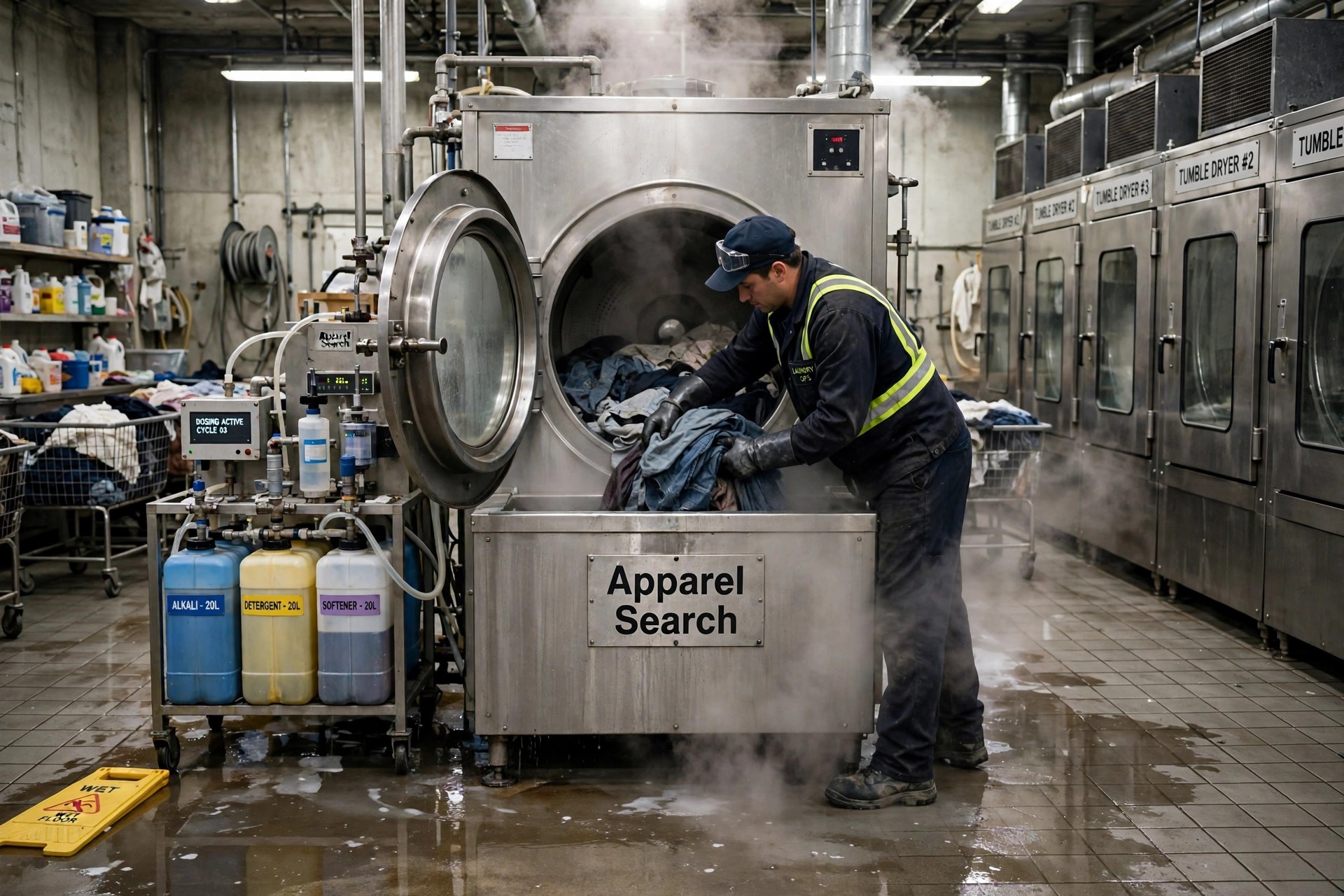
A washroom operator runs the wet-processing stage of garment finishing: the industrial laundry where jeans get their stonewash, dyed garments get their colour, and finished clothing is washed to its final shade, softness and dimensions before pressing and packing. The work is done on large washer-extractors, hydro-extractors and tumble dryers, following written recipes of time, temperature, water and chemicals, and it is skilled trade work — a few minutes or a few degrees wrong can fade a batch past its standard or shrink it out of tolerance, and wet garments cannot be unwashed.
More Production Job Descriptions by Letter:
Running Washes to Recipe
Each style arrives with a wash recipe developed and approved against a standard: load weight, water levels and temperature, detergent and softener quantities, and process-specific chemistry — enzymes for a bio-polish or stone-free fade, pumice stones for a true stonewash, bleach or potassium permanganate treatments for denim effects, dye and fixatives where the washroom also garment-dyes. The operator loads machines to the specified weight, because underloading and overloading both change the result, sets the programme, doses chemicals accurately, and times each stage. First pieces or first loads are checked against the approved standard for shade, hand-feel and effect before the batch proceeds.
Denim work shows the craft most clearly. A stonewash is abrasion managed precisely: stone-to-garment ratios, cycle length and water temperature decide whether five hundred pairs match the standard or emerge as five hundred individual results. The operator monitors mid-cycle, adjusts within the recipe's tolerances, and pulls samples for the washroom supervisor or quality checker to approve against the retained standard under standard lighting. Garment-dye work adds shade discipline — lab-dip logic at production scale, with dye weighed, dissolved and added in sequence, then fixed and washed off until rinse water and shade both run right.
Drying, Checking and Keeping the Room Running
Washed garments leave the washer wet and heavy, and the operator moves them through extraction and tumble drying at temperatures the fabric and recipe allow — too hot shrinks or damages, too cool holds up the whole finishing line. Dried loads are checked for shade consistency across the batch, residual moisture, shrinkage against the measurement spec on sampled garments, and faults the wash reveals or causes: stains, streaks, uneven fading, damaged buttons and zips, chemical spots. Faulty pieces are separated and reported, not quietly passed on, because the washroom is the last process that sees every garment before finishing.
The room itself is part of the job. Operators keep machines, filters, drains and dosing equipment clean and report faults — a leaking seal or a failing steam valve changes wash results before it stops the machine outright. Chemical handling follows the safety data: protective equipment worn, concentrated products stored and diluted correctly, spills contained, and effluent rules respected because washroom water leaves the site carrying what the process put in it. Records close the loop: batch cards noting recipe, machine, load, times and any adjustment, so a successful wash can be repeated and a failed one can be traced.
Skills and Abilities the Role Requires
Process discipline is the central skill: weighing, dosing, timing and temperature followed exactly, every load, when nobody is watching the dial but the garments will show it. A trained eye for shade and effect follows — judging colour against a standard under proper light, feeling hand and softness differences, spotting uneven work early enough to correct the batch rather than reject it. Basic machine understanding matters: what the washer-extractor's programmes do, how extraction and dryer heat behave, and when a sound or vibration means stop and report.
The physical demands are real and should be understood by applicants: wet garments are heavy, the room is warm and damp, loads move constantly between machines, and shifts stand. Chemical safety awareness, numeracy for recipes and ratios, and steady record-keeping complete the profile. Washroom operators work as a team under time pressure from the finishing line waiting downstream, and reliability — the load finished when promised, to the standard agreed — is what supervisors value most.
Qualifications, Training and Career Path
Washroom operators are usually trained on the job, starting as laundry assistants or sorters and learning machines, recipes and shade judgement under an experienced operator; employers value prior laundry, dyehouse or finishing experience but hire for care, stamina and reliability where training is provided. Safety training in chemical handling and machine operation is standard, and in larger laundries operators certify on specific machine types or processes — denim effects, garment dye, specialty finishes — each widening what they can run unsupervised.
The path leads to senior operator, washroom supervisor or laundry manager roles, and sideways into the technical heart of finishing: wash development and recipe creation, where new effects are engineered with designers, and quality and dyehouse technician posts. In denim especially, experienced wash operators hold knowledge brands pay for — how a wash will behave at production scale is learned at the machine, load by load, and the operators who master shade and recipe discipline become the people a laundry's reputation rests on.
Common Questions
What does a washroom operator do?
They run garment wet processing: loading industrial washers and dryers, following wash recipes of time, temperature, water and chemicals, producing finishes such as stonewash and garment dye, and checking shade, hand-feel and shrinkage against the standard.
Is washroom work the same as laundry work in a hotel or hospital?
The machines are similar but the purpose differs. A garment washroom is a production process: washes are recipes that create the product's colour, fade and feel, judged against an approved standard, not just cleaning.
What skills matter most for a washroom operator?
Exact recipe discipline, a good eye for shade under standard light, chemical safety, basic machine understanding, and the stamina for heavy wet work in a warm room.
More to Explore
Finishing and Manufacturing Resources
Production Directory Pages by Letter
References & Further Reading
More Job Description Categories
- Buying Job Descriptions
- Design Job Descriptions
- Marketing & PR Job Descriptions
- Miscellaneous Job Descriptions
- Planning & Allocation Job Descriptions
- Production & Sourcing Job Descriptions (current)
- Sales & Selling Job Descriptions
- Transportation & Warehouse Job Descriptions