Customs Broker Job Description
The licensed specialist who files the entry — classification, duty and release for imported clothing
A customs broker is the licensed professional who turns an arriving shipment of clothing into a cleared, duty-paid delivery. Importers of apparel rarely file their own entries: they hand the commercial documents to a broker, who classifies every garment, works out what duty is owed, submits the entry to customs, answers the questions that come back, and arranges the release so the freight can move to the warehouse. It is a paperwork trade built on product knowledge — the broker who understands how a garment is made files a better entry than one who only reads the invoice.
More Transportation & Warehouse Job Descriptions by Letter:
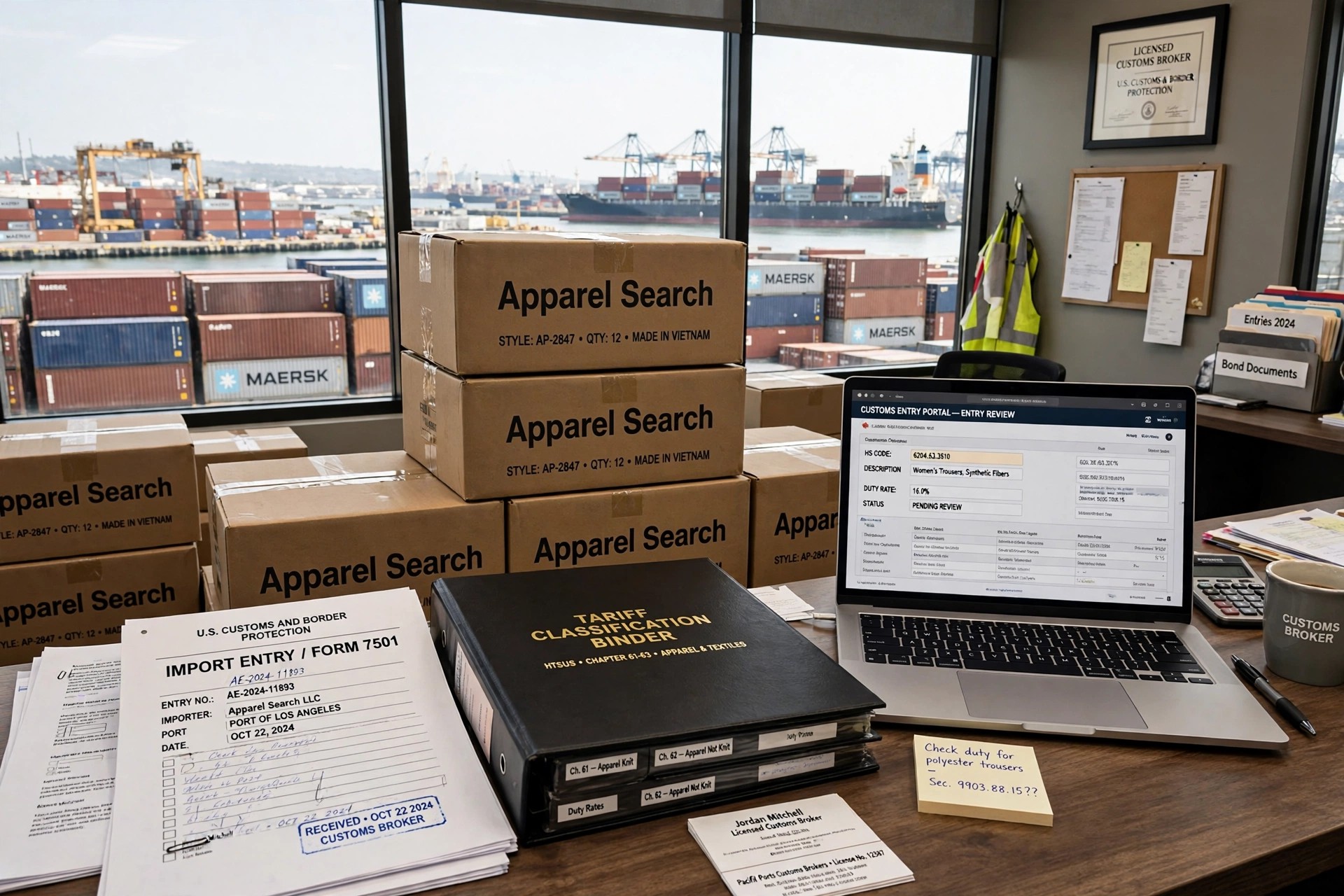
The Entry: From Documents to a Filed Shipment
The work starts with the importer's documents: the commercial invoice, the packing list, the bill of lading or air waybill, and whatever certificates the goods require. The broker checks that the documents agree with each other — quantities, descriptions, values, weights, marks — because an entry built on inconsistent paperwork inherits every inconsistency. For ocean freight, security filing data about the shipment must be transmitted before the vessel loads overseas, so the broker's clock starts while the goods are still at the factory's port, not when they arrive.
The entry itself is filed electronically through the customs broker's systems. Each line of the invoice becomes an entry line with its classification, value, duty rate and any special programme claim; the broker calculates the duties and fees, arranges payment on the importer's behalf, and posts the bond that guarantees them. When customs accepts the entry, the broker coordinates what happens next — examination if one is ordered, release, and the delivery order that lets the trucking company collect the freight from the terminal.
Classification and Duty: The Apparel Detail
Classification is the broker's core skill, and apparel makes it demanding. A garment's tariff line turns on its fibre content, whether it is knitted or woven, who it is made for, and construction details such as closures, linings and water resistance. The broker reads the importer's specifications and samples with those questions in mind, applies the classification consistently across the importer's whole range, and keeps the reasoning on file, because the same style will be entered again season after season and an inconsistency between entries is an invitation to questions.
Duty follows classification, and so do the extras: quota or safeguard measures where they apply, preferential rates under trade programmes where the goods qualify and the origin evidence supports the claim, and additional duties imposed on particular countries or products. The broker flags the cost consequences to the importer before goods ship where possible — a small construction change or a different sourcing country can change the landed cost of a garment line, and the broker is usually the first person in the chain who can see it in numbers.
Exams, Corrections and the Working Week
Not every entry sails through. Customs may hold a shipment for document review or physical examination, query a value, or challenge a classification, and the broker is the importer's voice in that conversation: supplying the missing document, explaining the product, arranging the exam and keeping the freight moving as fast as the process allows. Each day of delay costs the importer money in storage, in demurrage and in missed selling time, so a good broker's value is measured as much in prevented delays as in filed entries.
After release the work continues. Errors discovered in a filed entry are corrected through the post-entry procedures; records of every entry must be kept and produced if customs audits the importer; and recurring problems — an invoice format that keeps causing queries, a style classified two ways by two offices — are fed back to the importer as process fixes. The broker also knows the boundary of the role: filing entries is licensed customs business, but legal argument about what the law means belongs to the customs attorney, and brokers refer importers onward when a dispute crosses that line.
Licensing, Skills and Career Path
Customs brokers are licensed. In the United States the licence requires passing the customs broker examination — a demanding test of the tariff, the customs regulations and entry procedure — meeting citizenship and character requirements, and then maintaining the licence and any local permits in good standing. Brokerage firms employ licensed brokers alongside unlicensed entry writers and account staff who prepare work under the licence holder's supervision, which is how most people enter the trade: documentation or entry-writing desk first, licence once the knowledge is deep enough.
The skills are precision, product literacy and calm. Entries are legal documents filed against deadlines; a transposed digit or a missed cut-off has real consequences, and peak apparel seasons land thousands of lines on the desk at once. Brokers who know clothing — fibres, construction, how garments are costed and packed — progress to senior accounts, branch and brokerage management, in-house trade compliance roles with large importers, and independent practice. The customs clearance manager in this same letter is the operations-side neighbour: the manager runs the clearance process, the broker files the entries it depends on.
Common Questions
What does a customs broker do for an apparel importer?
Prepares and files the customs entry for imported clothing: checking the commercial documents, classifying each garment, calculating and arranging payment of duty, answering customs queries and exams, and coordinating release and delivery of the freight.
How is a customs broker different from a customs attorney?
The broker is licensed to transact customs business — preparing and filing entries — and handles the practical movement of shipments through the entry process. The attorney practises law: legal advice, compliance strategy and disputes. A broker refers legal questions to the attorney; an attorney does not file entries.
What licence does a customs broker need?
A customs broker licence, earned by passing the official broker examination on the tariff and customs regulations and meeting the eligibility requirements, then kept current alongside any permits needed for the ports served. Entry writers work under a licence holder's supervision.
More to Explore
Customs and Import Resources
References & Further Reading
More Job Description Categories
- Buying Job Descriptions
- Design Job Descriptions
- Marketing & PR Job Descriptions
- Miscellaneous Job Descriptions
- Planning & Allocation Job Descriptions
- Production & Sourcing Job Descriptions
- Sales & Selling Job Descriptions
- Transportation & Warehouse Job Descriptions (current)