Customs Clearance Manager Job Description
Running the clearance operation — brokers, documents, delays and compliance for imported clothing
A customs clearance manager runs the process that gets imported clothing legally into the country and physically to the warehouse. The role sits inside a large importer, a retailer or a brokerage organisation, and it is an operations job rather than a filing job: the manager owns the flow of entries across many shipments at once, supervises the people and the outside brokers who prepare them, fights the delays that exams and missing documents cause, and keeps the whole system consistent enough to survive an audit. Where the customs broker files the entry, the clearance manager makes sure a thousand entries a season are filed right, on time and at a controlled cost.
More Transportation & Warehouse Job Descriptions by Letter:
Owning the Clearance Flow, Shipment by Shipment
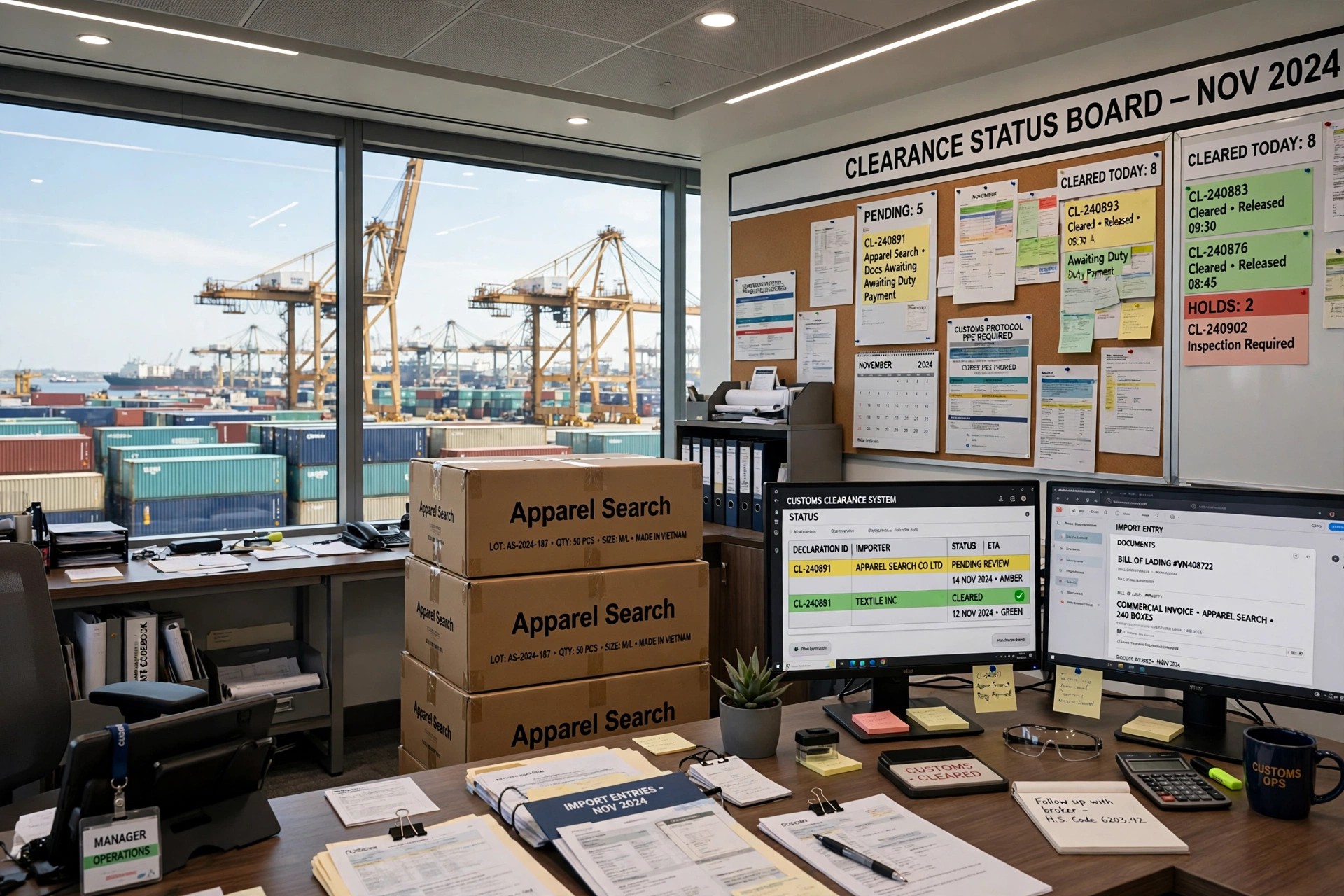
The manager's day is a queue of live freight. Inbound apparel shipments are tracked from vessel or flight departure through arrival, entry filing, examination and release to final delivery, and the manager works the exceptions: the container selected for exam the week a promotion launches, the shipment whose documents never arrived from the factory, the entry held over a classification query. Priorities are set with the sourcing and merchandising teams, because the commercial cost of a delay depends on what is in the box — a core replenishment and a dated fashion delivery do not carry the same urgency.
Service is managed as numbers. The manager measures how long clearance takes by port, carrier and broker, where the holds occur and what they cost in storage, demurrage and expedited trucking, then attacks the recurring causes. Document checklists go out to factories and buying offices so paperwork is right before goods sail; arrival forecasts are shared with the warehouse so released freight lands on a prepared dock. Clearance, run this way, stops being a surprise that happens to the supply chain and becomes a planned stage inside it.
Managing Brokers, Entry Staff and Procedures
Few importers file everything themselves, so the clearance manager usually directs a combination of in-house entry staff and external customs brokers. That means selecting brokers port by port, setting the instructions they work to — the importer's classification decisions, valuation methods and programme claims, in writing — reviewing their accuracy and timeliness, and auditing their work against the underlying documents. A broker who files exactly what the importer decided is an extension of the team; a broker left to improvise classifications shipment by shipment is a compliance risk the manager is paid to prevent.
Procedures are the manager's product. Standard operating procedures cover how a shipment is opened in the system, which documents are required for which product types, who approves a new style's classification, how exam and hold notices are escalated, and how records are filed so any entry can be reconstructed years later. When volumes surge at season changeovers, the manager staffs the desk to the forecast and rebalances work between ports and brokers rather than letting one queue quietly become next month's crisis.
Consistency, Records and the Compliance Programme
Customs judges an importer on consistency. The same garment entered under two classifications, values built two different ways, or origin claims the paperwork cannot support are the patterns that turn a routine review into a full audit. The clearance manager guards against them with a maintained classification database for the company's range, controlled valuation and origin documentation, and periodic self-audits that sample filed entries against invoices, packing lists and payment records — finding and correcting the company's own errors before customs finds them.
This is programme management, not law. The manager builds and runs the system, trains the sourcing and product staff whose purchase orders and specifications create the facts an entry is built on, and brings in the customs attorney when a question becomes legal — a disputed ruling, a disclosure decision, a penalty notice. Keeping that boundary clear is part of the job: operations owns the process, counsel owns the argument, and the broker owns the filing, and a well-run import department knows which desk a problem belongs on within minutes.
Skills, Qualifications and Career Path
Employers look for substantial experience inside import operations: entry filing or brokerage work, freight and port processes, and the documentation chain from factory to warehouse, ideally in apparel, where classification detail and seasonal volume make clearance unusually demanding. A customs broker licence is a strong credential for this role and some employers require one, because the manager must be able to judge filers' work; others accept equivalent years of supervised entry experience. Systems fluency matters throughout — the entry, tracking and reporting platforms are where the operation is actually seen and controlled.
People skills decide the rest. The manager negotiates with brokers and carriers, explains delays honestly to merchants who have selling floors waiting, and stays methodical when several shipments go wrong in the same week. Progression leads to head of import operations or trade compliance management for larger importers and retailers, to senior roles inside brokerage organisations, and sideways into the logistics management roles elsewhere in this category that share the same freight, viewed from the warehouse end instead of the border.
Common Questions
What does a customs clearance manager do?
Manages the whole clearance operation for imported clothing: tracking shipments from departure to release, supervising in-house entry staff and outside customs brokers, controlling exam and document delays and their costs, and keeping classifications, values and records consistent across every entry.
How is a customs clearance manager different from a customs broker?
The broker is licensed to prepare and file individual entries. The clearance manager runs the process those entries belong to — choosing and instructing brokers, setting procedures, measuring clearance performance and owning the compliance system — and may hold a broker licence without personally filing the daily volume.
Does a customs clearance manager need a broker licence?
It is a strong advantage and some employers require it, because the manager must judge the quality of licensed filers' work. Others hire on deep import-operations experience instead. Either way, the role also demands team leadership and process management beyond the licence itself.
More to Explore
Customs and Import Resources
- Customs Attorneys Directory
- Customs Guide for the Clothing Industry
- Customs Brokers Directory
- Customs Consultants
- Warehouse Directory
- Transportation Directory
- Production & Sourcing Job Descriptions
- Customs Broker Job Description
- Customs Attorney Job Description
- Transportation & Warehouse Directory — Letter C
Transportation & Warehouse Directory Pages by Letter
References & Further Reading
More Job Description Categories
- Buying Job Descriptions
- Design Job Descriptions
- Marketing & PR Job Descriptions
- Miscellaneous Job Descriptions
- Planning & Allocation Job Descriptions
- Production & Sourcing Job Descriptions
- Sales & Selling Job Descriptions
- Transportation & Warehouse Job Descriptions (current)