Global Supply Chain Manager Job Description
Designing and running the whole international chain — sourcing countries, lead times, trade lanes and risk, from factory to store
A global supply chain manager is responsible for the entire journey of clothing across borders: from the sourcing decision about which country and factory makes a garment, through production, freight and customs, to the distribution centre and finally the store or the customer's door. Where the logistics roles in this category run movement day by day inside a company's network, this role designs the network itself — which countries to source from, which lanes and modes carry the goods, how much inventory the chain should hold and where — and then answers for its cost, its speed and its resilience when the plan meets the real world.
More Transportation & Warehouse Job Descriptions by Letter:
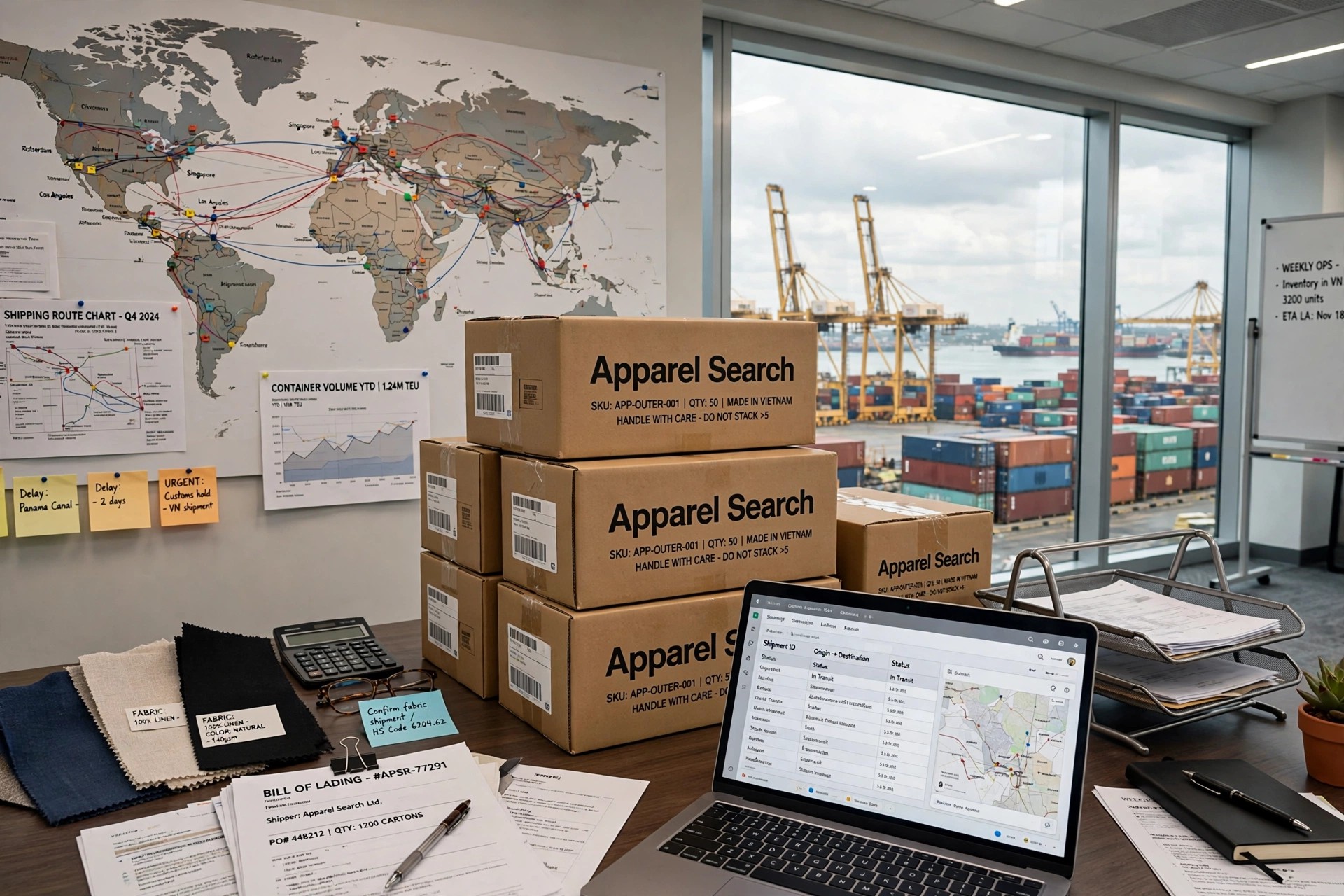
The Whole Chain: From Sourcing Decision to Store Shelf
The work begins long before anything ships. Working with sourcing, merchandising and finance colleagues, the manager helps decide where each product family is made, weighing labour and material costs against lead time, quality capability, capacity and the duty and freight consequences of each country choice. A low factory price on the far side of a slow or unreliable lane can cost more, landed, than a higher price closer to market — and it is this role that builds the landed-cost picture honestly enough for the business to choose with its eyes open.
From those decisions the manager builds the flow plan for each season: production windows at the factories, consolidation points where goods from several makers are combined, the split between sea and air freight, the ports and distribution centres the goods will pass through, and the inventory targets that decide how much stock the chain holds at each stage. Fashion seasons are fixed by the retail calendar, so the plan is built backwards from delivery dates that cannot move, with the slack placed deliberately where experience says it will be needed.
Lead Times and Trade Lanes: The Daily Arithmetic
Lead time is the role's central number, and it is a chain of smaller numbers: fabric production and delivery to the factory, garment making, inspection and packing, the journey to port, the ocean or air transit itself, customs clearance, and the inland leg to the warehouse. The manager knows each link for each sourcing country, tracks how the actual times drift against the plan, and re-plans early when a link stretches — moving a style to air freight while there is still a cheap decision to make, rather than after the selling season has already started without its stock.
Trade lanes are managed as relationships as much as routes. The manager works with freight forwarders and carriers on capacity and rates across the company's lanes, forecasts the volumes each season will put on them, and keeps alternative routings ready for the lanes that matter most. In apparel the volumes are intensely seasonal, and securing space for the peak intake — without paying peak prices for the whole year — is a negotiation this role prepares months ahead, from the company's own shipment history.
Risk, Disruption and Continuity
A global chain is exposed in ways a domestic one is not: port congestion and strikes, factory capacity failures, extreme weather on a lane, sudden changes in duties or trade rules, currency movement between the order and the payment, and the compliance exposure that comes with making goods in many jurisdictions at once. The manager maintains the risk picture for the chain — which styles, countries and lanes a single failure would hurt most — and builds the practical defences: dual sourcing for critical products, safety stock placed by risk rather than by habit, and documented alternative factories and routes that can be activated in days, not designed from scratch in a crisis.
When disruption lands anyway, this is the desk where it is worked. The manager re-routes, re-modes and re-sequences shipments, protects the deliveries the season depends on most, and tells the business early and plainly what will be late, what it will cost to fix, and what cannot be fixed at any price. That candour is a core part of the job: merchandisers can re-plan a season around honest information, but not around silence.
Skills, Qualifications and Career Path — and the Neighbouring Roles
Employers look for substantial supply chain or international logistics experience, ideally in apparel or another seasonal, import-heavy trade, together with the analytical strength to model costs and lead times across a multi-country network. Knowledge of freight modes and forwarding, customs and trade-programme basics, sourcing geography and inventory planning is expected, as is fluency with the planning and tracking systems the chain runs on. A degree in supply chain management, logistics, business or a related field is common, and professional supply chain certifications are widely held at this level.
The role is distinct from its neighbours in this directory, and the boundaries matter. The logistics manager runs the company's transport and warehouse operation — budgets, carriers and service levels — inside the network; the logistics coordinator and supervisor move and supervise individual shipments and shifts. The global supply chain manager sits upstream of all three, designing the network they operate and owning the sourcing-to-shelf result. Progression runs from this role to head of supply chain or operations director positions, or into senior sourcing leadership where the same network knowledge is the qualification.
Common Questions
What does a global supply chain manager do?
Owns the end-to-end flow of goods across countries: helping decide where products are sourced, planning production, freight and inventory flows by season, managing lead times and trade lanes with forwarders and carriers, and protecting the chain against disruption — from factory to store shelf.
How is a global supply chain manager different from a logistics manager?
Scope and horizon. The logistics manager runs transport and warehousing operations — budgets, carrier contracts and service levels — within the existing network. The global supply chain manager designs that network: sourcing countries, lanes, modes and inventory strategy, planned seasons ahead.
What qualifications suit a global supply chain manager?
Senior supply chain or international logistics experience, landed-cost and lead-time analysis, knowledge of freight, customs basics and sourcing regions, and systems fluency. A supply chain, logistics or business degree is common, and professional supply chain certification is widely held.
More to Explore
Supply Chain Resources
References & Further Reading
More Job Description Categories
- Buying Job Descriptions
- Design Job Descriptions
- Marketing & PR Job Descriptions
- Miscellaneous Job Descriptions
- Planning & Allocation Job Descriptions
- Production & Sourcing Job Descriptions
- Sales & Selling Job Descriptions
- Transportation & Warehouse Job Descriptions (current)