Logistics Manager Job Description
Owning the operation's numbers — budget, carrier contracts, service levels and the network inside the company
A logistics manager owns the movement operation of an apparel company as a business: its budget, its contracts, its service levels and its people. Factories, stores and customers experience logistics as deliveries; the manager experiences it as a set of commitments that must all be true at once — freight bought at a defensible cost, capacity secured for the peaks, stores and customers served at the promised level, and a team large and skilled enough to run it. This is the senior operational role in the company's transport and warehousing life, and the desk where the season's logistics successes and failures are finally accounted for.
More Transportation & Warehouse Job Descriptions by Letter:
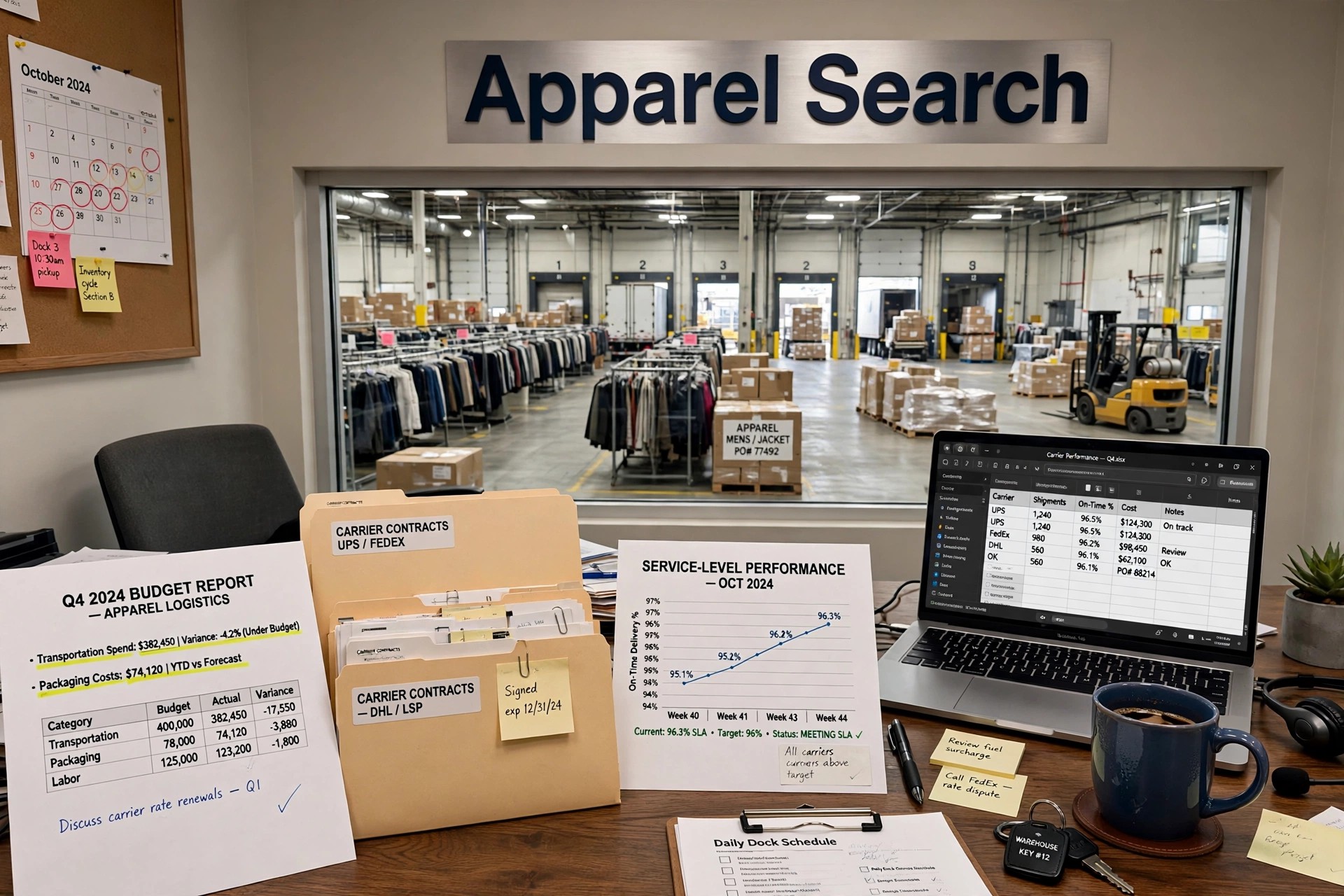
The Budget and the Network: What the Manager Owns
The budget is the role's foundation. The manager builds the annual logistics budget from the company's shipment history and sales plans — freight by lane and mode, warehousing and handling, packaging, systems and staffing — and then defends it through the year as volumes, rates and seasons move against it. Freight cost in apparel is read per garment and per order, not just in total, and the manager knows which lanes, services and habits drive the number: the expedited shipments that became routine, the split deliveries a better plan would have combined, the returns flow nobody budgeted for honestly.
Within the company, the manager also owns the shape of the internal network: which distribution centre handles which stores and channels, where e-commerce fulfilment sits, how stock is rebalanced between sites, and when a flow has outgrown its building or its carrier. Those decisions are made with merchandising, retail and finance at the table, but the analysis — volumes, distances, service consequences, cost — is prepared here, and so is the implementation plan when the network changes.
Carrier Contracts and Service Levels
The manager negotiates and manages the agreements the operation runs on: parcel and freight carriers, freight forwarders for the import lanes, and third-party warehouse or transport providers where the company uses them. Rates matter, but the contract is wider than rates — capacity commitments for peak weeks, cut-off and transit standards, claims and liability handling, reporting duties and review meetings all belong in it, because a cheap service that fails in the peak month is the most expensive service the company buys.
Service levels are the other half of the bargain, and they are set with the business, not for it. The manager agrees measurable standards — despatch times, delivery performance to stores, order accuracy, response times on problems — reports against them honestly, and investigates the misses to their cause: a lane, a carrier, a warehouse process or the company's own late decisions. When service and cost pull against each other, the manager prices the trade-off and puts it to the business as a choice, rather than quietly letting one consume the other.
Systems, Measurement and Improvement
Modern logistics runs on its systems — order, transport and warehouse management platforms, tracking feeds and the reports built from them — and the manager is their business owner: choosing and configuring them with IT colleagues, keeping lane, carrier and rate data accurate, and making sure the dashboards the company reads describe reality. A manager who cannot trust the data manages by anecdote, and the department's credibility with finance and merchandising depends on its numbers being the ones that survive audit.
Improvement is the standing project beneath the daily operation. The manager works the recurring evidence — the lanes whose transit times drift, the factories whose documentation fails, the warehouse bottleneck that appears every peak — into changes with owners and dates: a re-tendered lane, a revised booking cut-off, a packaging change that cuts damage and freight cube at once. Small, permanent fixes compound; the difference between a logistics operation that improves yearly and one that merely survives its peaks is usually this discipline, applied at this desk.
Leadership, Skills, Qualifications and Career Path
The team reports through structure: supervisors run the shifts and coordinators run the shipments, and the manager's leadership is exercised through them — setting the department's standards and priorities, reviewing performance lane by lane and person by person, hiring for the peaks ahead of need, and developing supervisors toward management. Employers appoint from senior logistics, supply chain or distribution roles, and look for the full combination: contract negotiation, budget ownership, carrier and forwarder knowledge across import and domestic lanes, systems fluency, and the standing to represent logistics in rooms where its costs are challenged.
The boundaries with this page's neighbours are matters of scope. The logistics supervisor leads the team at shift level; the coordinator executes at order level; the manager owns the operation at budget and contract level. Upstream, the global supply chain manager designs the international network this operation runs inside — sourcing countries and end-to-end strategy — while the logistics manager's network is the company's own transport and warehousing. From here, progression runs to head of logistics, supply chain leadership and operations director roles.
Common Questions
What does a logistics manager do?
Owns the logistics operation as a business: building and defending its budget, negotiating carrier and forwarder contracts, agreeing and reporting service levels, shaping the internal distribution network, owning its systems and data, and leading the team through its supervisors.
How is a logistics manager different from a logistics supervisor?
The supervisor leads the team shift by shift — workload, priorities, standards. The manager leads the operation — budget, contracts, service levels and network decisions — and the supervisors report to the manager.
What qualifications does a logistics manager need?
Senior logistics or distribution experience with budget and contract responsibility, carrier and forwarder knowledge across domestic and import lanes, systems and data fluency, and team leadership. A logistics, supply chain or business degree is common at this level.
More to Explore
Logistics Resources
Transportation & Warehouse Directory Pages by Letter
References & Further Reading
More Job Description Categories
- Buying Job Descriptions
- Design Job Descriptions
- Marketing & PR Job Descriptions
- Miscellaneous Job Descriptions
- Planning & Allocation Job Descriptions
- Production & Sourcing Job Descriptions
- Sales & Selling Job Descriptions
- Transportation & Warehouse Job Descriptions (current)