Logistics Supervisor Job Description
Front-line leadership of the logistics team — shifts, workload, standards and the warehouse hand-off
A logistics supervisor leads the people who move the goods. In an apparel company's logistics office or distribution operation, this is the front-line manager: the person who opens the shift, divides the day's shipments and problems among the coordinators and clerks, sets the order in which things get done, and answers for the team's output by the time the shift ends. Where the logistics coordinator's craft is the individual shipment, the supervisor's craft is the team that handles hundreds of them — its workload, its standards, its training and its morale through the peaks of the fashion calendar.
More Transportation & Warehouse Job Descriptions by Letter:
Leading the Shift: People Before Paperwork
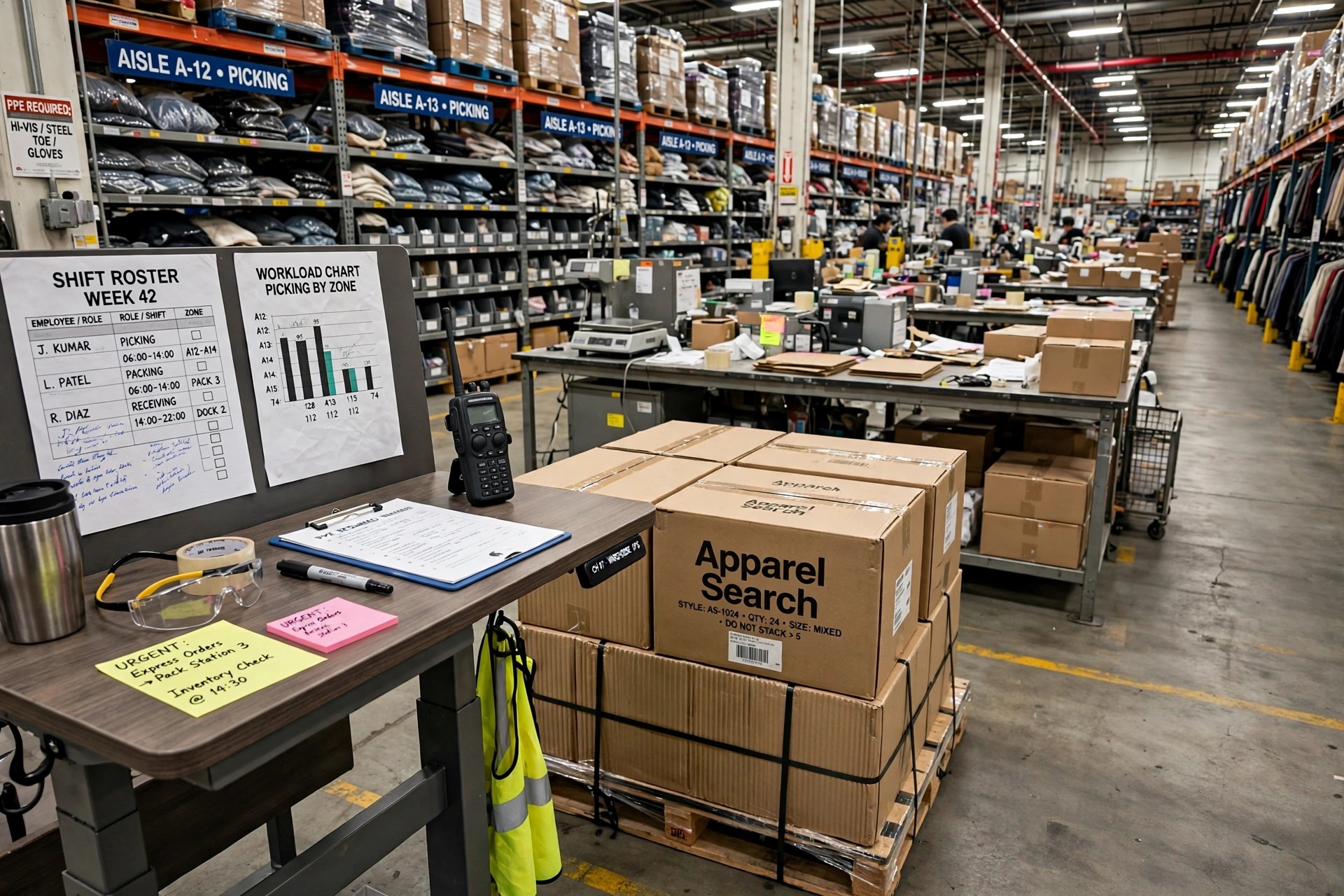
The supervisor's day starts with the state of play: which shipments are critical today, which problems were carried over, who is in and who is absent. Work is assigned deliberately — urgent lanes and major accounts to the experienced hands, routine traffic where newer staff can build skill under a safety net — and priorities are stated plainly, because a team that guesses its own priorities will guess differently from person to person. Through the shift the supervisor walks the work rather than watching a screen: checking the stuck shipment at a coordinator's desk, unblocking the query that has waited two days for an answer, re-dividing the load when a crisis lands on one person's accounts.
Supervision in logistics is also cover and continuity. The supervisor holds the team's knowledge of each other's lanes well enough to keep freight moving through holidays, sickness and resignations, maintains the handover notes between shifts, and is the first escalation point when a coordinator's problem outgrows order level — a carrier failure across many shipments, a warehouse refusal, a store group's service complaint. Deciding what to solve, what to delegate back with guidance and what to pass up to the manager is the role's constant judgement.
Workload, Priorities and the Warehouse Hand-Off
Apparel logistics workload is violently uneven: the autumn intake, pre-holiday shipping and sale-period redistribution can triple a normal week, and the supervisor plans for it — leave blackouts agreed fairly in advance, temporary staff requested in time and trained before the peak, overtime organised while it is still a plan rather than a panic. Within the peak, the supervisor sequences the work so the shipments that protect revenue — store openings, promotions, key accounts — are never queued behind freight that could wait a day without consequence.
The other daily interface is the warehouse. Logistics promises receiving windows, pick releases and outbound cut-offs that the warehouse must staff, and the supervisor is the person who keeps those promises honest in both directions: telling the floor early when a late inbound will bunch the evening's work, and telling merchandising plainly when the floor cannot take another rush release today. Companies feel the quality of this hand-off as a single fact — whether goods flow or pile up — and it is largely made at this desk.
Performance, Training and Standards
The supervisor owns the team's standards in practice: documents checked before they leave, tracking updated the same day, problems escalated with facts attached. New coordinators are trained against those standards with their work sampled and corrected kindly and specifically; experienced staff are reviewed on the measures that matter — on-time performance on their lanes, document accuracy, problem-resolution time — and coached where the numbers or the complaints point. Persistent errors are treated as information first: a lane whose paperwork always fails may need a better checklist, not a sterner warning, and building those checklists, templates and lane notes is squarely this role's craft.
The role also carries the team's voice upward. The supervisor reports workload pressure, recurring carrier or factory failures and system problems to the logistics manager with evidence and a proposed remedy, and carries the manager's decisions back to the team explained rather than merely announced. That two-way honesty is why the supervisor is usually the culture of the department in miniature: standards, fairness and calm under pressure are set here before they are set anywhere else.
Skills, Qualifications and Career Path
Supervisors are almost always promoted from the work they will lead: several years as a logistics coordinator or in freight, import or distribution operations, with a record of accuracy and reliability through at least one full peak season. The additional qualifications are human ones — the ability to assign work fairly, correct without humiliating, keep confidences, and stay visibly calm when the day's plan collapses — backed by solid knowledge of documents, lanes and systems so the team's technical questions stop here. Formal logistics or supervisory training strengthens an application, but the promotion evidence is the trust of the team and the manager alike.
In the ladder described across this directory the supervisor sits between the coordinator, who coordinates shipments, and the logistics manager, who owns budget, contracts and strategy. The step up to manager is the step from leading a team to owning the operation's numbers. A parallel neighbour is the assistant warehouse manager on the building side of the same operation — the two roles meet daily at the warehouse hand-off, and experience in either is recognised preparation for the other.
Common Questions
What does a logistics supervisor do?
Leads the logistics team shift by shift: assigning shipments and problems across coordinators and clerks, setting priorities, training and checking standards, planning cover for peaks, liaising with the warehouse, and handling the escalations that outgrow order level.
How is a logistics supervisor different from a logistics coordinator?
The coordinator coordinates shipments; the supervisor supervises the people who coordinate them — workload, priorities, performance and training. Supervisors are normally promoted from strong coordinator or operations roles.
What does a logistics supervisor need to be promoted to logistics manager?
A record of running the team through peak seasons, evidence-based reporting on carriers, lanes and workload, and growing fluency in budgets and service measures — the manager owns the operation's contracts and numbers, not just its shifts.
More to Explore
Logistics Resources
Transportation & Warehouse Directory Pages by Letter
References & Further Reading
More Job Description Categories
- Buying Job Descriptions
- Design Job Descriptions
- Marketing & PR Job Descriptions
- Miscellaneous Job Descriptions
- Planning & Allocation Job Descriptions
- Production & Sourcing Job Descriptions
- Sales & Selling Job Descriptions
- Transportation & Warehouse Job Descriptions (current)