Warehouse Purchasing Job Description
Buying what the warehouse itself consumes — packaging, equipment, supplies and services, at the right price and never out of stock
Warehouse purchasing is the buying specialty that serves the warehouse itself. A clothing warehouse consumes a river of things that are not clothing: cartons and polybags, hangers, tags and labels, pallets and tape, racking parts and truck spares, cleaning and safety supplies, and services from equipment maintenance to waste removal. The warehouse purchasing role makes sure all of it arrives — specified correctly, priced defensibly, delivered when the operation needs it — because a warehouse that runs out of cartons stops despatching as completely as a warehouse that runs out of stock.
More Transportation & Warehouse Job Descriptions by Letter:
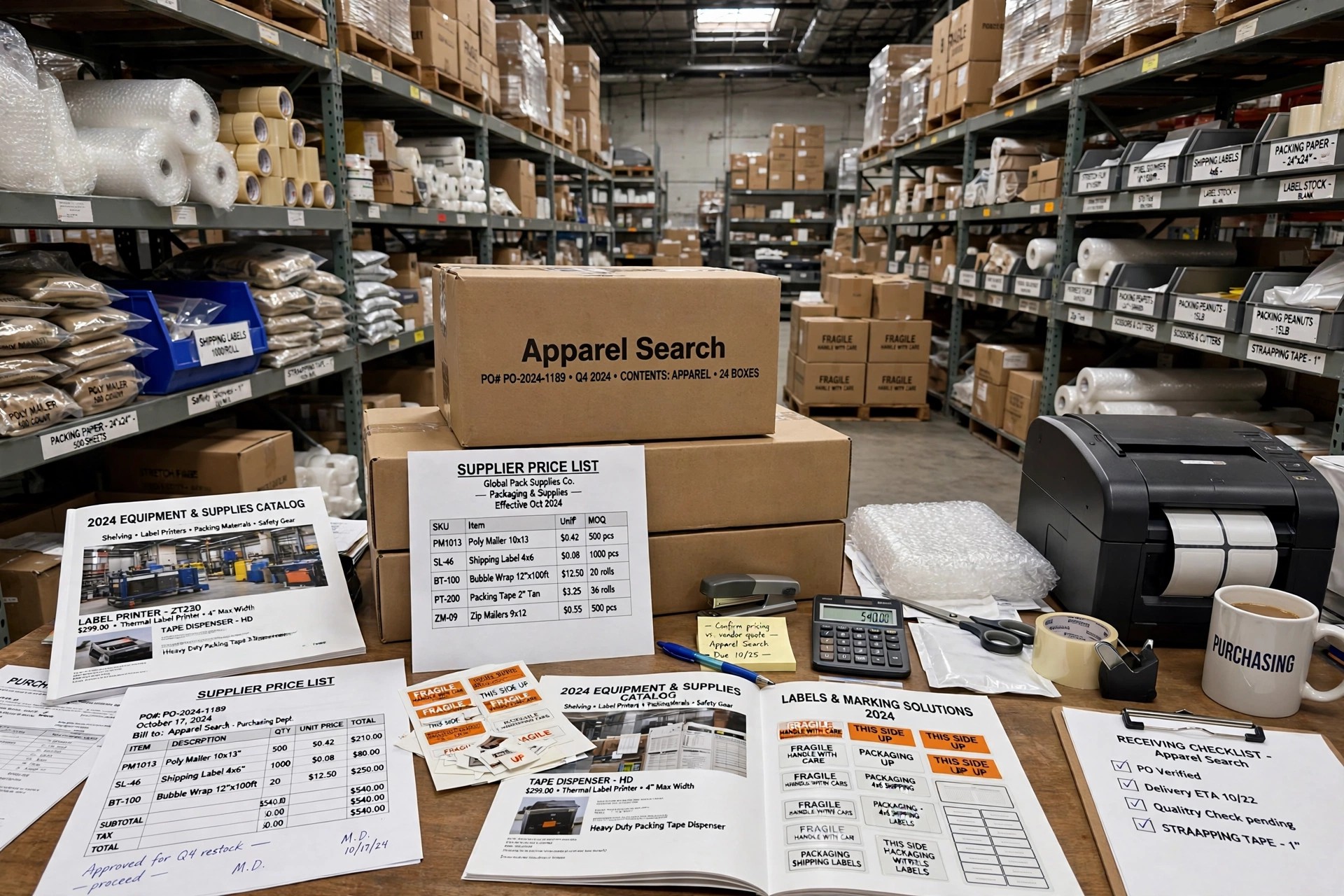
What Warehouse Purchasing Actually Buys
The buying list divides into families. Packaging and presentation materials come first by volume: shipping cartons in the building's working sizes, polybags, tissue, hangers, price tickets, labels and tape — items bought by the hundred thousand, where a fraction of a cent per unit is real money and a specification error is a season of awkward packing. Then come the warehouse's physical needs: pallets, racking components, workbenches, trolleys and the parts and spares that keep forklifts and conveyors running. Finally the consumables and services: cleaning and safety supplies, uniforms and protective equipment, equipment servicing contracts, and the everyday services a large building contracts for.
One boundary defines the specialty: warehouse purchasing does not buy the merchandise. The garments, fabrics and trims a company sells are bought by its fashion buyers and sourcing teams; the warehouse buyer buys the means by which those goods are stored, processed and shipped. The two buying worlds meet constantly — a new garment program changes the packaging it needs — but their suppliers, specifications and measures are entirely different.
From Requisition to Purchase Order
Work arrives as requisitions: a supervisor's request for packing materials, the manager's work order for a replacement part, a department's recurring consumables running low. The purchasing role turns each request into a disciplined order — specification confirmed with the people who will use the item, quantity set against current stock and expected consumption rather than habit, price checked against the agreed supplier or the market, and a purchase order raised so that delivery, invoice and budget all match when the goods arrive. Receiving is verified with the floor: what arrived is what was ordered, in the quantity ordered, usable.
The standing half of the job is stock control for supplies themselves. Packaging and consumables are held at levels that balance two failures: the emergency order at premium prices because a line ran out mid-peak, and the quiet waste of cash and space in overstocked slow movers. Consumption is tracked against despatch volumes, reorder points are set per item, and the peak seasons — when packaging use can triple — are ordered ahead while suppliers still have capacity.
Suppliers, Prices and Reliability
Supplier management is where the role earns its keep. Warehouse supplies are competitive markets, and the buyer compares suppliers on the whole bargain — unit price, quality consistency, delivery reliability, minimum quantities and payment terms — rather than on a headline price that a failed delivery then makes meaningless. Specifications are held firmly: a cheaper carton that collapses in transit, or a label adhesive that fails on garments, is not a saving. Trial orders, sample checks with the departments who use the item, and honest scorekeeping of each supplier's delivery record all belong to this desk.
Negotiation here is continuous and practical: annual agreements for the big packaging families, price reviews when material costs move, consolidated orders that earn volume terms across a company's sites. The buyer also keeps credible alternatives qualified for the items the warehouse cannot run without, so that a supplier failure is a switch, not a stoppage — the same continuity discipline the logistics roles apply to freight, applied to supplies.
Skills, Qualifications and Career Path
Employers look for purchasing or procurement experience, ideally in a warehouse, manufacturing or distribution environment where the items bought are operational rather than glamorous. The core skills are commercial: numeracy and price analysis, negotiation, specification writing clear enough for a supplier to be held to, purchase-order and stock systems fluency, and the persistence to chase deliveries with the same energy the logistics team chases freight. Knowledge of packaging materials and warehouse equipment is learned and then becomes the specialty's value — few buyers know both a carton's board grades and its price per thousand.
Inside this directory the role sits beside the warehouse management manager, whose budget it spends carefully and whose requisitions it challenges and fulfils, and at a deliberate distance from the fashion buying roles in the Buying category, whose product is the merchandise itself. Progression runs to senior buyer and purchasing or procurement management, often widening from one warehouse's supplies to a whole company's operational buying.
Common Questions
What does warehouse purchasing buy?
Everything the warehouse consumes rather than sells: packaging and presentation materials (cartons, polybags, hangers, tickets, labels), pallets, racking and equipment parts, cleaning and safety supplies, and contracted services such as equipment maintenance — not the clothing merchandise itself.
How is warehouse purchasing different from fashion buying?
Object and supplier. A fashion buyer buys the garments the company sells, judging style, range and margin. Warehouse purchasing buys the operational means of storing and shipping those garments, judging specification, unit price, delivery reliability and stock cover.
What skills does a warehouse purchasing role need?
Procurement experience, price analysis and negotiation, clear specification writing, purchase-order and stock-control systems fluency, and working knowledge of packaging materials and warehouse equipment. Reliability in chasing deliveries matters as much as price.
More to Explore
Warehouse Buying Resources
Transportation & Warehouse Directory Pages by Letter
References & Further Reading
More Job Description Categories
- Buying Job Descriptions
- Design Job Descriptions
- Marketing & PR Job Descriptions
- Miscellaneous Job Descriptions
- Planning & Allocation Job Descriptions
- Production & Sourcing Job Descriptions
- Sales & Selling Job Descriptions
- Transportation & Warehouse Job Descriptions (current)