Warehouse Supervisor Job Description
Front-line leadership of the warehouse floor — the shift, its workload, its people and its standards
A warehouse supervisor is the front-line leader of a clothing warehouse: the person who turns the day's orders, deliveries and staffing into a worked shift. Supervisors do not own the building — that is the warehouse manager's job — and they no longer spend the shift primarily picking or packing. Their work is the team itself: who does what, in what order, to what standard, and what happens when the plan meets a late truck, an absent picker or a despatch deadline that will not move.
More Transportation & Warehouse Job Descriptions by Letter:
Leading the Shift on the Floor
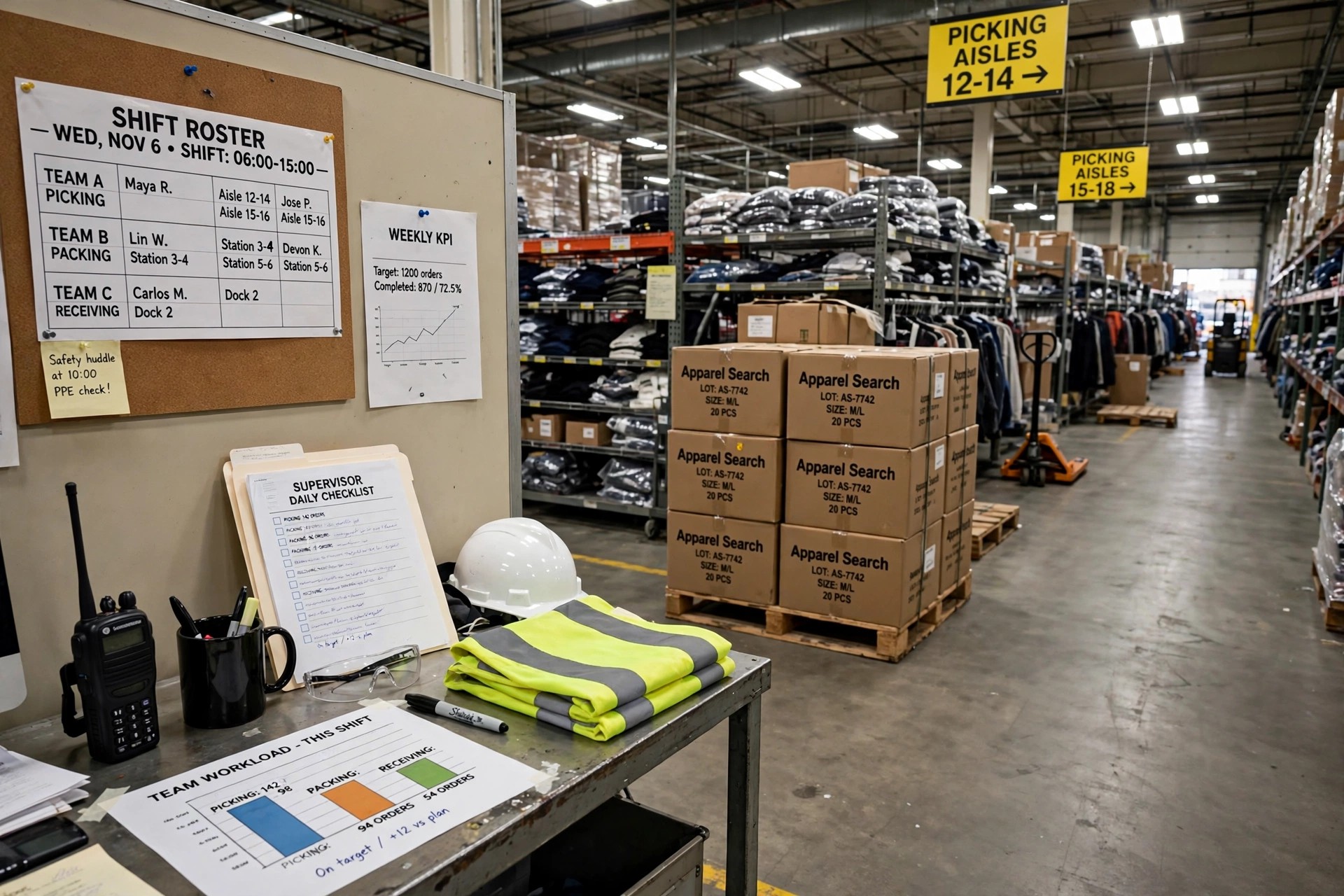
The supervisor's shift starts with the state of the building: which deliveries are due in, which orders must leave, where yesterday's work was left, and who is actually available to do it. Receiving, put-away, picking, garment processing, packing and despatch crews are assigned against those priorities, with experienced workers placed where the day's risk sits — the large store order, the fragile despatch, the intake from a supplier whose cartons always need checking. Through the shift the supervisor walks the floor rather than watching it, moving labor from a finished task to a building queue before the queue becomes a missed cut-off.
Supervision is also the warehouse's first line of problem-solving. A picking shortfall, a damaged intake, a labeling error found at packing — each lands on the supervisor first, to be fixed within the shift, worked around with a revised sequence, or escalated to the manager early with the facts assembled. The quality of that judgement, repeated daily, is most of what a warehouse's reliability actually consists of.
Workload, Peaks and the Daily Hand-Off
Apparel warehousing is violently seasonal, and the supervisor plans the floor's part in it: intake surges when new-season stock lands, despatch peaks before promotions and holidays, returns floods in January. Leave is scheduled fairly around known peaks, temporary workers are requested in time and placed where their simpler tasks free experienced staff, and overtime is organized as a plan rather than discovered as an emergency. Within a peak day, the supervisor sequences work so that revenue-critical despatches never queue behind stock movements that could safely wait.
At the shift's end comes the hand-off: to the next supervisor, and upward to the warehouse manager. What was received, picked and despatched; what is short, damaged or late and why; which equipment or system fault is open. A clean hand-off is a professional signature — buildings lose more stock and time at shift boundaries than almost anywhere else, and the supervisor owns that boundary.
Training, Safety and Standards
New warehouse workers learn the job to the supervisor's standard: scanning discipline, location accuracy, garment-handling care in ticketing, hanging and folding, and the packing quality a store will judge the warehouse by. The supervisor samples work, corrects specifically and kindly, and signs workers off task by task, because a worker passed as trained who was not is an error stored for a busier day. Experienced staff are coached on output and accuracy measures, and recurring faults are treated as information — a badly laid-out picking face produces errors no warning will fix, and redesigning it is supervisory work.
Safety leadership sits here in practice, whatever the policy document says. Equipment checks, aisle discipline, safe lifting, racking damage reporting and the authority to stop an unsafe practice all live or die at supervisor level. In a building with powered trucks and high racking, the supervisor's visible insistence on the rules — especially under despatch pressure — is the safety culture the workforce actually experiences.
Skills, Qualifications and Career Path — the Team's Leader, Not the Building's Owner
Supervisors are promoted from the floor they will lead: solid service as a warehouse worker or assistant, a record for accuracy and reliability through at least one peak season, and the human equipment to assign work fairly, correct without humiliating and stay calm when the day's plan collapses. Knowledge demands are practical and complete — every department's tasks, the warehouse system, the safety rules — because the team's questions stop at this desk first. Formal supervisory or warehousing training strengthens an application, but the promotion evidence is the trust of the workers and the manager alike.
The ladder around this role is clear. Below it, the warehouse worker and the warehouse assistant do the building's production and support work. Above it, the warehouse management manager owns the whole building — its budget, layout, security and results — where the supervisor owns a shift and a team within it. A parallel neighbour is the logistics supervisor under L, who leads the logistics office team rather than the warehouse floor. The step from supervisor to manager is the step from leading people through a shift to owning the operation's numbers.
Common Questions
What does a warehouse supervisor do?
Leads the warehouse team shift by shift: assigning receiving, picking, processing, packing and despatch work, setting priorities, planning cover for peaks, training and checking workers, enforcing safety and quality standards, and handing over cleanly to the next shift and the warehouse manager.
How is a warehouse supervisor different from a warehouse manager?
The supervisor owns a shift and a team — workload, priorities, standards and problems as they arise. The warehouse management manager owns the whole building — budget, layout, security, inventory control and results — and the supervisors report to the manager.
How do you become a warehouse supervisor?
Usually by promotion from warehouse worker or assistant roles, with a record for accuracy, reliability through a peak season, complete practical knowledge of the building's tasks and systems, and the fairness and calm that leading a shift requires.
More to Explore
Warehouse Leadership Resources
Transportation & Warehouse Directory Pages by Letter
References & Further Reading
More Job Description Categories
- Buying Job Descriptions
- Design Job Descriptions
- Marketing & PR Job Descriptions
- Miscellaneous Job Descriptions
- Planning & Allocation Job Descriptions
- Production & Sourcing Job Descriptions
- Sales & Selling Job Descriptions
- Transportation & Warehouse Job Descriptions (current)