Fashion Museums of the World · Getaria
Cristóbal Balenciaga Museoa
On a hill above the fishing port of Getaria, beside the palace of the family who first believed in him, stands the first large museum ever devoted to a single couturier. The Cristóbal Balenciaga Museoa holds the work of the designer Dior called the master of us all — in the town where he was born, learned to sew, and is buried.
Museum Label
- Institution
- Cristóbal Balenciaga Museoa — run by the Cristóbal Balenciaga Foundation
- Home
- Aldamar Palace and its modern annex, Aldamar Parkea 6, Getaria, Spain
- Founded
- Opened 7 June 2011, inaugurated by Queen Sofía
- Collection
- Garments, accessories, documents and personal objects spanning Balenciaga's whole career, from a suit of 1912 to his final Paris years
- Director
- Miren Vives
- Known for
- Being the first large museum devoted exclusively to a single couturier, in his birthplace
The Institution
One Couturier, One Museum, One Small Town
Most fashion museums are encyclopaedias; the Cristóbal Balenciaga Museoa is a biography. Opened on 7 June 2011 in Getaria, the small Basque fishing town where Cristóbal Balenciaga was born, it was the first large museum devoted exclusively to a single couturier — an entire institution built around one man's work, in the place where that work began. It is run by the Cristóbal Balenciaga Foundation, a public foundation whose mission is to promote, develop and publicise the figure and work of Balenciaga, and it treats its subject with the seriousness of a national archive: this is not a brand showcase but a research museum that happens to hold the most personal collection of a great designer's work anywhere.
The collection spans the whole arc of a career, from a tailored suit of 1912 — made when its maker was seventeen — through the Spanish ateliers and the Paris decades to the sculptural couture of the 1960s. Alongside the garments sit the accessories that completed his silhouettes, the headdresses he was famous for, and a second, quieter collection: documentation and personal objects, photographs and letters, and the working papers of his houses — invoices, patterns and tools of the trade from the Eisa and Balenciaga ateliers. A museum that keeps the paperwork as carefully as the dresses is telling you something about its subject: Balenciaga's genius was in the making, and the making leaves records.
Much of the holding arrived as gifts from the people who wore the clothes. The American collector Rachel "Bunny" Mellon, one of his most devoted clients, was among the most generous donors; his pupil Hubert de Givenchy gave pieces and lent the project his authority as the Foundation's honorary president; and among the most famous single garments is the wedding dress Balenciaga made for Fabiola de Mora y Aragón on her marriage to King Baudouin of Belgium in 1960. Because historic textiles cannot bear permanent light, only part of the collection is on view at any one time — around a hundred pieces in the collection exhibition, displayed on specially made invisible mounts and rotated for conservation, so the museum you visit is never quite the whole museum.
The institution works outward as well as inward. Its research team documents the collection piece by piece, and its project The Hands that Sew, begun in 2014, records the testimony of the people who worked in Balenciaga's ateliers — the seamstresses and tailors whose hands knew techniques that died with the house in 1968 — before that knowledge is lost. By its tenth anniversary the museum had organised a continuing programme of exhibitions and congresses and made more than 400 loans to institutions including the Victoria and Albert Museum and the Metropolitan Museum of Art: the small town lends to the capitals, because for Balenciaga, Getaria is where the originals live.
History in Brief
From a Fisherman's Son to the Master of Us All
Cristóbal Balenciaga Eizaguirre was born in Getaria on 21 January 1895, the son of a fisherman and of Martina Eizaguirre, a seamstress who worked for the Marquises of Casa Torres — the family of the Aldamar Palace, beside which his museum now stands. The Marchioness became one of his earliest patrons, recognising the boy's gift as he studied her Paris clothes, and supported his formal training as a tailor in Madrid. It is one of fashion's great symmetries: the palace where the seamstress's son first saw couture is now part of the museum that bears his name.
By the late 1910s Balenciaga had his own business in San Sebastián, the elegant resort city where the Spanish court summered, and he expanded to Madrid and Barcelona, dressing Spanish royalty and aristocracy through the 1920s and early 1930s. He arrived in Paris, when the Spanish Civil War drove him there in 1937, not as a hopeful but as a master with two decades of experience — and Paris recognised it. He opened his couture house on Avenue George V in August 1937, and within a few seasons the most demanding clients in fashion were beating a path to the Spaniard who cut like a tailor, draped like a sculptor and answered to no trend. You can follow the house he founded in our Balenciaga company profile.
His peers' verdict is the famous one: Christian Dior called him "the master of us all". Balenciaga guarded that mastery fiercely — he showed his collections a month after the rest of Paris, admitted the press on his own terms, and built his clothes with an architect's disregard for anything but the line he intended. In 1968, at seventy-three, judging that ready-to-wear had ended the world couture was made for, he closed his house entirely and retired to Spain. He died on 24 March 1972 in Valencia, and he is buried where the story started, in Getaria's cemetery.
The museum took longer to build than the career it honours. The Cristóbal Balenciaga Foundation was constituted in 1999 to create it; construction beside the Aldamar Palace began in 2000, stalled amid delays and disputes, and resumed in 2008. On 7 June 2011 the finished museum was inaugurated by Queen Sofía of Spain, with Hubert de Givenchy — Balenciaga's most famous pupil, and the Foundation's honorary president — in attendance, and it opened to the public that June: the first large museum in the world given over to one couturier alone, in a fishing town of a few thousand people.
Technique, Material, Form
What Made His Name: The Architect of the Silhouette
Balenciaga was a tailor before he was anything else, and everything distinctive in his work follows from that. Where other couturiers sketched and delegated, Balenciaga could cut, fit and sew a garment himself, and his clothes are constructed the way buildings are: the architecture is inside. Collars stand away from the neck to frame jewellery; sleeves are cut to free the arm; a sleeve's set, a shoulder's exact slope, the placing of a single seam — these were his vocabulary. The museum's current long-running collection exhibition takes its title from exactly this triad — Cristóbal Balenciaga: Technique, Material and Form — and walks visitors through the work as its maker understood it: a biographical opening, then room after room of couture read through how it was made.
His great subject, from the 1940s on, was the silhouette itself — the outline a body makes in clothes — and his method was subtraction. In 1947, the very year Dior's New Look cinched Paris back into corseted hourglasses, Balenciaga moved the opposite way, launching a decade-long experiment in freeing the body from the waist:
| Silhouette | Year | What it changed |
|---|---|---|
| The barrel line | 1947 | Coats and suits with an arched, rounded back that stood away from the body — volume behind, calm in front, the waist already dissolving. |
| The semi-fitted suit | 1951 | Fitted in front, loose and curved at the back: two silhouettes in one garment, and a new ease inside formal tailoring. |
| The tunic | 1955 | Straight, pure lines in two pieces that enveloped the body without pressing on it — the waist abolished in day dress. |
| The sack dress | 1957 | A loose chemise with no waist at all. Clients were baffled; the 1960s were announced. The most prophetic dress of the decade. |
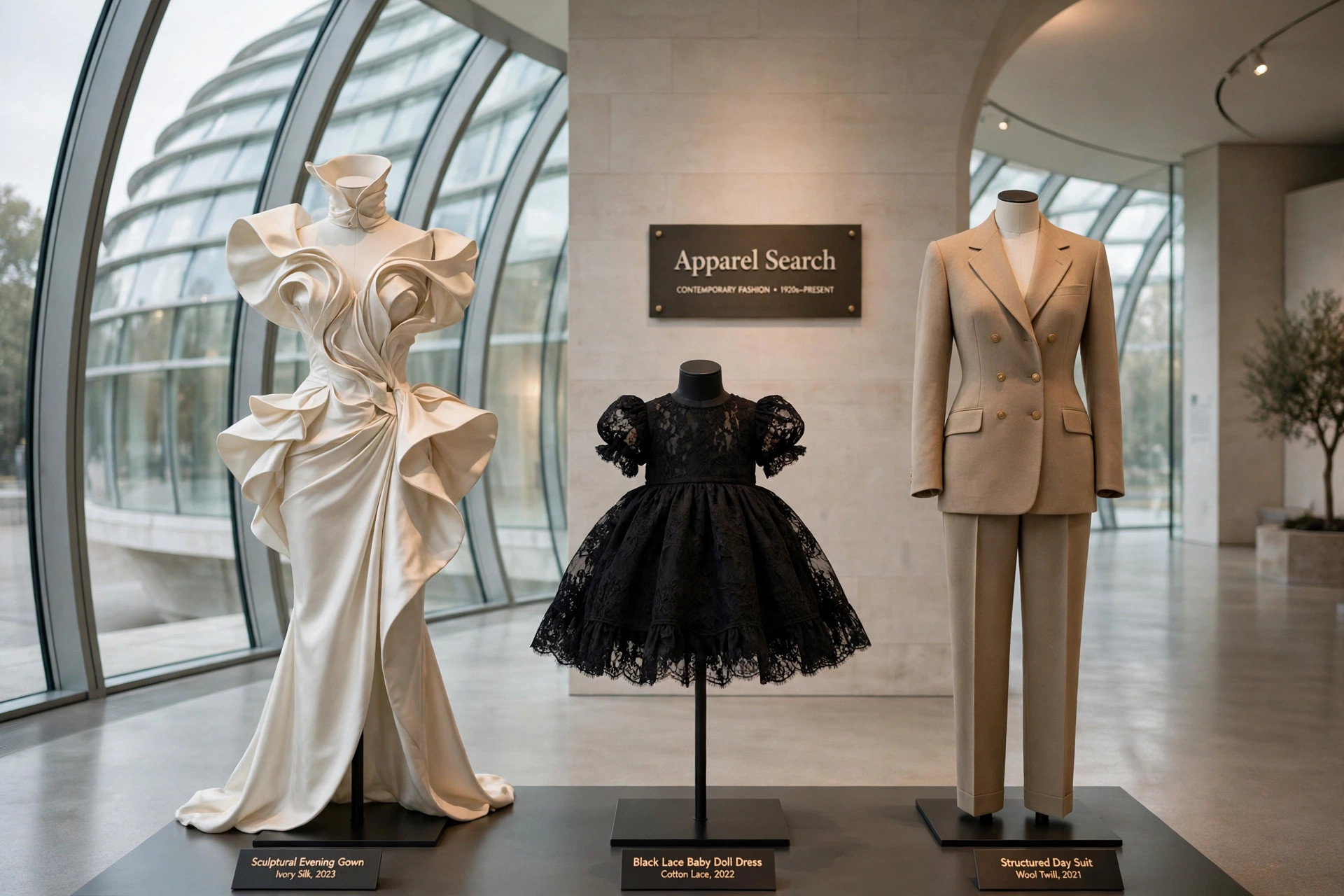
| The baby doll dress | 1958 | A high-waisted trapezoid of lace over a fitted under-dress — abstraction with a smile, and the silhouette of the coming youth decade. |
Spain runs through all of it. Diana Vreeland's famous summary of his sources — the bullring, the flamenco dancer, the fishermen's loose blouses, the glories of the church — points at a designer who never stopped quoting his own country: the black of Goya and of Spanish mourning, the volume of a dancer's skirt, the austerity of a cloister, translated into Parisian cloth. He worked in fabrics developed with his mills for exactly the weight and body a design required — stiff silk gazar exists in couture because Balenciaga needed a cloth that would hold air like his drawings did.
The museum keeps that legacy in motion with temporary exhibitions alongside the collection display — at the time this guide was prepared, three exhibitions were running at once, among them The Givenchiaga Family, on the creative kinship between Balenciaga and Givenchy, and a photography exhibition on Georges Dambier's Paris of the 1950s. Earlier shows have paired him with Azzedine Alaïa and, in 2025, put Cristóbal's own work in dialogue with the modern house's in The Subtleties of a Dialogue. The argument of all of them is the museum's founding one: this is not nostalgia, it is a living technique that contemporary fashion still studies.
Dior called him the master of us all; the museum in his birthplace exists to show you, seam by seam, why his peers were right.
The Home
A Palace, a Glass Annex and a Hill Above the Sea
The museum stands on a hill above Getaria, in Aldamar Park, and it is really two buildings in conversation. The first is the Aldamar Palace, the 19th-century summer residence of the Marquises of Casa Torres — the family whose marchioness backed the young Balenciaga, and in whose service his mother sewed. Exhibitions and the life of the Foundation occupy a building that is itself the first object in the collection: the place where the couturier's eye was formed.
Beside it rises the new museum building, a large contemporary annex of curved glass and dark volumes. Its volumetric concept was the work of Julián Argilagos; the studio AV62arquitectos then gave the building its final form and designed its interiors and museography — some 5,988 square metres in all, by the studio's account. The design thinks like its subject: an outer glass skin wraps inner volumes the way a Balenciaga garment wraps a body, with space held between the two, and the exhibition halls are arranged as a sequence of distinct rooms — beginnings, day, cocktail, night, brides — so that a visit reads as a couture collection once did, look by look.
The setting does the rest. Getaria is a working fishing port on the Gipuzkoa coast, some 25 kilometres west of San Sebastián, with a medieval old town, a harbour of serious restaurants and the green hill of San Antón offshore. Balenciaga's museum is not in a fashion capital, and that is its meaning: fashion's most revered technician came from fishermen and seamstresses, and his museum asks you to make the small journey he made in reverse — out of the capitals, back to the source.
Visiting
Visiting as a Fashion Pilgrim
The Cristóbal Balenciaga Museoa is at Aldamar Parkea 6 in Getaria, an easy excursion from San Sebastián — under an hour by road or by the coastal bus — and it pairs naturally with a day in the town: the museum on its hill in the morning, the harbour and the old town after. Allow the visit its proper pace. The collection exhibition rewards slow looking: these are garments whose genius is in the cut, and the museum displays them on near-invisible mounts, lit and spaced so you can walk around a silhouette and read it from every side, the way its maker intended it to be seen.
What a fashion visitor should not miss: the early room, where the teenage tailor's work begins the story in his own town; the great sequence of 1950s silhouettes — barrel, tunic, sack, baby doll — where you can watch the waist disappear across a single decade; the bridal pieces, including, when it is on view, the dress made for Queen Fabiola; and whichever temporary exhibitions are running alongside, since the museum programmes several at once and they are where its research meets the present. Students and makers should note the museum's other life: congresses, workshops and study activity run through the year, and its documentation — patterns, atelier papers, the recorded voices of The Hands that Sew — makes it a place to work as well as to look.
Getaria itself is part of the exhibit: the church and cemetery where Balenciaga is buried, the port his father fished from, the streets his mother sewed in. No other museum in this series sits so completely inside its subject's biography. Check the museum's own website for what is on, opening hours and tickets before you go, since exhibitions rotate and the programme changes.
Exhibitions change and galleries are rehung, so the details here describe the Cristóbal Balenciaga Museoa as documented for this guide — the museum's own site always carries the latest version.
Common Questions
Common Questions
Why is the Balenciaga museum in Getaria?
Because Getaria is where Cristóbal Balenciaga was born, on 21 January 1895, and where he first learned to sew. His mother Martina was a seamstress, and the Marchioness of Casa Torres — one of his earliest patrons — lived in the Aldamar Palace, beside which the museum now stands. He is buried in Getaria's cemetery.
What is special about the Cristóbal Balenciaga Museoa?
It was the first large museum devoted exclusively to a single couturier. Opened on 7 June 2011 and run by the Cristóbal Balenciaga Foundation, it holds garments, accessories, documents and personal objects from across Balenciaga's whole career, and studies his work through exhibitions, research and loans to museums worldwide.
Who was Cristóbal Balenciaga?
A Spanish couturier (1895–1972) regarded by his peers as the master of haute couture — Christian Dior called him the master of us all. Trained as a tailor in Spain, he opened his Paris house in 1937 and reshaped the silhouette with the barrel line, the sack dress and the baby doll dress before closing his house and retiring in 1968.
How many pieces does the museum hold?
Published counts differ between sources, so this guide does not print a single figure. What is consistent is the shape of the collection: garments and accessories from Balenciaga's Spanish beginnings to his last Paris years, major donations from clients such as Rachel "Bunny" Mellon, and famous individual pieces such as the wedding dress made for Queen Fabiola of Belgium in 1960 — with only part of the holdings on view at any one time, rotated for conservation.
What should a fashion lover not miss at the Balenciaga Museoa?
The collection exhibition — a walk through Balenciaga's technique, materials and forms, from his beginnings in 1912 to the sculptural couture of the 1960s — and whichever temporary exhibitions are running alongside it; the museum usually shows several at once. Check the museum's own website for what is on, opening hours and tickets before you go.
In This Series
Every guide in Fashion Museums of the World, from the section hub.
Museums & Exhibitions on Apparel Search
The site's existing museum coverage, including the term guide this series grows from.
Related on Apparel Search
The designer's house, the designer, and the industry around the museum.
Search Apparel Search