Fashion Museums of the World · Paris
Palais Galliera
Paris has two great fashion museums, and this is the one that belongs to the city itself: the Musée de la Mode de la Ville de Paris, housed in a Renaissance-style palace built for a Genoese duchess, holding almost 200,000 works of dress — and famous for doing fashion the hard way, in temporary exhibitions that empty and refill the palace season after season.
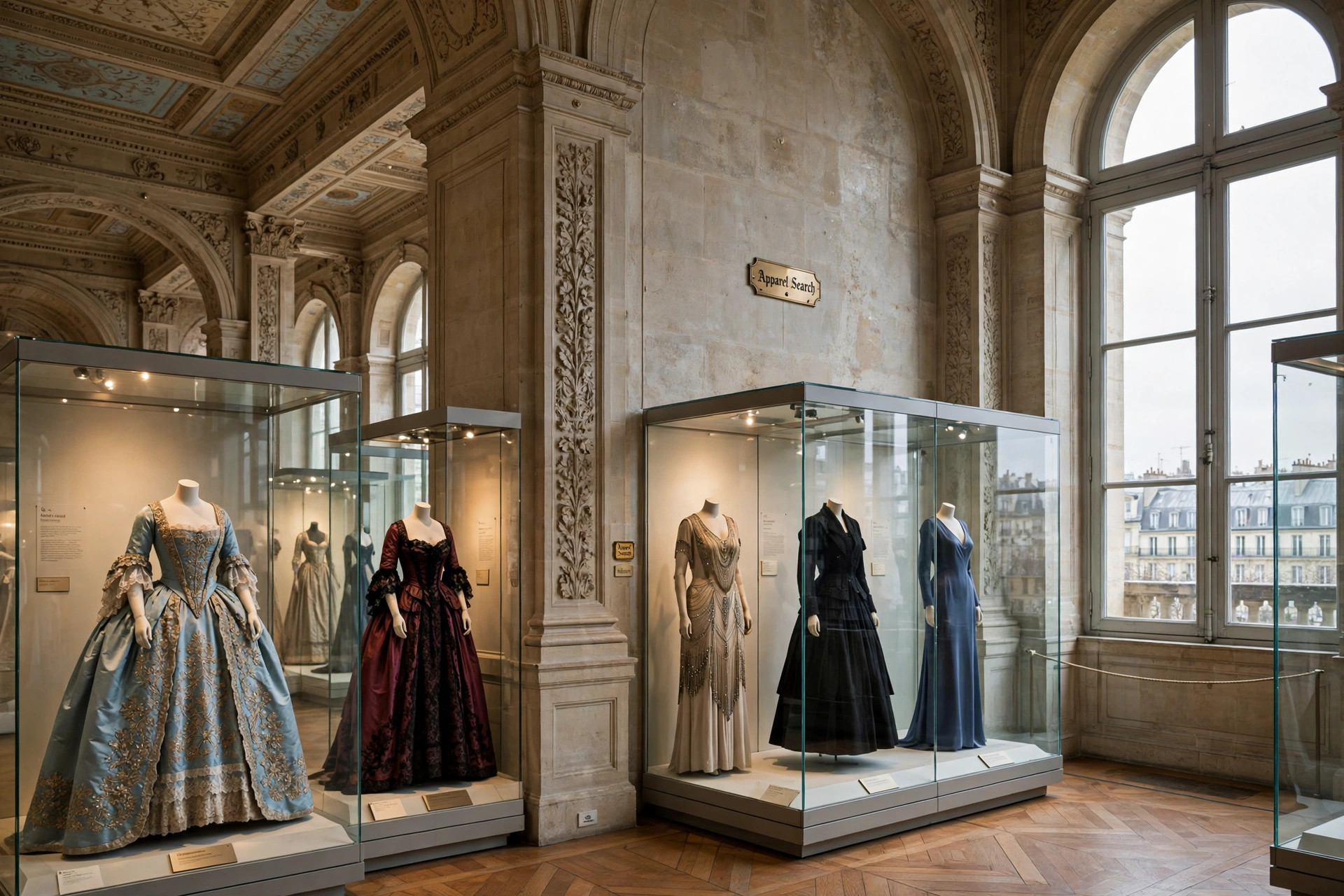
Museum Label
- Institution
- Palais Galliera — Musée de la Mode de la Ville de Paris, the City of Paris fashion museum (part of Paris Musées)
- Home
- 10 avenue Pierre Ier de Serbie, 75116 Paris
- Founded
- Fashion museum inaugurated in the palace in 1977; the palace itself was completed in 1894
- Collection
- Almost 200,000 works, plus 116,000 archive documents (the museum's figures)
- Director
- Émilie Hammen, director since 2025
- Known for
- Two major temporary exhibitions a year, and the Gabrielle Chanel galleries' rotating display of the collection
The Institution
The City of Paris Keeps Its Clothes Here
Every museum in this series answers to somebody — a university, a foundation, a brand. The Palais Galliera answers to Paris. It is the fashion museum of the City of Paris, one of the municipal museums grouped since 2013 under Paris Musées, and its job is the municipal one: to collect, conserve and show the dress of the city that invented haute couture. Its formal name says exactly that — Musée de la Mode de la Ville de Paris, the Paris Museum of Fashion — and the palace it lives in has given it the shorter name the world uses, Palais Galliera.
The collection the city keeps here is, by the museum's own count, almost 200,000 works, backed by 116,000 archive documents. The works run from the 18th century to the present day: court dress and crinolines, the wardrobes of named Parisians, and the output of the houses that made Paris fashion's capital — Balenciaga, Pierre Balmain, Christian Dior, Jacques Fath, Mariano Fortuny, Jean Paul Gaultier, Givenchy, Paul Poiret, Paco Rabanne, Yves Saint Laurent and Elsa Schiaparelli among them, alongside older treasures the museum lists with pride, from clothes associated with Marie-Antoinette and the Empress Josephine to the dress Audrey Hepburn wore at Longchamp in 1966. Around the garments sits everything that explains them: undergarments — the slips, corsets and crinolines that built the silhouettes — accessories from hats and fans to gloves once owned by Sarah Bernhardt, and the graphic arts and photography holdings, drawings, prints and advertisements, that show how each era pictured its own clothes.
The museum is organised the way its collection demands. Curatorial departments follow the centuries and the crafts — 18th-century fashion, 19th-century fashion, contemporary creation (a department created in 1987, so the collecting never stops at history), accessories, and graphic arts — and behind them stands the conservation operation every fashion museum lives or dies by: restoration workshops and, since 1994, dedicated off-site reserves of some 4,800 square metres where the works rest in the dark between their moments on stage. A garment at the Galliera may spend twenty years asleep for every month it is seen. That ratio is not a failure of display; it is the price of the collection surviving at all.
What the visitor meets, then, is never the collection in general. It is an argument made from it: one designer's world, one century's question, one technique — built by the curators, dressed on made-to-measure forms, and taken down again when its run ends. Paris, which changes its clothes faster than any city on earth, has given itself a fashion museum that works the same way.
History in Brief
A Duchess's Palace, a Collector's Wardrobe, a City's Museum
The palace and the collection arrived by separate roads and met only in 1977. The palace came first. Maria Brignole Sale De Ferrari, Duchess of Galliera — heir to a Genoese banking fortune, widowed in 1876 — decided to build Paris a museum palace for the art collection she and her husband had formed. The architect Léon Ginain, a Prix de Rome winner, designed her a palace in the Italian Renaissance manner, modelled on the palaces of her native Genoa: cut stone over a steel frame built by the Eiffel company, mosaic floors and domes by Giandomenico Facchina, and statues of Painting, Architecture and Sculpture on the avenue front. Construction ran from 1879 to 1894 — but the gift unravelled as it rose. A notary's error made the deed a gift to the City of Paris rather than to France, and when the Republic's 1886 law expelled the heirs of France's former royal houses, the Duchess — herself of Orléans descent — withdrew the rest of her bequest in protest. Her paintings went to Genoa. Paris kept the empty palace.
The city used it, for eighty years, for whatever needed a grand room: the first exhibition, devoted to portraits of women and lace, was opened by President Félix Faure in 1895; industrial arts followed in 1902, then modern art shows and prestigious auction sales. Meanwhile the fashion collection was being born elsewhere. In 1907 the painter and collector Maurice Leloir founded the Société de l'Histoire du Costume, the Society of the History of Costume, and began assembling the historic garments nobody else thought to preserve. The Society donated its collection to the City of Paris in 1920; it lived at the Musée Carnavalet, acquired a dedicated costume museum annexed first to Carnavalet and then, from 1956, to the city's Museum of Modern Art, and grew through the century as Paris's memory of its own dress.
In 1977, under chief curator Madeleine Delpierre, the collection finally came home to the palace: the Musée de la Mode et du Costume de la Ville de Paris was inaugurated at the Palais Galliera, with its stores and restoration workshops in the basements. The name has been tuned twice since — shortened in 1997 to Musée de la Mode de la Ville de Paris, and re-presented in 2010, under director Olivier Saillard, as the Palais Galliera, with the palace itself restored to its former glory. Saillard's eight years made the museum a byword for poetic, scholarly exhibitions; Miren Arzalluz, who succeeded him in 2018, turned it toward the questions of modern society, and the fashion historian Émilie Hammen has directed the museum since 2025.
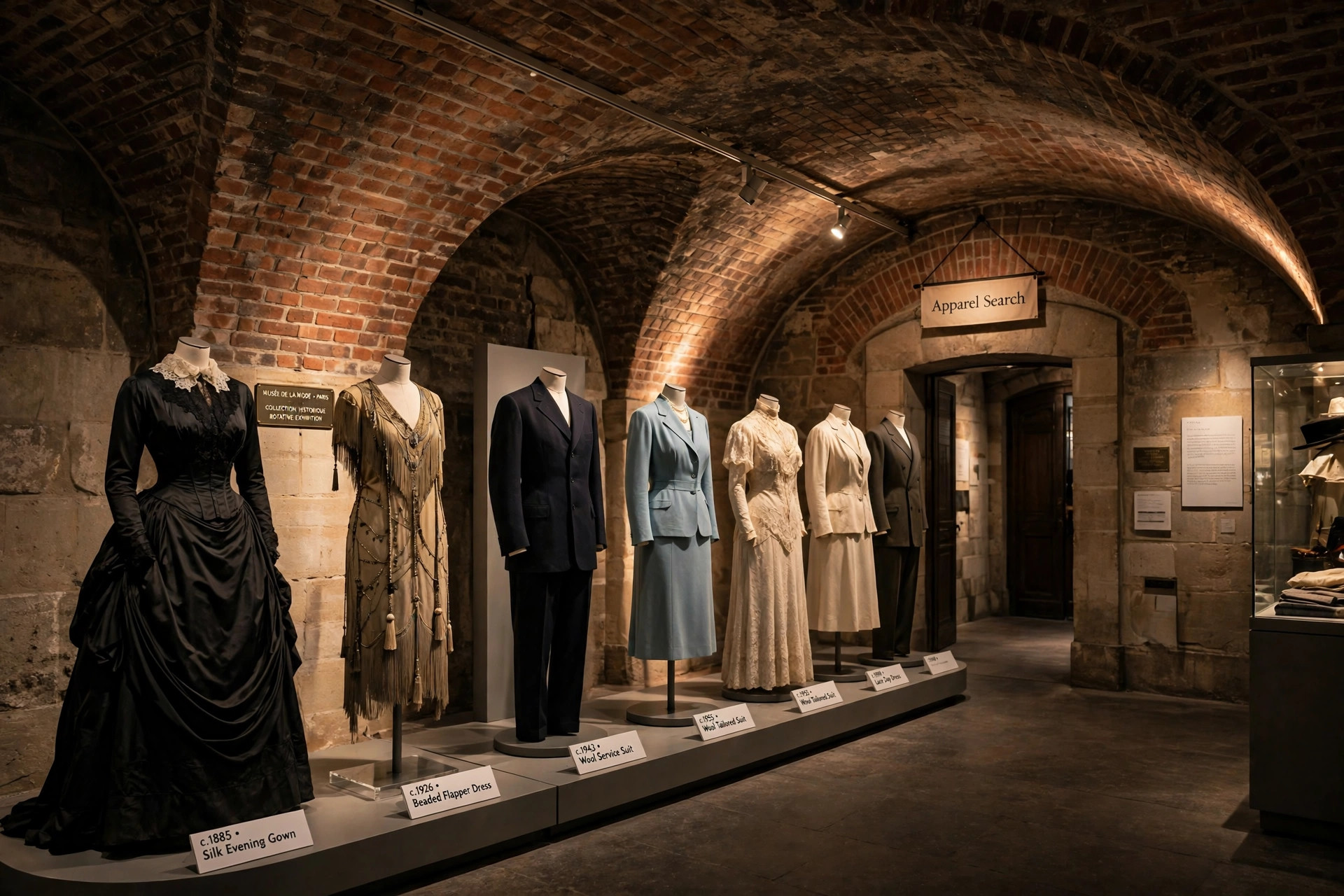
One date in that span changed what kind of museum this is. After two years of major works, the Galliera reopened in October 2020 with its exhibition space doubled: beneath the garden, in the palace's vaulted brick cellars, the Gabrielle Chanel galleries — some 670 square metres, created with the support of the house of Chanel — gave the museum room for something it had never had, a continuing display of its own collection, shown in rotation. The reopening exhibition was the one the new space deserved: Gabrielle Chanel. Fashion Manifesto, the first Paris retrospective of Chanel's work, with more than 350 pieces. The palace built for one woman's collection had become, a century and a quarter later, the home of a far larger one.
The Exhibition Museum
Two Great Shows a Year — and Now, a Collection on View
For most of its life the Galliera has had no permanent display at all, and it said so plainly: for conservation reasons, the collections were shown only in temporary exhibitions — two major exhibitions a year, in the museum's own summary — and the palace closed between shows while one world was dismantled and the next built. That rhythm made each Galliera exhibition an event in the Paris calendar and taught a generation of visitors to plan around it: you did not drop in on the Galliera; you attended it.
The Chanel galleries softened that rule without breaking it. Since 2021 the lower galleries have carried a rotating presentation of the collection itself — a history of fashion told masterpiece by masterpiece, from the 18th-century robe volante to Comme des Garçons, refreshed in sections as fragile pieces are rested and replaced. The main galleries upstairs keep the old rhythm of the great temporary exhibition. The honest summary for a visitor today is therefore double: there is now usually collection on view below, and there is always a headline exhibition above — but both change, both can pause, and the museum's own site is the only reliable statement of what is on this month.
The landmark exhibitions show the range the model allows — monographs that reintroduced designers to their own city, and theme shows that used dress to argue about society:
| Exhibition | Year | Why it mattered |
|---|---|---|
| Alaïa | 2013–14 | The reopening retrospective for Azzedine Alaïa, Olivier Saillard's sculptural staging of the couturier-collector's work. |
| Jeanne Lanvin | 2015 | The first major Paris retrospective of the oldest French house still in activity, made with Alber Elbaz. |
| Margiela / Galliera, 1989–2009 | 2018 | The first retrospective in France of Martin Margiela's years at his own house — the museum examining fashion's great anonym. |
| Gabrielle Chanel. Fashion Manifesto | 2020–21 | The reopening show in the doubled museum: Paris's first Chanel retrospective, and the debut of the galleries that bear her name. |
| Frida Kahlo, Beyond Appearances | 2022–23 | The artist's wardrobe and prosthetics as self-portraiture — the theme-show Galliera at its most searching. |
| Fashion on the Move | 2023–25 | Three chapters on dress, sport and the moving body, timed to Paris's Olympic moment. |
| Rick Owens, Temple of Love | 2025–26 | A living designer's retrospective that spilled onto the palace façade itself. |
| A Wardrobe of One's Own | 2026–27 | The current headline show, to February 2027: how 19th-century women took up trousers, suits and riding dress — with the painter Rosa Bonheur's own wardrobe shown complete for the first time. |
Read as a list, it is a programme. Read as a method, it is the Galliera's real collection policy made visible: the museum buys and borrows for arguments, not for shelves, and its exhibitions — catalogued, toured and argued over internationally — are how a municipal collection speaks to the world.
The Home
A Genoese Palace on the Chaillot Hill
The building deserves its own paragraph in any visit, because the Galliera is that rare fashion museum whose container argues with its contents in the best way: 19th-century palace architecture, built to impress, now filled with the clothes that architecture's century wore. The palace stands at 10 avenue Pierre Ier de Serbie in the 16th arrondissement, facing its square and garden, a short walk from the Palais de Tokyo and the Trocadéro. Ginain's design is Italian Renaissance in cut stone — a Genoese palazzo transplanted to Paris — and its details repay a slow look: the steel skeleton by the Eiffel company hidden inside the masonry, Facchina's mosaics underfoot, the three façade statues personifying Painting, Architecture and Sculpture, and the garden that wraps the building, one of the quietest green rooms in the district.
Inside, the museum now works on two levels with two tempers. Upstairs, the palace's grand rooms — refurbished under Saillard to recover their original splendour — host the temporary exhibitions, their gilded proportions a deliberate counterpoint to a Margiela deconstruction or a Kahlo wardrobe. Below, the red-brick vaults of the Chanel galleries, excavated and converted in the 2018–20 works, give the collection display an intimate, crypt-like calm that suits fragile textiles and low light. A bookshop-boutique, a seasonal café in the courtyard and garden, and education spaces complete a museum that has learned, across fifty years, to be both palace and laboratory.
A palace built for paintings it never received became, a century later, the palace Paris chose for the art it actually invented: fashion.
Visiting
Visiting as a Fashion Pilgrim
Plan a Galliera visit around the programme, not the calendar. The museum's year is built from its exhibitions — typically two major temporary shows in the main galleries, with the collection display rotating in the Gabrielle Chanel galleries below — and there can still be pauses between installations, so check the museum's own website for what is on, and for opening arrangements and tickets, before you go; all three change with the programme. As documented for this guide, the headline exhibition A Wardrobe of One's Own: Dissident Femininities in the 19th Century runs to February 2027, joined from December 2026 by En volume!, a show about the techniques — tailoring, draping, knit — that give a garment its shape.
What a fashion visitor should not miss: the headline exhibition, whatever chapter of it fills the palace rooms; the Chanel galleries' rotating history of fashion, which is the closest thing in France to a permanent fashion display and the best single-room survey of the collection's strengths; and the palace itself, from the mosaic floors to the garden, which Parisians treat as part of the exhibition. Give the pair of Paris fashion museums their due by pairing this visit with the city's other great fashion address across the river — the Musée des Arts Décoratifs in the Louvre's Rivoli wing, the next Paris guide in this series — whose temporary-exhibition model the Galliera shares and whose collections complement, rather than duplicate, these.
Exhibitions change and galleries are rehung, so the details here describe the Palais Galliera as documented for this guide — the museum's own site always carries the latest version.
Common Questions
Common Questions
Is the Palais Galliera the same as the Paris fashion museum?
Yes. Palais Galliera is the name of the palace and the name the museum is known by; its formal title is the Musée de la Mode de la Ville de Paris, the City of Paris fashion museum. It is one of the City of Paris museums grouped under Paris Musées, and it has been the home of the municipal fashion collection since 1977.
Can you see the Galliera collection at any time, or only in exhibitions?
Historically, only in exhibitions: for conservation reasons the museum showed its collections in two major temporary exhibitions a year and closed between shows. That changed in part in 2020, when the Gabrielle Chanel galleries opened in the palace vaults with a rotating display of the collection itself. The main galleries still work by temporary exhibition, so check the museum site for what is on before you visit.
How large is the Palais Galliera collection?
The museum puts its holdings at almost 200,000 works, with a further 116,000 archive documents behind them. The works span fashion from the 18th century to the present day: garments, undergarments, accessories, and the drawings and photographs that document them.
Who was the Duchess of Galliera, and why is her palace in Paris?
Maria Brignole Sale De Ferrari, Duchess of Galliera, was a Genoese heiress who paid for a Renaissance-style museum palace in Paris to house the art collection she and her husband had formed. A dispute over the gift and the politics of the 1880s sent her paintings to Genoa instead; the empty palace passed to the City of Paris, which used it for exhibitions for eighty years before making it the city fashion museum in 1977.
What should a fashion lover not miss at the Palais Galliera?
The headline temporary exhibition in the palace rooms, and the Gabrielle Chanel galleries below the garden, where the museum shows its own collection in rotation — the nearest thing France has to a permanent fashion display. Leave time for the palace and its garden as well. Check the museum site for the current exhibitions before you go, since the programme is the visit.
In This Series
Every guide in Fashion Museums of the World, from the section hub.
Museums & Exhibitions on Apparel Search
The site's existing museum coverage, including the term guide this series grows from.
Related on Apparel Search
The country whose capital this is, the house whose name is on its newest galleries, and where to shop the city afterwards.
Search Apparel Search