Fashion Museums of the World · Antwerp
MoMu — Antwerp Fashion Museum
In a former department store on Antwerp's Nationalestraat, a museum, a fashion school and an archive share one wooden staircase. MoMu holds the largest collection of contemporary Belgian fashion in the world — more than 38,000 pieces — in the very building where the Antwerp Six's successors are still being trained. This is the museum of the city that taught fashion to think in Dutch.
Museum Label
- Institution
- MoMu (ModeMuseum) — the fashion museum of the City of Antwerp
- Home
- ModeNatie, Nationalestraat 28, Antwerp
- Founded
- 21 September 2002, in the ModeNatie building
- Collection
- More than 38,000 pieces — the largest collection of contemporary Belgian fashion in the world (the museum's figure)
- Director
- Kaat Debo, director and chief curator
- Known for
- Belgian designer fashion, the Antwerp Six, and immersive exhibitions beside the Royal Academy's Fashion Department
The Institution
The Museum Belgian Fashion Built for Itself
MoMu — short for ModeMuseum — is the fashion museum of the City of Antwerp, and its brief is unusually focused for a museum of its size: it collects, conserves, studies and exhibits Belgian fashion. That focus is not parochialism. From the 1980s onward, this one port city produced a generation of designers who changed how the world dresses, and MoMu is the institution that generation's home town built to keep their work — and to keep asking what fashion means. The museum states its mission in terms of curiosity: fashion is more than clothing, it is a prism for looking at the world, and a contemporary fashion museum should push beyond the canonised narratives of fashion history.
The collection behind that mission now runs to more than 38,000 pieces — the museum's own figure — which makes it, in MoMu's words, the largest and most important collection of contemporary Belgian fashion in the world. It is a broader holding than the word "fashion" suggests: clothing and accessories, certainly, but also textiles, patterns, the tools and machines of textile production, and the printed invitations to fashion shows — the paper trail of an industry, preserved alongside the garments. International loan requests arrive continually, because for the work of the Antwerp designers there is no deeper source to borrow from.
The collection has two roots. Its historical root is the Western European costume and textile collection of the former provincial Costume and Textile Museum Vrieselhof in Oelegem, which formed the museum's core at its founding. In 2011 that historical holding grew by more than 2,000 objects from the 18th, 19th and early 20th centuries, acquired from the private collection of Jacoba de Jonge. Its contemporary root is deliberate policy: since 2011, MoMu's acquisitions have prioritised contemporary designer fashion, above all the work of Belgian designers and of alumni of the Fashion Department of the Royal Academy of Fine Arts in Antwerp — the school, housed in the same building, whose graduates fill the galleries downstairs.
MoMu is also a working research institution. The MoMu Library is an academic library for historical and contemporary fashion, textiles and ethnic costume, holding over 15,000 books, hundreds of contemporary and historical magazines, an archive of reference works and a growing digital image database — ranked by the museum among the top fashion libraries in its field worldwide. Alongside it, the study collection, added in 2017, exists to be handled rather than merely viewed: a separate teaching collection of historical, contemporary and ethnic clothing, fragments and samples that students and researchers can study up close, because a museum of making believes you learn a garment by getting near its seams.
History in Brief
A Fashion District Gets Its Museum
Antwerp fashion announced itself to the world in the 1980s, when the Royal Academy's fashion graduates began winning international attention — the story told in full in the next section. Through the 1990s the city recognised that this was not a moment but an identity, and at the end of 1997 Antwerp assigned a large 19th-century building on Nationalestraat to the Flanders Fashion Institute, with the ambition of an international fashion centre. From 1998 the building hosted fashion events and exhibitions — Vitrine, and Mode voor Van Dyck during the city's Van Dyck Year in 1999 — while the plans for something permanent took shape.
In 1999 the Ghent architect Marie-José Van Hee was commissioned to renovate the building, and work began in August 2000. The project arrived with a flourish: in May 2001 the city-wide fashion programme MODE 2001 Landed Geland, creatively led by Walter Van Beirendonck, wrapped the building's façade in fluorescent yellow, and that December the Copyright bookshop became the new centre's first tenant. In the summer of 2002 the Fashion Department of the Royal Academy of Fine Arts moved in, ready to start the academic year in its new home.
On 21 September 2002, MoMu opened its doors with a festival and gala and a retrospective of Patrick Van Ommeslaeghe, himself a former Academy student — a statement of intent in a single programme: this museum would be about the designers its own city trained. Its first director was Linda Loppa, who had also led the Academy's Fashion Department, embodying from day one the link between the museum and the school. The building took the name it still carries: ModeNatie, the fashion nation in miniature.
From the start, MoMu defined itself by exhibitions rather than by a static display: two temporary exhibitions a year, each with completely rebuilt, immersive scenography that transforms the galleries into the world of a designer or a theme, plus smaller shows in the ground-floor gallery. That model ran for sixteen years — and then the museum closed its doors to rebuild itself. From April 2018 to September 2021, the architects B-architecten renovated the ModeNatie, respecting Van Hee's original design while adding some 800 square metres of public space: a large multi-purpose gallery and, at last, a permanent exhibition hall for the collection itself. MoMu reopened on the weekend of 4 and 5 September 2021, under director and chief curator Kaat Debo, able for the first time to tell three fashion stories at once across 2,000 square metres.
The Antwerp Six
The Van to London — and the School Behind It
Every fashion city has an origin myth; Antwerp's involves a rented van. In 1986, six recent graduates of the Royal Academy's Fashion Department loaded their collections into a van and drove to London to show at the British Designer Show during London Fashion Week. Their work — radical, individual, indifferent to the glamour codes of the day — stopped the international press in its tracks. Their Flemish names, the story goes, proved so hard for journalists to pronounce that the group was simply dubbed the Antwerp Six, and the label stuck for forty years.
The six were never a collective with a house style, and that is the point MoMu's curators make: what they shared was a school, not a look. Walter Van Beirendonck built bold, graphic, colour-saturated menswear and became a pillar of the Academy itself as a teacher. Ann Demeulemeester developed a poetic language of black, white and romantic severity. Dries Van Noten married rich print, colour and textile craft to clothes of unusual wearability, building one of independent fashion's great houses. Dirk Bikkembergs fused tailoring with sportswear before sportswear was fashion's default. Dirk Van Saene pursued an artist's path of surreal, hand-worked one-offs. And Marina Yee deconstructed and remade existing garments years before upcycling had a name. A seventh name belongs in the margin of every account: Martin Margiela graduated from the Academy in the same era and is forever mentioned alongside the Six — but he was not one of them, and precision on that point is a small Antwerp point of honour.
The school behind them is the Fashion Department of the Royal Academy of Fine Arts Antwerp, one of Europe's most demanding fashion courses, famous for a graduate show that draws recruiters and press from every fashion capital. Under Mary Prijot, the Six's generation was trained in the early 1980s; later alumni — among them Veronique Branquinho, A.F. Vandevorst and Bernhard Willhelm — kept the Academy's name in the front rank. Crucially for this guide, the department is not across town from the museum: it is inside the ModeNatie, in the same building as MoMu and the library. Students pass the collection on their way to the studio, and the museum's ground-floor presentation shows current student work every year — conservation, presentation and creation sharing one address, exactly as the building's founders intended.
Forty years after the van trip, MoMu is giving the Six their first major exhibition together. The Antwerp Six, curated by Romy Cockx and Kaat Debo with guest curator Geert Bruloot — who accompanied the designers to London in 1986 — brings together some eighty silhouettes with drawings, photographs, show invitations and never-before-shown archival material, giving each designer a defined space of their own. It runs to 17 January 2027, and it is the centrepiece of the museum's current programme. It also caps a quarter-century of landmark exhibitions that made MoMu's reputation far beyond Belgium:
| Exhibition | Year | Why it mattered |
|---|---|---|
| Backstage: Selection I | 2002 | The opening exhibition — the collection introducing itself, and the museum's immersive way of showing it. |
| Yohji Yamamoto: Dream Shop | 2006 | An early proof that Antwerp would stage the world's avant-garde, not only its own. |
| Maison Martin Margiela '20' The Exhibition | 2008 | Twenty years of the Academy's most elusive graduate, celebrated in his home city. |
| Game Changers: Reinventing the 20th Century Silhouette | 2016 | Balenciaga as protagonist in a century of silhouette revolution — the thread that ties this museum to the Balenciaga Museoa in this series. |
| Margiela: The Hermès Years | 2017 | The quiet years reclaimed: Margiela's understated Hermès collections, reassessed at last. |
| Olivier Theyskens: She Walks in Beauty | 2017 | A Belgian romantic's career surveyed whole, from gothic beginnings to couture polish. |
| The Antwerp Six | 2026 | Forty years on, the six designers of 1986 exhibited together at major scale for the first time. |
MoMu's exhibitions have travelled as well as drawn travellers — to Paris, Stockholm, London, Tokyo, Munich, Istanbul and Melbourne among other cities — carrying the Antwerp story outward the same way the van once did.
The Home
ModeNatie: A Department Store Reborn as a Fashion Nation
MoMu's home began as commerce. Nationalestraat itself was cut through old Antwerp in 1876–1884, a Parisian-style boulevard linking the Groenplaats to the new southern districts. On a plot along it, the architect Ernest Dieltiens — who also taught at the Royal Academy — designed a grand commercial building in 1893. From 1894 it housed Pierre Einmahl's New England, a store selling ready-to-wear clothing for men and children, alongside the luxury Hotel Central: fashion retail and fashionable lodging under one roof from the very beginning.
The 20th century used the building harder. The hotel rooms became offices in 1908; the gas and electricity company took space and gave the block its local nickname, "Den Ellentrik"; from the mid-1960s the City of Antwerp ran sheltered workshops there until 1990. When fashion reclaimed the building at the end of the 1990s, it was returning to the trade the address had started with a century earlier.
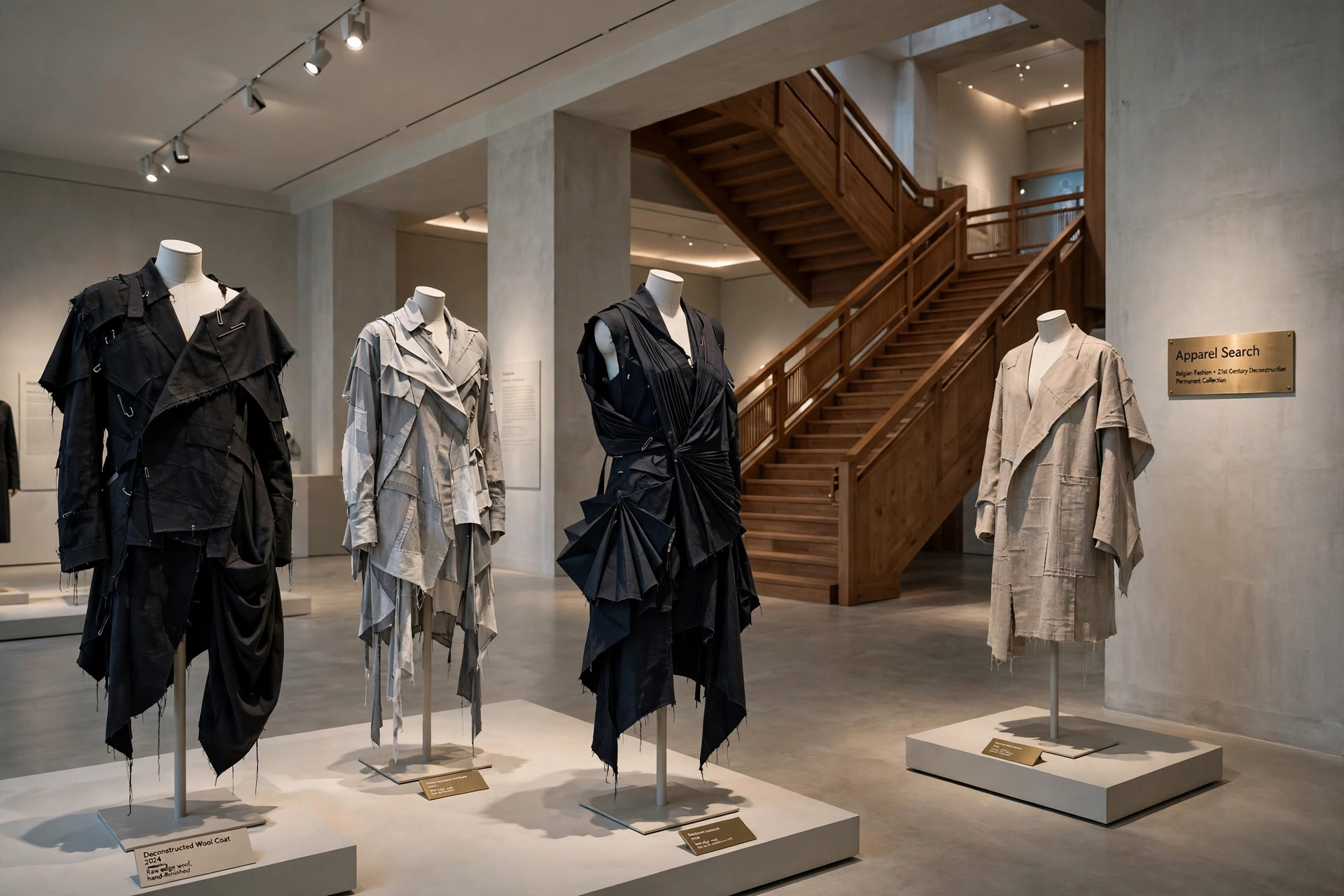
Marie-José Van Hee's renovation for the 2002 opening gave the ModeNatie its signature interior: a generous entrance hall and atrium organised around a massive sculptural wooden staircase, which the 2018–2021 renovation by B-architecten carefully preserved while opening up the new galleries around it. The result is a museum that feels like a house of fashion rather than a warehouse of it — daylight, wood and stone, with the exhibition floors above and the life of the street outside.
What makes the ModeNatie unique among the museums in this series is its tenancy. Three organisations share the roof: MoMu itself; the Fashion Department of the Royal Academy of Fine Arts, where the next Antwerp generation is being trained; and Flanders District of Creativity, the Flemish creative-industries body. Add the MoMu Library and reading room, the museum café and shop, and the building functions as a complete fashion ecosystem — the place where Belgian fashion is simultaneously made, taught, archived and exhibited.
In Antwerp, the museum, the school and the archive share one staircase — the students quite literally walk past fashion history on their way to make more of it.
Visiting
Visiting as a Fashion Pilgrim
MoMu stands in the ModeNatie at Nationalestraat 28, in the heart of Antwerp's fashion district — the streets around it, Nationalestraat and Kammenstraat above all, hold the flagship stores and studios of the designers whose work fills the museum, so the pilgrimage continues naturally out of the front door. Plan the visit around the museum's three simultaneous stories: the ground-floor collection presentation, which rotates silhouettes and archive material from the museum's own holdings so that no two visits see quite the same museum; the current temporary exhibition in the main galleries; and the smaller presentations in the ground-floor gallery.
What a fashion visitor should not miss: the collection presentation first, for the arc of Belgian fashion from the Vrieselhof centuries to the newest Academy talent; then the temporary exhibition, experienced as its designers intended — MoMu rebuilds its galleries completely for each show, so the scenography is part of the exhibit. While The Antwerp Six runs, to 17 January 2027, it is the essential ticket: the first chance to see all six designers' work assembled at this scale, in the city and the building where their story began. If you study or make fashion, ask about the library and the study collection, which can be consulted by appointment, and about the museum's programme of talks, tours and workshops that runs alongside every exhibition.
Antwerp rewards the fashion traveller beyond the museum too: the Academy's end-of-year show is one of the great scouting events of the fashion calendar, and the city's fashion story is written in its shopfronts as much as its galleries. But everything starts at the ModeNatie. Check MoMu's own website for what is on, opening hours and tickets before you go, since exhibitions and hours change with the programme.
Exhibitions change and galleries are rehung, so the details here describe MoMu as documented for this guide — the museum's own site always carries the latest version.
Common Questions
Common Questions
What is MoMu?
MoMu — short for ModeMuseum — is the fashion museum of the City of Antwerp, Belgium. It opened on 21 September 2002 in the ModeNatie building on Nationalestraat, and it collects, conserves, studies and exhibits Belgian fashion, holding the largest collection of contemporary Belgian fashion in the world.
How big is the MoMu collection?
More than 38,000 pieces, by the museum's own count: clothing, accessories and textiles, plus the tools of the trade — patterns, production machines and fashion show invitations. Its historical core came from the former Costume and Textile Museum Vrieselhof, and since 2011 its acquisitions have focused on contemporary Belgian designer fashion.
Who are the Antwerp Six?
Six designers who trained at the Fashion Department of Antwerp's Royal Academy of Fine Arts and showed together in London in 1986: Walter Van Beirendonck, Ann Demeulemeester, Dries Van Noten, Dirk Bikkembergs, Dirk Van Saene and Marina Yee. Their breakthrough put Antwerp on the fashion map. Martin Margiela graduated in the same era and is often named with them, but he was not one of the six.
What is the ModeNatie?
The ModeNatie is MoMu's home on Nationalestraat in Antwerp — a 19th-century building that began as the New England fashion store and the Hotel Central. Renovated by architect Marie-José Van Hee for the museum's 2002 opening, it houses three organisations under one roof: MoMu, the Fashion Department of the Royal Academy of Fine Arts, and Flanders District of Creativity.
What should a fashion lover not miss at MoMu?
The ground-floor collection presentation, which shows rotating highlights from the museum's own collection, and the current temporary exhibition — MoMu stages two a year, each with completely rebuilt, immersive scenography. The Antwerp Six, the first major exhibition on the group, runs to 17 January 2027. Check MoMu's own website for what is on, opening hours and tickets before you go.
In This Series
Every guide in Fashion Museums of the World, from the section hub.
Museums & Exhibitions on Apparel Search
The site's existing museum coverage, including the term guide this series grows from.
Related on Apparel Search
The industry around the museum, and one of the Six in profile.
Search Apparel Search