Fashion Museums of the World · London
V&A — Victoria and Albert Museum
The V&A is the world's great museum of art and design, and inside it sits Britain's national collection of fashion: dress spanning five centuries, from a young man's shirt of 1540 to this season's catwalk. One honest warning belongs at the top of this guide: the museum is open, but its famous Fashion Gallery is currently closed for redevelopment, and will not reopen until Autumn 2028. Fashion at the V&A has not stopped in the meantime — it has moved into exhibitions and a remarkable new storehouse across the city — and this guide covers both the collection and where to find it now.
Museum Label
- Institution
- Victoria and Albert Museum (V&A) — the national museum of art, design and performance, holding the UK's national collection of fashion
- Home
- V&A South Kensington, Cromwell Road, London
- Founded
- 1852, as the Museum of Manufactures; renamed the Victoria and Albert Museum in 1899
- Collection
- Fashion spanning five centuries — described by the V&A as the largest and most comprehensive collection of dress in the world (the V&A's own description); the Fashion Gallery that usually displays it is closed for redevelopment until Autumn 2028
- Director
- Sir Tristram Hunt, Director since 2017
- Known for
- Landmark fashion exhibitions — Alexander McQueen: Savage Beauty, Christian Dior: Designer of Dreams — and, from Autumn 2028, a transformed Fashion Gallery reopening as The Burberry Gallery
The Institution
The National Collection of Dress
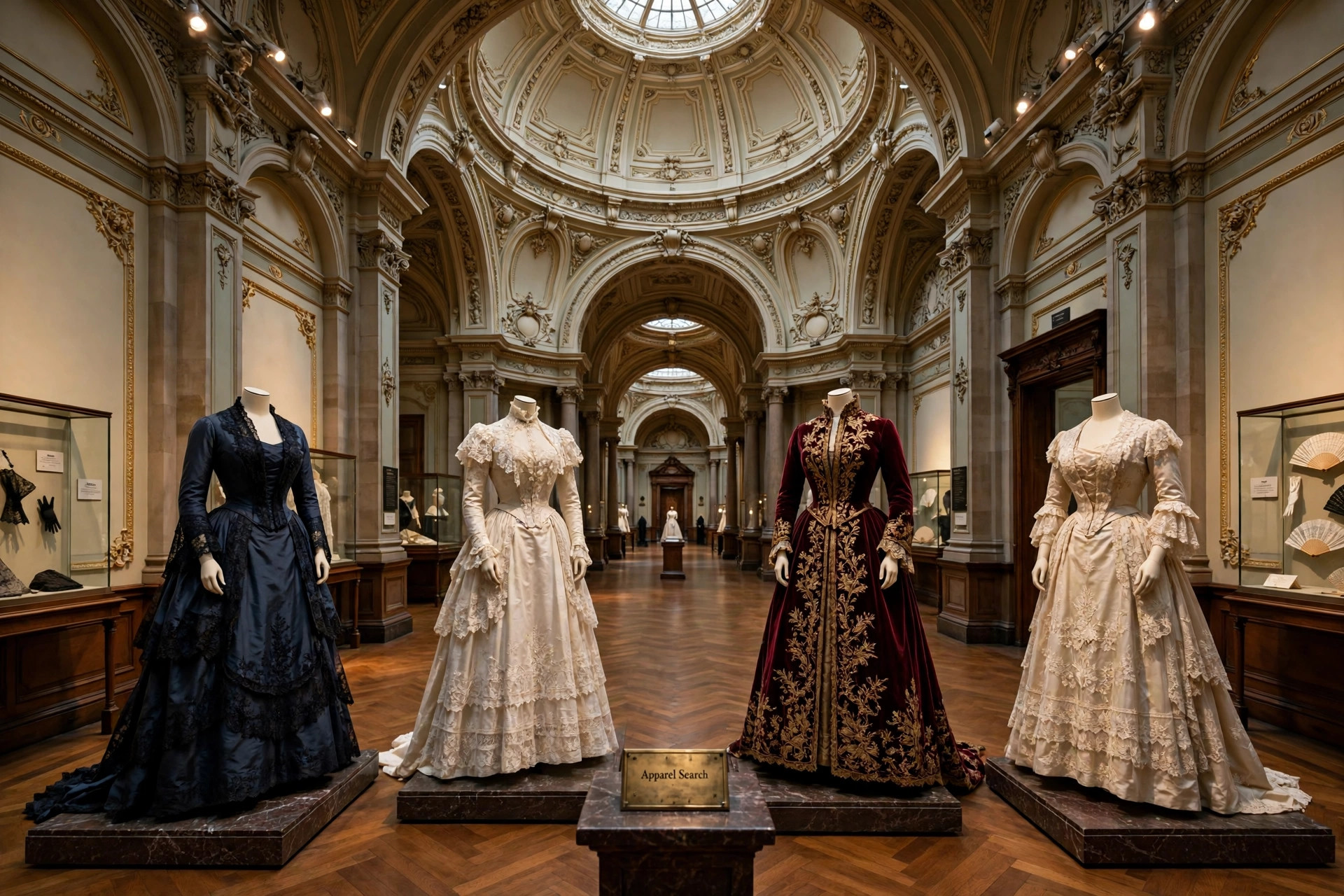
Fashion at the V&A is not a sideline. The museum holds the United Kingdom's national collections in a string of fields — photography, ceramics, furniture, jewellery, textiles among them — and fashion is one of them, which means the dress collection is kept the way a national library keeps books: as the country's permanent record of what was made, worn and meant. The V&A describes its fashion holdings, in its own words, as the largest and most comprehensive collection of dress in the world, and the span behind that claim is five centuries, from the 16th century to clothes that were on a catwalk last season.
The highlights the museum itself picks out read like a syllabus of fashion history: rare 17th-century gowns; the vast 18th-century 'mantua' court dresses, one of whose skirts is, by the museum's count, almost eight feet wide; 1930s eveningwear by Coco Chanel and Elsa Schiaparelli; 1960s daywear by Mary Quant and Barbara Hulanicki of Biba; and post-war couture by Christian Dior and Cristóbal Balenciaga. At one end of the timeline sits what the museum identifies as the earliest European garment in the collection, a young man's shirt dated 1540; at the other, Alexander McQueen's Plato's Atlantis dress of 2010 and the contemporary British and international fashion the museum still actively collects.
A collection like this is also a working tool, and the V&A treats it as one. Its curators and conservators have pioneered ways of reading garments from the inside out — most famously X-raying couture to reveal the hidden structures inside a Balenciaga, the boning, padding and engineering that a wearer was never meant to see. Designers, pattern-cutters and students use the collection the same way: a V&A garment is evidence of how something was actually made, not just how it looked, and that is why the museum's fashion scholarship — its books, its online collection records, its study facilities — carries weight far beyond its galleries.
Keeping five centuries of dress alive is slow, skilled work, and the museum does it in public view more than most. Historic garments arrive fragile — silk shattered by light, seams strained by the very silhouettes that made them famous — and before a piece can be shown it may spend months with conservators: supported, cleaned, and mounted on a form padded to reproduce the body it was cut for, corsetry and all. The museum's research culture feeds the same end. Its curators publish the collection garment by garment, its X-ray studies of couture construction are standard references for pattern-cutters, and its study rooms put original pieces in front of the students and designers who will make the next century's fashion. A national collection, in other words, is not a warehouse with a gallery attached; it is an argument, renewed by every acquisition, that dress belongs in the first rank of the arts a country keeps.
That breadth is the point of the place. The V&A was founded to improve British design by showing designers and manufacturers the best of what had ever been made, anywhere — and fashion, the most everyday of the applied arts, was part of that mission from the start. A visitor who comes for the dress will find it in conversation with everything around it: the textiles it was cut from, the jewellery worn with it, the photographs that sold it and the furniture of the rooms it was worn in.
History in Brief
Born of the Great Exhibition
The V&A grew directly out of the Great Exhibition of 1851, the Crystal Palace showcase that convinced Prince Albert and the civil servant Henry Cole that Britain needed a permanent museum of good design. In 1852 they opened the Museum of Manufactures at Marlborough House in Pall Mall, with Cole as its first director, funded in part from the Exhibition's profits. In 1857 the young museum moved to its present site — then the unfashionable suburb of Brompton, promptly re-christened South Kensington by the museum authorities to make it sound more attractive — and became the South Kensington Museum, the anchor of the museum quarter Londoners still call Albertopolis.
From the beginning it was a pioneer with a democratic streak. The South Kensington Museum was the first museum in the world to light its galleries with gas so that working people could visit in the evening, and the first to open refreshment rooms — the world's first museum restaurant — because Cole believed a museum should be a civilised alternative to the gin palace, not a temple that closed at dusk. The building grew in campaigns across the rest of the century, and in 1899, when Queen Victoria laid the foundation stone of the new Cromwell Road frontage in her last public ceremony, the museum took the name it carries today: the Victoria and Albert Museum.
Fashion's home inside that building, for most living memory, has been the Fashion Gallery — Room 40, the domed gallery where the permanent dress display rotated through the centuries. It is one of the museum's largest dedicated permanent galleries and one of its most visited, yet it had not been structurally redeveloped since 1962. That long life is why the present chapter of the museum's history is a building project: the gallery closed in May 2025 to be transformed, with the support of Burberry, and will reopen in Autumn 2028 as The Burberry Gallery — a participatory new space for the same five centuries of dress. Until then, the collection's public life continues elsewhere in the museum and across London, as the Visiting section below explains.
The Exhibitions
The Shows That Filled the Museum
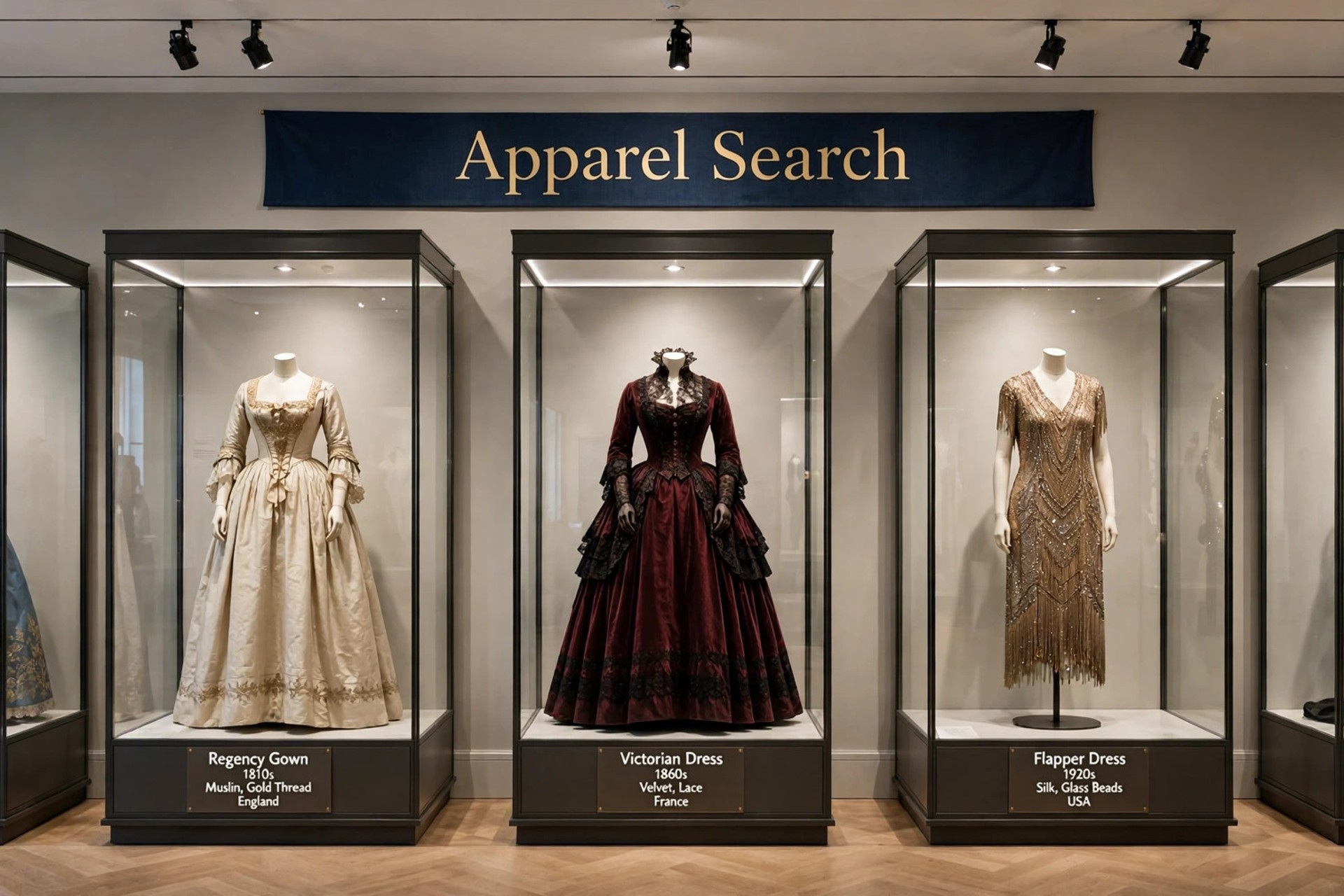
If the permanent gallery was fashion's steady presence at the V&A, the temporary exhibitions are what turned the museum into fashion's loudest stage. The V&A's run of fashion blockbusters over the last decade has no real parallel: shows that sell out within weeks, extend their runs, and send designers' archives and reputations soaring. The landmark exhibitions, and what each one proved:
| Exhibition | Year | What it showed |
|---|---|---|
| Alexander McQueen: Savage Beauty | 2015 | The posthumous retrospective that became, at the time, the most popular exhibition in the museum's history — the V&A records 480,000 tickets sold — and confirmed London as the show's emotional home. |
| Balenciaga: Shaping Fashion | 2017–18 | The master couturier examined through his construction — patterns, X-rays and the garments of his clients and protégés, drawn from the V&A's own Balenciaga holdings. Our Balenciaga company profile tells the house's story. |
| Fashioned from Nature | 2018–19 | The first UK exhibition to trace fashion's relationship with the natural world from 1600 to the present — beauty and environmental cost in the same cases. |
| Christian Dior: Designer of Dreams | 2019 | Reimagined from the Paris original with the V&A's couture collection at its heart; seen by just under 595,000 visitors, it overtook Savage Beauty as the most visited exhibition in the museum's history. |
| Mary Quant | 2019–20 | The designer who dressed the 1960s street, shown with garments crowd-sourced from the wardrobes of the women who had worn them. |
| Fashioning Masculinities: The Art of Menswear | 2022 | The museum's first major exhibition devoted to menswear, from Renaissance portraiture to contemporary designers dissolving the rules. |
| Africa Fashion | 2022–23 | A continent-wide celebration of African fashion scenes, past and present, built with the creatives who made them. |
| Gabrielle Chanel. Fashion Manifesto | 2023–24 | The first UK exhibition dedicated to Chanel, charting the evolution of the most copied design language in fashion. |
| NAOMI: In Fashion | 2024–25 | Forty years of Naomi Campbell's career, told through around a hundred looks from her own wardrobe and the archives of the designers she defined. |
The formula behind the list matters as much as the names. A V&A fashion exhibition is built like an argument: a strong thesis, several hundred objects, loans negotiated for years, and gallery design that treats a dress with the theatrical seriousness of an opera set. The museum's Fashion in Motion series makes the same point in miniature — live catwalk shows in the galleries, free to attend, running for more than twenty years — fashion presented not as a relic but as something that moves.
The Home — and the New One
Seven Miles of Galleries, and a Storehouse That Opens Its Doors
V&A South Kensington is a city in itself: buildings occupying some 12 acres, with what the museum calls seven miles of galleries, from the medieval and Renaissance courts to the Cast Courts' full-size plaster armies and the cool tiled Gamble Room, the world's first museum refreshment room. Fashion visitors should know the geography honestly: the dress collection's permanent home, Room 40, is behind hoardings until 2028, but the rest of this vast museum — including its fashion exhibitions in the temporary galleries — is open as usual, and dress turns up everywhere in it, in portraits, photographs, textiles and jewellery.
The genuinely new chapter is across the city. In May 2025 the museum opened V&A East Storehouse in the Queen Elizabeth Olympic Park — a working collections store, larger than thirty basketball courts, holding more than 250,000 objects, and designed from the start for the public to walk through. Racks of storage are cut through with more than a hundred small curated displays, conservation studios sit behind glass, and through the museum's Order an Object service anyone can book, free, to have up to five objects from the stored collections brought out and shown to them up close. For fashion, this is transformative: the national collection of dress is largely stored here, and a 1954 pink silk taffeta evening dress by Cristóbal Balenciaga was, the museum reported, the most requested object of all in the service's first weeks. A companion site, V&A East Museum, followed in the same Olympic Park quarter in 2026, completing the museum's expansion east.
A national collection earns the name when the public can actually reach it — and the Storehouse lets a visitor ask for a garment the way a reader asks for a book.
Visiting
Visiting as a Fashion Pilgrim — Read This First
Start with the honest position, because it decides how to plan. V&A South Kensington is open, and general admission is free — but the Fashion Gallery (Room 40) is closed for redevelopment and will remain closed until Autumn 2028, when it reopens as The Burberry Gallery. If you travel to London expecting the permanent dress display of past visits, you will not find it, and no guide should pretend otherwise.
What you will find is fashion by other doors. The museum's temporary exhibition programme continues at South Kensington: at the time this guide was documented, the free display The Burberry Trench: Crafting an Icon — tracing Thomas Burberry's 1879 invention of gabardine through a century of the trench coat, in the rarely opened Prince Consort Gallery — runs to 3 January 2027, a fitting preview of the gallery Burberry is helping to rebuild. Across the city, V&A East Storehouse puts the stored fashion collection itself within reach through its open displays and the Order an Object service. And the whole fashion collection, all five centuries of it, is searchable through the museum's online collection pages, which is how designers and researchers plan a study visit.
So plan a V&A fashion trip in this order: check what fashion exhibition is on at South Kensington; give the Storehouse a half-day of its own and book an Order an Object slot well ahead if there is a garment you have always wanted to see up close; and leave time for the museum beyond fashion, because the dress makes most sense surrounded by the art and design it lived among. For current exhibitions, opening arrangements and tickets, the museum's own site, vam.ac.uk, is the authority — check it before you travel.
Exhibitions change and galleries are rehung, so the details here describe the V&A as documented for this guide — the museum's own site always carries the latest version.
Common Questions
Common Questions
Is the V&A's Fashion Gallery open?
No — and this guide states it plainly so no one travels on a false promise. The Fashion Gallery (Room 40) at V&A South Kensington is closed for redevelopment and will reopen in Autumn 2028 as The Burberry Gallery. The museum itself is open, and fashion remains on view in the meantime through temporary exhibitions at South Kensington and through the stored collection at V&A East Storehouse.
What is the V&A's fashion collection?
It is the United Kingdom's national collection of fashion: dress spanning five centuries, from a young man's shirt dated 1540 to contemporary catwalk pieces. The V&A describes it, in its own words, as the largest and most comprehensive collection of dress in the world, with strengths the museum itself highlights in 17th-century gowns, 18th-century mantua dresses, 1930s eveningwear by Chanel and Schiaparelli, 1960s daywear by Mary Quant and Barbara Hulanicki, and post-war couture by Dior and Balenciaga.
Is the V&A free to visit?
General admission to V&A South Kensington is free, as the museum's own visit pages confirm. Major temporary exhibitions are usually ticketed separately. This guide deliberately lists no prices or hours, because both change — check vam.ac.uk for the current arrangements before you go.
Where can I see V&A fashion while the Fashion Gallery is closed?
In three places. Fashion exhibitions continue in the temporary galleries at V&A South Kensington — a free display on the Burberry trench coat runs there to 3 January 2027. At V&A East Storehouse in the Queen Elizabeth Olympic Park, the stored collection is on open display and any visitor can book the free Order an Object service to see chosen garments up close. And the full collection is searchable online through the museum's collection pages.
What should a fashion lover not miss at the V&A?
Whatever fashion exhibition is currently staged at South Kensington — the museum's blockbusters are the best-attended fashion shows in Britain — and a session at V&A East Storehouse, where the national collection of dress can be ordered up and examined like books in a reading room. Until Autumn 2028, do not plan around the Fashion Gallery itself: it is the one fashion room in London that is definitely closed.
In This Series
Every guide in Fashion Museums of the World, from the section hub.
Museums & Exhibitions on Apparel Search
The site's existing museum coverage, including the term guide this series grows from.
Related on Apparel Search
The industry around the museum, the couturier it knows best, and London's own fashion week.
Search Apparel Search