Fashion Museums of the World · Paris
Musée des Arts Décoratifs
In the Louvre palace's Rivoli wing, at 107 rue de Rivoli, sits the other half of Paris's fashion memory: the Musée des Arts Décoratifs, where dress is kept not as a world of its own but as one of the decorative arts — shown, by deliberate policy, only in temporary exhibitions, some of which have become the most visited fashion shows in French museum history.
Museum Label
- Institution
- Musée des Arts Décoratifs (MAD) — the fashion and textiles department of Les Arts Décoratifs
- Home
- 107 rue de Rivoli, 75001 Paris — the Pavillon de Marsan and Rohan wing of the Palais du Louvre
- Founded
- 1864, as the Union Centrale des Arts Décoratifs; a dedicated fashion museum opened within it in 1986
- Collection
- One of the largest fashion and textile holdings in France, built in part on the UFAC collections (the museum publishes no single fashion-only count)
- Director
- Bénédicte Gady, director of the museums
- Known for
- Blockbuster fashion exhibitions in the Louvre palace — Dior in 2017, Schiaparelli in 2022, and LOOK! in 2026–27
The Institution
Fashion, Kept Among the Decorative Arts
The Musée des Arts Décoratifs — MAD, in its own modern shorthand — is not a fashion museum that also holds furniture. It is a museum of the decorative arts entire: furniture, ceramics, glass, jewellery, toys, wallpaper, graphic design and advertising, from the Middle Ages to the present, in which fashion and textiles form one great department. That framing is the institution's founding idea and its distinction. Where its Paris partner in this series, the Palais Galliera, treats dress as a subject sufficient unto itself, MAD treats a dress as it treats a chair or a jewel: as a made thing, in which art, craft, industry and daily life meet — and it shows fashion surrounded by the rooms, objects and images the fashion was made to live among.
The fashion holdings themselves are among the largest in France — garments, textiles and accessories from the early modern period to this season's couture, deepened decisively by the collections of the Union Française des Arts du Costume (UFAC), the private association whose holdings joined the museum in the years before its fashion museum opened. A note of honesty belongs here, because this guide's research found the published figures in conflict: secondary sources offer precise fashion-and-textile counts that the museum's own published pages do not confirm, so this guide prints no single number. What can be said on the record is the shape of the thing: a national-scale fashion and textile collection, strong in French haute couture from the great houses — Chanel, Dior, Yves Saint Laurent, Balenciaga, Schiaparelli, Gaultier and their peers — and in the textiles, patterns, drawings and photographs that document how the garments came to be.
None of it is on permanent display, and that, too, is policy rather than accident. Textiles are the most light-sensitive objects in the building; MAD shows its fashion the way the Galliera historically showed its own, in temporary exhibitions — more than seventy fashion and textile exhibitions since 1986, by the museum's count — each drawing a few hundred pieces out of store, and each returning them to rest. Between fashion exhibitions, the department is a research collection: catalogued, conserved, lent to museums worldwide, and studied by the designers who come to read construction off the originals. The visitor's fashion museum and the scholar's fashion archive are the same institution on different days.
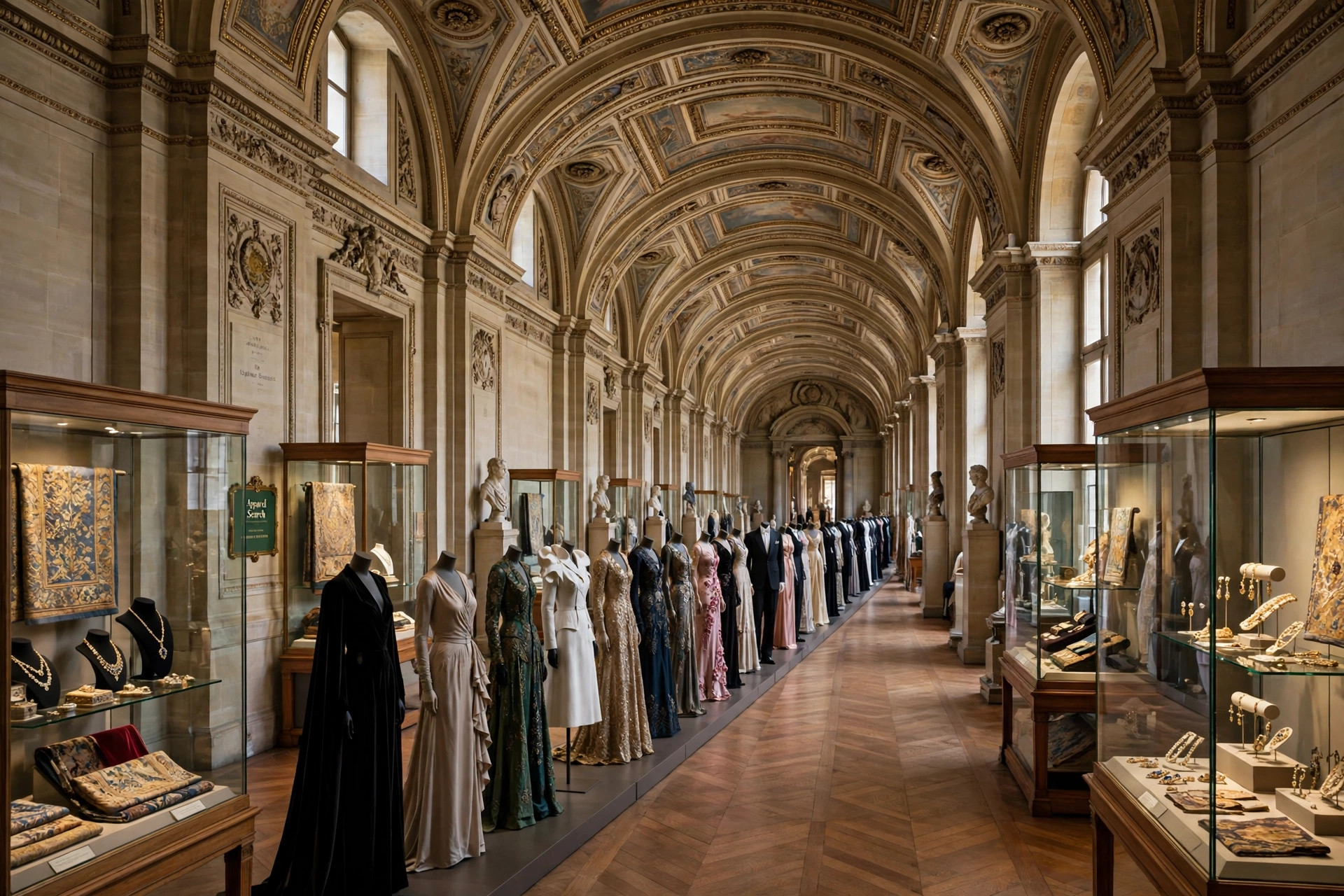
What MAD adds to that model is scale of staging. Its great nave — the tall central hall of the Marsan wing — is one of the grandest exhibition rooms in Paris, and the museum has learned to fill it theatrically: whole streets of Dior, surrealist worlds for Schiaparelli, forty silhouettes parading the nave for its own fortieth anniversary. A fashion exhibition here is not a row of cases. It is a temporary city of clothes, built inside a palace.
History in Brief
From the Union Centrale of 1864 to the Fashion Museum of 1986
The institution begins in the age of the great exhibitions. In 1864, Parisian industrialists, artists and collectors founded the Union Centrale des Beaux-Arts Appliqués à l'Industrie — soon the Union Centrale des Arts Décoratifs — to do for the applied arts what the Louvre across the courtyard did for the fine arts: collect the best made things, and raise the standing of the people who made them. The Union held its first exhibition in 1865, built a museum and library, and in the first years of the new century settled into its permanent home in the Louvre palace itself, the Pavillon de Marsan on the rue de Rivoli, where the museum opened in 1905. The parent body, renamed Les Arts Décoratifs in 2004, still runs the museum today, alongside the Musée Nissim de Camondo and the École Camondo.
Fashion entered that story early and kept knocking. The Union's precursor staged France's first public exhibition of historic dress in 1874, and another in 1892, and historic garments and accessories slowly joined the collections. The decisive gift came from a parallel effort: the Union Française des Arts du Costume, founded in 1949 by the costume historian François Boucher, which assembled a vast private collection of French dress — some 63,000 pieces by the time of its donation to the Union Centrale in 1981. A collection that size demanded a stage of its own.
It got one in 1986, when — at the initiative of Jack Lang, then France's minister of culture — the Musée des Arts de la Mode, the Museum of the Arts of Fashion, opened inside the Musée des Arts Décoratifs in the Marsan wing. Its inaugural exhibition, Moments de Mode, staged fashion history with theatrical flair — a mannequin in a 19th-century cycling suit pedalling a mechanical bicycle, garments floating on invisible mounts — and announced that this museum would show clothes as spectacle as well as scholarship. In 1997 the fashion museum took a new name, the Musée de la Mode et du Textile, opened under that banner by the exhibition Géométrie; in time it was folded back into the parent museum's structure as its fashion and textiles department, the form in which it works today — same collections, same galleries, same exhibition programme, under the MAD name.
The curatorial line runs unbroken through the renamings. Olivier Saillard, who programmed MAD's fashion exhibitions in the 2000s before directing the Palais Galliera, set the house style of the designer monograph treated as literature — Yohji Yamamoto, Christian Lacroix — and his successors widened it into the blockbuster era: the museum's fashion shows of the 2010s and 2020s, Dior above all, proved that a decorative-arts museum in the Louvre's wing could out-draw almost anything in Paris. The current fashion curatorship, for the post-1947 collections, is Sophie Lemahieu's; the museum's director, Bénédicte Gady, co-curated the fortieth-anniversary exhibition that crowns this history.
The Blockbuster Habit
Forty Years of Exhibitions, Forty Silhouettes
MAD's fashion reputation rests on its exhibition list, and the museum knows it: its current anniversary exhibition is built from nothing else. The landmark shows trace a clear arc — from the founding spectacles of 1986, through the monograph years, to the blockbusters that made fashion the museum's biggest draw:
| Exhibition | Year | Why it mattered |
|---|---|---|
| Moments de Mode | 1986 | The inaugural show of the Musée des Arts de la Mode — fashion history staged with theatre professionals, moving mannequins and floating garments. |
| Yves Saint Laurent | 1986 | The fashion museum's first designer monograph, in its founding year — the template for four decades of them. |
| Madeleine Vionnet | 2009 | The great retrospective of the bias-cut pioneer, whose miniature mannequin and draping research the museum still teaches from. |
| La Mécanique des Dessous | 2013 | The hidden engineering of dress — corsets, crinolines and the structures beneath the silhouette — a theme show at its most ingenious. |
| Fashion Forward: Three Centuries of Fashion | 2016 | The collections surveyed across three centuries, the department showing its full depth in its own house. |
| Christian Dior, Couturier du Rêve | 2017–18 | The blockbuster of blockbusters: more than 708,000 visitors, the most visited exhibition in the museum's history, later toured worldwide. |
| Les Mondes Surréalistes d'Elsa Schiaparelli | 2022 | Schiaparelli in dialogue with her surrealist circle — Dalí, Cocteau, Man Ray — fashion shown as an art movement. |
| Iris van Herpen: Sculpting the Senses | 2023–24 | Contemporary couture as technology and sculpture, the monograph tradition brought fully into the present. |
| LOOK! 40 Years of Fashion at the Museum | 2026–27 | The current show, to 4 April 2027: forty silhouettes for forty exhibitions, and the museum's own workrooms opened to view. |
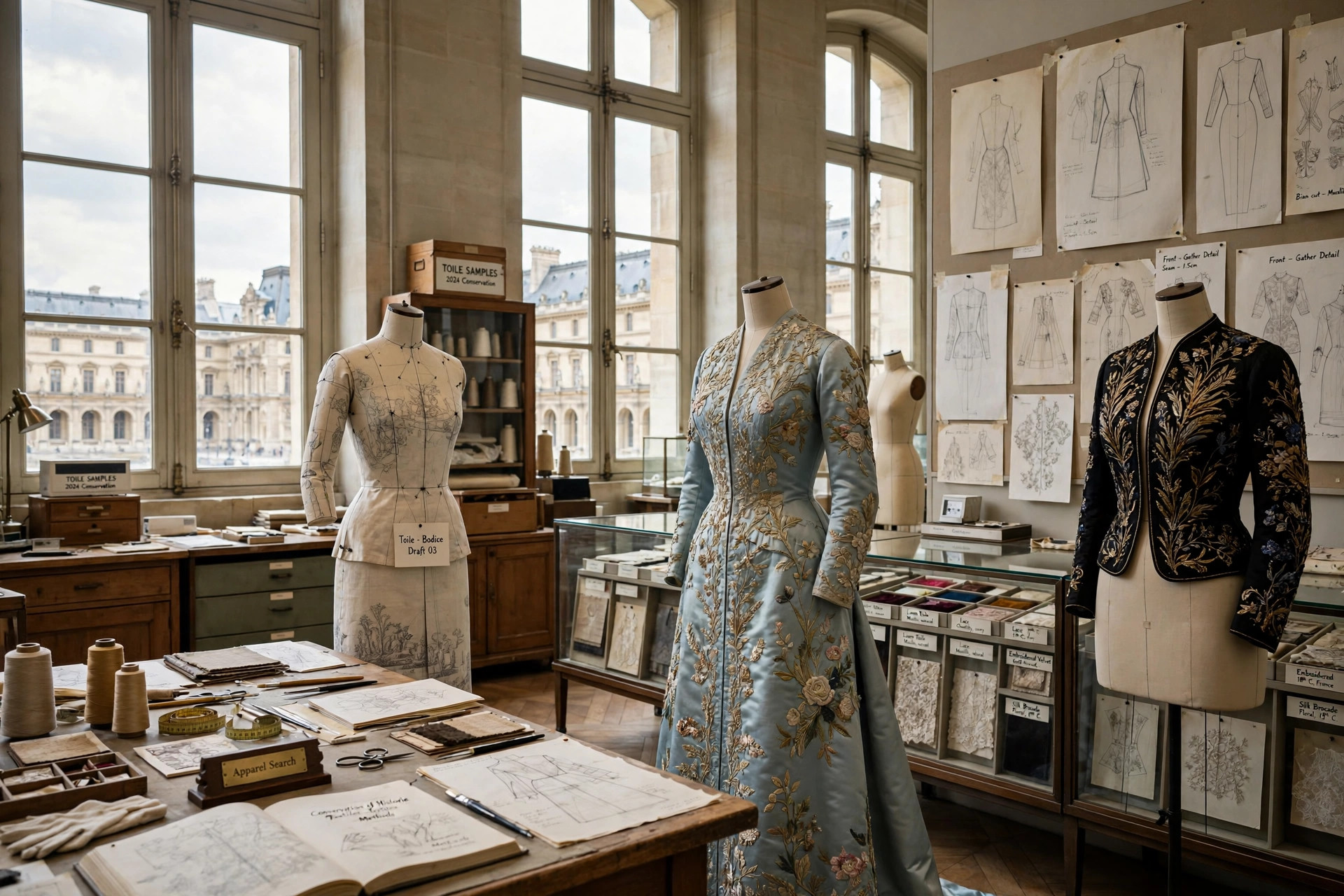
LOOK! deserves its own paragraph, because it is the rare fashion exhibition whose subject is fashion exhibitions. Forty iconic silhouettes stand in the great nave, one for each landmark show of the forty years since 1986 — a Galliano kimono dress for Dior, a Vionnet of 1938, an Alaïa of 1989, stays from the 1740s — and around them the galleries follow what the museum calls the two lives of a garment. The first life is creation: sketches, moodboards, embroidery samples, patterns, toiles, the runway, the photograph. The second begins at the museum door: acquisition, documentation, storage on padded made-to-measure supports, restoration down to X-raying a 16th-century doublet, the building of the display mannequin — the mannequinage that lets a fragile dress stand without strain — and finally the exhibition itself. It is the most honest show in this series' Paris pair: the Galliera shows you the clothes; MAD, this season, shows you what it costs to keep them.
A dress in a museum has had two lives — one on the body it was made for, and one, far longer, in the hands of the people who keep it.
The Home
The Marsan Wing of the Louvre Palace
The address misleads first-time visitors in the most delightful way: 107 rue de Rivoli is the Louvre — the same palace, the same stone — but a different museum, with its own entrance, its own collections and its own history, occupying the palace's north-west wing along the rue de Rivoli and the Tuileries gardens. The Pavillon de Marsan and the Rohan wing give MAD a run of palace rooms that few museums anywhere can match: period rooms and galleries of furniture and objects from the Middle Ages onward, the great nave for exhibitions, and views across the Tuileries to the Louvre's own courtyards.
For the fashion visitor, the building makes the museum's argument before a single label is read. You reach the fashion galleries through centuries of French rooms — Boulle marquetry, Sèvres porcelain, Art Nouveau and Art Deco interiors — so that when the couture appears, it appears in context: the New Look among the post-war rooms it was designed for, a Schiaparelli among the surrealist objects she collaborated with. No white-cube fashion museum can borrow that context; MAD simply lives in it. And the palace scale cuts the other way, too: the nave that swallows a Dior retrospective whole is the same room in which forty silhouettes, one per exhibition, can stand in a single view for LOOK! — the department's whole history visible at a glance, which is precisely the exhibition's point.
Visiting
Visiting as a Fashion Pilgrim
The first rule of a MAD visit is that fashion here is an event, not a fixture. There is no permanent fashion gallery to fall back on: the fashion and textiles department shows its collections in temporary exhibitions, and between them the galleries turn to the museum's other subjects. So the visit is decided by the programme — check the museum's own website for what is on, and for opening arrangements and tickets, before you go. As documented for this guide, the fashion event of the season is LOOK! 40 Years of Fashion at the Museum, running to 4 April 2027 in the great nave and the adjoining galleries.
What a fashion visitor should not miss: the current fashion exhibition, taken slowly — MAD's shows reward attention to the workroom details, the patterns and toiles and restoration stories, as much as to the famous dresses; the nave itself, the grandest fashion room in Paris when a show fills it; and at least a taste of the permanent decorative-arts galleries around it, the period rooms and design collections that are this museum's unique context for dress. Pair the visit with its natural partner across the city, the Palais Galliera in the 16th arrondissement — the other Paris guide in this series — and you will have seen the two complementary halves of how Paris keeps its fashion: the city's own collection in its duchess's palace, and the nation's decorative-arts collection in the Louvre's wing.
Exhibitions change and galleries are rehung, so the details here describe the Musée des Arts Décoratifs as documented for this guide — the museum's own site always carries the latest version.
Common Questions
Common Questions
Is the Musée des Arts Décoratifs part of the Louvre Museum?
No. It is a separate museum, run by Les Arts Décoratifs, housed inside the Louvre palace in the Pavillon de Marsan and Rohan wing at 107 rue de Rivoli. It has its own entrance, collections and exhibitions. The palace is shared; the museums are distinct, and a visit to one is not a visit to the other.
Is fashion always on display at the Musée des Arts Décoratifs?
No. The fashion and textiles collections are not on permanent display. They are shown in temporary exhibitions — more than seventy since the fashion museum opened in 1986 — because textiles are extremely sensitive to light and must rest in store between shows. Check the museum site for the current exhibition before planning a fashion visit.
How big is the fashion collection at the Musée des Arts Décoratifs?
It is one of the largest fashion and textile holdings in France, spanning garments, textiles and accessories from the early modern period to contemporary couture, and built in part on the collections of the Union Française des Arts du Costume. Published secondary figures for the fashion holdings alone conflict, and the museum publishes no single fashion-only count, so this guide describes its scale rather than printing a number it cannot verify.
What is LOOK! 40 Years of Fashion at the Museum?
It is the exhibition marking forty years since the Musée des Arts de la Mode opened at the museum in 1986, running to 4 April 2027. Forty iconic silhouettes in the great nave stand for forty of the exhibitions staged since then, and the surrounding galleries follow the two lives of a garment: its creation in the atelier, and its afterlife of storage, restoration and display in the museum.
What should a fashion lover not miss at the Musée des Arts Décoratifs?
The fashion exhibition of the season — currently LOOK!, with its forty silhouettes in the nave and its behind-the-scenes tour of how garments are made, kept and restored — and a walk through the permanent decorative-arts galleries, whose period rooms give the couture its context. Check the museum site for what is on before you go, since fashion here is shown by exhibition, not permanently.
In This Series
Every guide in Fashion Museums of the World, from the section hub.
Museums & Exhibitions on Apparel Search
The site's existing museum coverage, including the term guide this series grows from.
Related on Apparel Search
The country whose national fashion story this museum tells, the house of its greatest blockbuster, and the week that fills the city around it.
Search Apparel Search