Fashion Museums of the World · Florence
Museo Salvatore Ferragamo
In the medieval basement of a Florentine palace stands the museum of a shoemaker who treated the shoe as engineering, sculpture and autobiography at once. Salvatore Ferragamo made shoes for Hollywood stars, studied the anatomy of the foot to make high heels bearable, and — when wartime Italy ran short of steel and leather — invented some of the most copied footwear of the twentieth century out of cork, wood and fishing line. His family's museum, opened in May 1995, is where that story is kept.
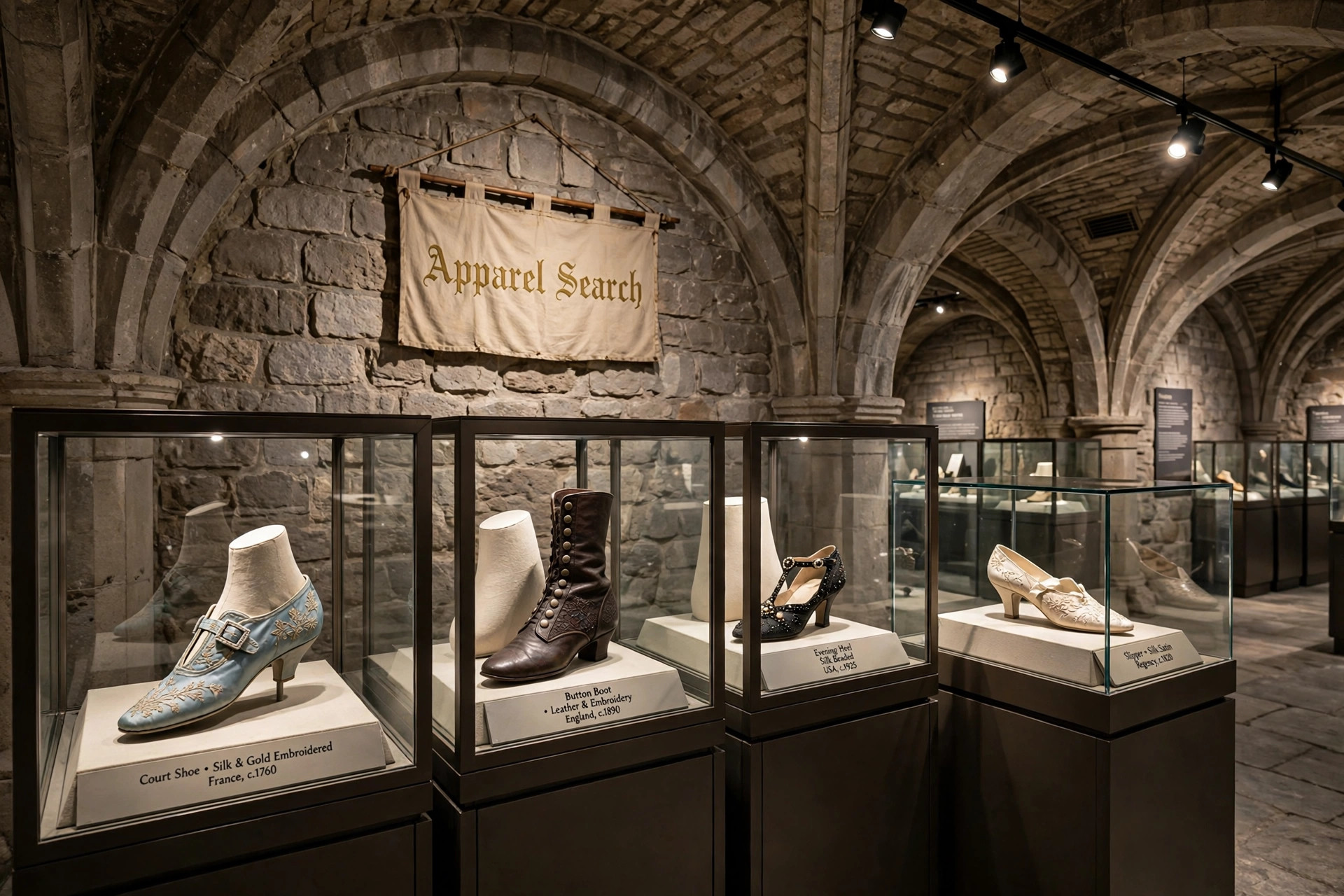
Museum Label
- Institution
- Museo Salvatore Ferragamo — the company museum of the Ferragamo fashion house
- Home
- Palazzo Spini Feroni, Piazza Santa Trinita, Florence — in the palace's medieval basement
- Founded
- Opened in May 1995 by Wanda Ferragamo and the Ferragamo family
- Collection
- The Ferragamo archive of Salvatore Ferragamo's footwear, documents, patents and designs, shown in rotation — the museum publishes no single headline count, and this guide invents none
- Director
- Stefania Ricci, director of the museum and of Fondazione Ferragamo since 1995
- Known for
- Presenting the shoe as a work of art and invention — and for exhibitions that read Ferragamo's world through art, film, sustainability and society
The Institution
A Company Museum That Behaves Like an Art Museum
Most fashion houses keep an archive. The Ferragamo family built theirs a museum — and not a showroom with better lighting. The Museo Salvatore Ferragamo describes itself, in its own words, as a company museum dedicated to the history of the Ferragamo company, the life of its founder and his creations. It opened in May 1995, which made it one of the first corporate museums in Italy, and it was a family act before it was a corporate one: Salvatore's widow Wanda Ferragamo and their children created it to make the founder's art public, after a decade in which touring Ferragamo exhibitions had drawn crowds at major museums around the world.
What the museum holds is, at its core, the working evidence of one designer's career: the shoes Salvatore Ferragamo created between his return to Italy in 1927 and his death in 1960, together with the patents, lasts, sketches, photographs, press cuttings and advertising that explain how they were made and for whom. The personal lasts — the wooden forms shaped to individual feet, including those of famous clients — are among the most quietly eloquent objects in fashion: a star's public glamour reduced to the exact shape of her foot. Because no single display can hold a career of that density, the museum works by rotation and by theme, drawing different selections out of the archive for each exhibition.
That exhibition programme is the museum's real signature. Rather than leaving the founder's shoes in a permanent shrine, the museum uses them as the starting point for research exhibitions that reach outward — into art, architecture, design, film, economic and social history. Its archive list runs from The Art of the Shoe and Shoes and Famous Feet to shows on Audrey Hepburn and Marilyn Monroe, on silk, on sustainable thinking, and on Italy's entanglement with Hollywood. The current exhibition returns to the source: Salvatore Ferragamo 1898–1960, a full retrospective of the founder's life and work, which the museum announced in May 2026 had been extended — following wide public participation — until 14 February 2027.
The museum is also a working cultural institution in the present tense: guided and tactile tours, an accessible audio guide, openings of the company archive to the public, podcasts, and collaborations with other Italian company museums. In 1999 the company's cultural commitment was recognised with the Guggenheim Business and Culture Award. Read our profile of the founder himself in the Salvatore Ferragamo designer profile — this guide is about the museum that keeps his work.
History in Brief
From Bonito to Hollywood to Florence
Salvatore Ferragamo was born in 1898 in Bonito, a small village in Campania, the eleventh of fourteen children. By his own account he made his first shoes at nine, trained for a year in Naples, and opened a small workshop in his parents' home as a teenager. In 1914 he emigrated to the United States, following brothers who had already left: a brief spell in a Boston shoe factory convinced him that industrial production was not his path, and he moved on to Santa Barbara, California, where he and his brothers opened a shoe repair and made-to-measure workshop.
California gave him two things no Italian apprenticeship could. The first was cinema: his workshop began making shoes for the early film industry, and when production moved to Hollywood, he followed, opening the Hollywood Boot Shop in 1923. The client list that followed — the stars of the silent and early sound eras — earned him the nickname the American press gave him, the Shoemaker to the Stars. The second was science. Ferragamo enrolled in anatomy studies at the University of Southern California to understand the structure of the foot, and his lifelong design principle followed from it: a shoe should distribute the body's weight the way the arch itself does. His reinforced steel shank, supporting the arch inside high-heeled shoes, came out of that study.
In 1927 he returned to Italy — deliberately, to make his shoes where the craftsmanship was. He chose Florence, a city synonymous with art and artisan skill, and set up first in Via Mannelli, importing skilled shoemakers' work at a scale the local workshops initially could not match. The 1929 crash hit the business hard, but the 1930s rebuilt it on invention: in 1938 he bought Palazzo Spini Feroni outright and made it the company's headquarters and flagship store, where it remains. Salvatore Ferragamo died in Florence in 1960. His widow Wanda — who had not previously run the business — took it over with their children and led its growth into a global fashion house, a story the museum tells as part of its own: the museum exists because that second generation decided the founder's work belonged in public.
The museum's own prehistory matters. In 1985 the curator Stefania Ricci organised the first great Ferragamo retrospective at Palazzo Strozzi in Florence; it toured — to the Victoria and Albert Museum in London, to Los Angeles, later to Tokyo and Mexico City — and its success, especially with young visitors, persuaded the family that a permanent museum was justified. Ricci has directed the museum since it opened in 1995, and still directs both the museum and Fondazione Ferragamo today.
The Inventions
What Made Its Name: The Shoe as Invention
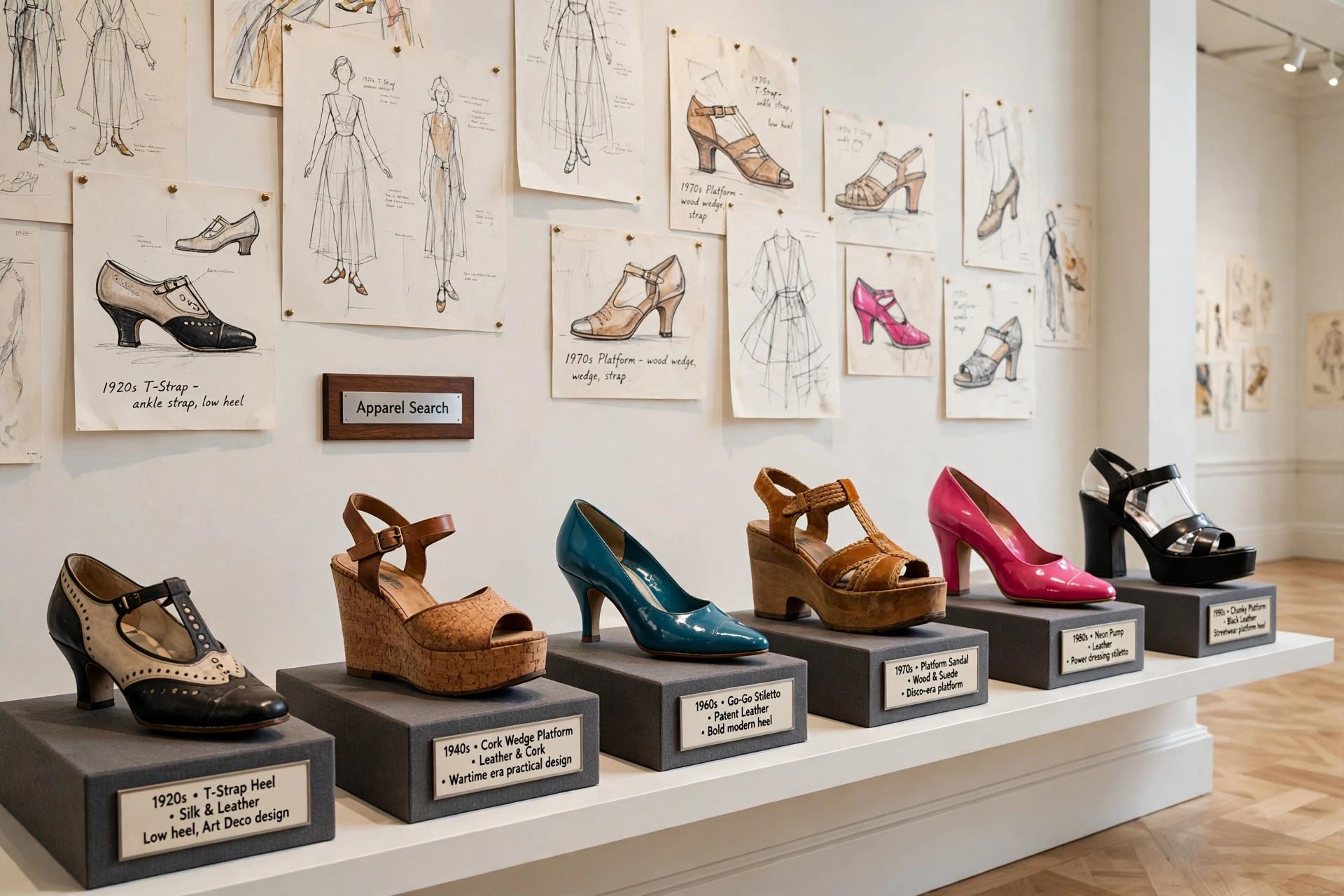
Ask what this museum is for, and the honest answer is a list of inventions. Ferragamo patented designs the way an engineer does, and his most famous creations were answers to constraints — a foot's anatomy, a star's working day, a country under sanctions and wartime shortage. When Italy's autarky policies and then the war cut off steel and fine leather, he turned to what Italy had: cork from Sardinia, wood, raffia, cellophane, and the new nylon fishing line. Necessity produced the two most imitated shoe ideas of the century.
| Creation | Year | Why it matters |
|---|---|---|
| The cork wedge | 1930s | A solid wedge of layered cork filled the space between heel and sole — support and height in one sculptural form, born of the steel shortage and copied worldwide ever since. |
| The Rainbow sandal | 1938 | A multicoloured platform sandal of layered cork and suede, made for Judy Garland — the platform wedge at its most joyful, and the museum's emblem object. |
| The Invisible sandal | 1947 | An upper of braided transparent nylon fishing line over a sculpted wooden sole — a shoe that seems to float. It won Ferragamo the Neiman Marcus Award, fashion's Oscar, shared that year with Christian Dior. |
| The cage heel | 1950s | An open lattice of metal forming the heel — jewellery engineering under the foot, and a signature of his most experimental decade. |
| The steel shank | California years, refined in Florence | The invisible invention inside the others: arch support borrowed from anatomy, which is why his vertiginous heels could actually be worn. |
The exhibitions make the same argument at gallery scale. The retrospective format the museum pioneered for footwear — shoes displayed with the lasts, patents, sketches and film stills that explain them — treats a sandal the way an art museum treats a drawing: as the visible end of a thinking process. Later themed shows widened the lens: Italy in Hollywood explored the Italian emigrant world Ferragamo himself had lived in; Sustainable Thinking used his experiments with poor and recycled materials — fish skin, cork, hemp, cellophane — to open a conversation about fashion's material future; Women in Balance read the decades of Wanda Ferragamo's leadership through the working lives of Italian women. The founder's shoes are the constant; the questions change.
Other museums collect the shoe as fashion. This one keeps it as evidence — of anatomy studied, materials improvised, and a craftsman who patented beauty.
The Home
Palazzo Spini Feroni: A Medieval Palace as Headquarters
The museum's building would justify a guide of its own. Palazzo Spini Feroni, on Piazza Santa Trinita at the end of Via de' Tornabuoni, Florence's luxury street, was built from 1289 for Geri Spini, banker to the Pope and to the kings of France and England, who raised it — the museum's own account says plainly — to manifest his family's power through the building's grandeur. It is one of the great surviving medieval palaces of Florence, fortress-like outside and frescoed inside.
Its later lives read like a compressed history of the city. After the Spini came the Guasconi, the da Bagnano and the Feroni families, who commissioned the decorations that still cover the piano nobile: the chapel frescoes by Bernardino Poccetti, painted between 1609 and 1612, and a cycle of seventeenth- and eighteenth-century frescoes and stuccoes, including Giuseppe Piamontini's marble relief of the Fall of the Giants of 1705. In the nineteenth century the palace became a luxury hotel — its guests included Chancellor Metternich and Franz Liszt — and then, during the years when Florence was capital of Italy, the seat of the City Council. The G.P. Vieusseux Scientific and Literary Cabinet, the reading room at the centre of foreign intellectual life in Florence, was also housed here, and Oscar Wilde was among the palace's prominent residents and visitors.
Ferragamo's chapter began in 1938, when Salvatore opened his luxury footwear workshop in the palace and then bought the building — an immigrant shoemaker's son acquiring one of the great houses of the city his craft had brought him back to. It has been the company's headquarters and its first store ever since. The museum occupies the palace's medieval basement, its pillared, cross-vaulted rooms the oldest fabric in the building: you descend from the polished luxury street into the thirteenth-century undercroft, and the shoes are waiting in the vaults. On special occasions the museum also opens the frescoed piano nobile above — the two halves of the building, commerce's palace and art's, belong to the same visit.
Visiting
Visiting as a Fashion Pilgrim
The Museo Salvatore Ferragamo is in Palazzo Spini Feroni on Piazza Santa Trinita in Florence, a short walk from the Arno and the Ponte Santa Trinita, in the middle of the city's luxury shopping quarter. The visit is compact by the standards of this series — this is a focused company museum, not an encyclopedia — which makes it an ideal hour inside a Florentine day that also holds the Uffizi, the Oltrarno workshops and, across the city, Palazzo Gucci. Allow time for the details: the lasts, the patents and the sketches reward slow looking more than the headline shoes do.
What a fashion visitor should not miss: the current retrospective Salvatore Ferragamo 1898–1960, extended to 14 February 2027, which is the fullest account of the founder the museum has mounted; the Rainbow sandal and the Invisible sandal, the two objects on which his legend rests; and the building itself — look up in the entrance hall for the medieval coats of arms, and ask whether any piano nobile opening coincides with your visit. If you are travelling with someone who cannot see the shoes, ask the museum about its tactile tours and accessible audio guide, among the most thoughtful access programmes in any fashion museum. As everywhere in this series, check the museum's own website for current exhibitions, opening arrangements and tickets before you go — this guide deliberately prints no hours or prices, because both change.
Pair the visit with its natural companions: the Salvatore Ferragamo designer profile linked above for the man, the Italy clothing industry guide in the links below for the industry his house helped define, and Palazzo Gucci, a ten-minute walk away in Piazza della Signoria — two Florentine houses, two company museums, one afternoon.
Exhibitions change and galleries are rehung, so the details here describe the Museo Salvatore Ferragamo as documented for this guide — the museum's own site always carries the latest version.
Common Questions
Common Questions
Is the Museo Salvatore Ferragamo only about shoes?
No — although shoes are its heart. The museum is the Ferragamo company's museum, and its exhibitions use Salvatore Ferragamo's footwear as a starting point for wider subjects: art, film, materials, sustainability and Italian social history. Alongside the shoes you will find lasts, patents, sketches, photographs, advertising, and in themed exhibitions clothing and works of art as well.
Where is the Museo Salvatore Ferragamo?
In Florence, in the medieval basement of Palazzo Spini Feroni on Piazza Santa Trinita — the palace that has been the Ferragamo headquarters and flagship store since Salvatore Ferragamo bought it in 1938. The museum entrance is at Piazza Santa Trinita 5R, in the heart of the city's luxury shopping district.
What is on at the Museo Salvatore Ferragamo now?
The museum's current exhibition is the retrospective Salvatore Ferragamo 1898–1960, tracing the founder's life and work. The museum announced in May 2026 that, following wide public participation, the exhibition has been extended until 14 February 2027. Check the museum's own website before visiting, as exhibition dates can change again.
Who was Salvatore Ferragamo?
Salvatore Ferragamo (1898–1960) was an Italian shoemaker who emigrated to California, made shoes for Hollywood — earning the nickname Shoemaker to the Stars — studied anatomy to make shoes fit the foot scientifically, and returned to Florence in 1927 to found the house that bears his name. He is remembered for inventions including the cork wedge, the Rainbow sandal of 1938 and the Invisible sandal of 1947. Our designer profile tells his story in full.
What should a fashion lover not miss at the Museo Salvatore Ferragamo?
The founder's landmark creations — above all the Rainbow sandal made for Judy Garland and the Invisible sandal with its nylon fishing-line upper — shown with the lasts, patents and sketches that explain how they were made. Do not miss the building either: the museum sits in the medieval vaults of Palazzo Spini Feroni, one of Florence's great palaces. Check the museum's website for what is on, opening hours and tickets before you go.
In This Series
Every guide in Fashion Museums of the World, from the section hub.
Museums & Exhibitions on Apparel Search
The site's existing museum coverage, including the term guide this series grows from.
Related on Apparel Search
The founder's profile, the industry around his house, and Florence's other great fashion house.
Search Apparel Search