Fashion Museums of the World · Milan
Armani/Silos
Most fashion museums collect other people's clothes. Armani/Silos collects one man's: Giorgio Armani's own exhibition space in Milan, opened in 2015 inside a converted 1950s granary, where his creations are arranged not by date but by the themes that run through his work — androgyny, distant cultures, and the stars he dressed. It is part museum, part archive, and entirely an argument about how Armani wanted his work to be read.
Museum Label
- Institution
- Armani/Silos — Giorgio Armani's exhibition space and archive
- Home
- Via Bergognone 40, Tortona district, Milan
- Founded
- Opened 30 April 2015, for the 40th anniversary of Giorgio Armani's career
- Collection
- The designer's own archive, from 1980 to the present — about 400 outfits and 200 accessories in the permanent thematic display (the European Fashion Heritage Association's figure)
- Known for
- Creations arranged by theme rather than chronology; the open digital archive; the Giorgio Armani Privé couture retrospective
The Institution
A Designer's Own Museum, Run on His Own Terms
Most of the museums in this series collect the work of many hands across many centuries. Armani/Silos does the opposite: it is the exhibition space and archive of a single designer, created by Giorgio Armani himself to hold his own work — and, in his words as reported by the European Fashion Heritage Association, to show how central the history of fashion is to understanding cultural and social change. Fashion, he argued, “which seems to want to live in an eternal present, needs to reflect on itself and its own roots in order to face the future.” The Silos is that reflection, built at architectural scale.
That single-author control is the first thing to understand about the place. Armani conceived and oversaw the building's renovation himself, chose the building, chose the name, and shaped the selection and its arrangement. The result is less a neutral retrospective than an authorised reading: the designer telling you, garment by garment, what his work was about. The career that reading summarises — from the unstructured jacket to the red carpet — is traced in our Giorgio Armani designer profile; this guide is about the building he built to house it.
The space works on two tracks at once. On the upper floors, a permanent display presents the designer's own creations, drawn from the Armani archives and arranged by theme. On the ground floor, a programme of temporary exhibitions — devoted in turn to fashion, photography, architecture and design — brings in the work of other creators Armani admired. Add a digital archive open to researchers and the merely curious, a café and a gift shop, and the Silos is best understood as a working cultural centre with a permanent exhibition at its core, not a shrine with a ticket desk.
Its setting reinforces the point. The Silos stands at Via Bergognone 40 in Milan's Tortona district, directly across from the Armani headquarters and the Armani Teatro, the theatre where the house stages its runway shows. A visitor stands, in other words, at the working centre of the Armani world — the archive on one side of the street, the business and the catwalk on the other — in the district that Milan Fashion Week long ago made its own.
History in Brief
Forty Years In, a Granary Becomes an Archive
Giorgio Armani, born in Piacenza in 1934, came to fashion by an indirect route: medical studies abandoned, military service, then a job at Milan's La Rinascente department store in 1957, followed by design training in Nino Cerruti's studio. In 1975, with his partner Sergio Galeotti, he launched his own label. His signature move, as Britannica summarises his own account of it, was to soften the image of men and harden the image of women — dressing men in women's fabrics and giving women the power suit. The unstructured, deconstructed jacket that resulted rewrote what tailoring could feel like, and it is the garment the Silos exists to explain.
The world beyond fashion noticed in 1980, when Richard Gere's wardrobe in American Gigolo — the first film production, as Milan's official visitor guide notes, to feature a wardrobe designed entirely by Armani — turned the designer's fluid suits into a global image. Armani then pioneered the modern red carpet, encouraging film stars to wear his clothes at the Academy Awards and building the bond between designer and cinema that one whole floor of the Silos is devoted to.
By the time he built his own museum, Armani's work had already been given the full museum treatment elsewhere: in 2000–01 the Guggenheim Museum in New York presented a major retrospective of his first twenty-five years. The Silos can be read as the designer's answer to that experience — a retrospective he would curate himself, in his own city, in a building shaped to his own argument, and one that could keep growing instead of closing.
On 30 April 2015, in the year of Expo Milano and on the 40th anniversary of his career, Armani opened Armani/Silos in the building he had chosen for it: a granary built in 1950. The opening display filled all four floors with, by the contemporary counts, some 600 garments and 200 accessories from the Giorgio Armani collections of 1980 to the present, arranged under the themes of daywear, exoticism, colour schemes and light — the thematic, anti-chronological hang that still defines the museum.
The name he kept is the building's own. “I decided to call it Silos because this building used to store food, which is, of course, essential for life,” Armani explained. “For me, just as much as food, clothes are also a part of life.” A decade on, the space has taken on a further role its founder did not originally announce: Armani died in Milan on 4 September 2025, aged 91, in the year his house marked fifty years and his couture line twenty. The Silos — his building, his selection, his themes — now stands as the most complete statement of his legacy in his own words.
The Permanent Display
Not Chronology but Themes: Androgynous, Ethnicities, Stars
Walk the permanent display and you will not find 1980 at one end and today at the other. The European Fashion Heritage Association, describing the display in 2022, counts approximately 400 outfits and 200 accessories across three floors, tracing the work from 1980 to the present along three narrative paths. The point of the arrangement is argument, not archive order: a jacket from the first decade hangs beside one from the fourth so the visitor can see the constant — the line, the fabric, the restraint — rather than the season.
| Theme | Floor | What it shows |
|---|---|---|
| Androgynous | First | The quintessence of Armani style: simplicity and precision with a surprising fluidity — the exchange between masculine and feminine that made his name. |
| Ethnicities | Second | Distant cultures and countries that fired the designer's imagination — Africa, China, Japan, Persia, Arabia, Syria and Polynesia among them — absorbed and reinterpreted in his own idiom, never simply copied. |
| Stars | Third | Armani's profound connection with film and entertainment: evening dressing, Hollywood nights and the red-carpet glamour he helped invent. |
The three paths are the mature form of an idea present from opening day, when the hang was described in four themes — daywear, exoticism, colour schemes and light. The vocabulary settled, but the principle never changed: Armani's work is organised by the obsessions that recur across it, not by the calendar that produced it. A museum arranged by chronology would show a designer changing with fashion; this one shows fashion changing around a designer who largely declined to.
Read as a set, the three floors are a definition of the house style from three directions — how it cuts, where it looks, and who it dresses. The display craft serves the same end: the mannequins are custom-made for each garment, Milan's visitor guide notes, so every piece sits on a form built for its own body rather than a standard figure. It is the museum equivalent of the designer's own fitting room — nothing generic, nothing off the rack.
The Exhibitions
The Ground Floor: Photography, Architecture and Privé
The permanent display is only half the Silos' life. Since 2016 the ground floor has hosted temporary exhibitions across the fields Armani cared about — fashion, photography, architecture and design — and in recent years the programme has leaned strongly toward photography, turning the Silos into one of Milan's centres for the photographic image as well as for dress.
The photography shows carry the designer's personal stamp. Heimat. A Sense of Belonging (2020) presented the work of Peter Lindbergh, personally curated by Armani with the Peter Lindbergh Foundation around the values the two men shared — honesty, soulfulness, timelessness. The Magnum Photos exhibition Colors, Places, Faces, curated with the agency, ranged across ten photographers' ways of seeing the world in colour; Guy Bourdin — Storyteller (2023) assembled a hundred photographs by the French fashion-photography legend, iconic and little-known alike. Architecture took its turn in 2019 with an exhibition on Tadao Ando — the architect of the Armani Teatro across the street — adapted from the Centre Pompidou, and fashion itself in Accents of Style (2019), a retrospective of Armani accessories.
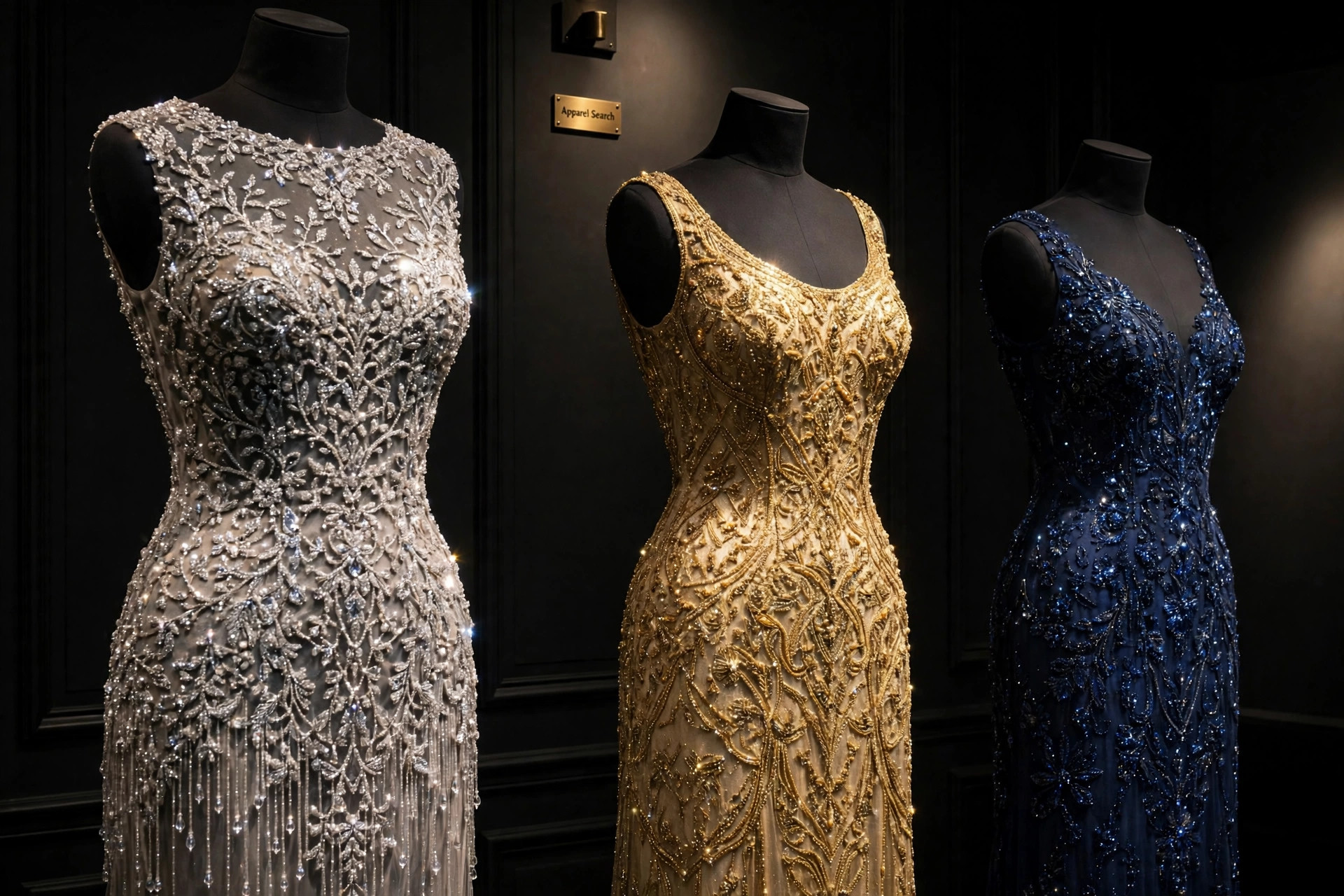
The exhibition that now fills the building is the house's own. Giorgio Armani Privé 2005–2025: Twenty Years of Haute Couture, which opened on 21 May 2025 and was curated by the designer himself, brings together about 150 haute couture creations from the two decades of Giorgio Armani Privé — the couture line launched in Paris in 2005 and always shown there, exhibited in Milan for the first time. Milan listings record the run as extended to 20 December 2026: twenty years of beaded, luminous evening dressing, in the building built to argue for it.
The Home
A Beehive of Concrete, and an Archive You Can Touch
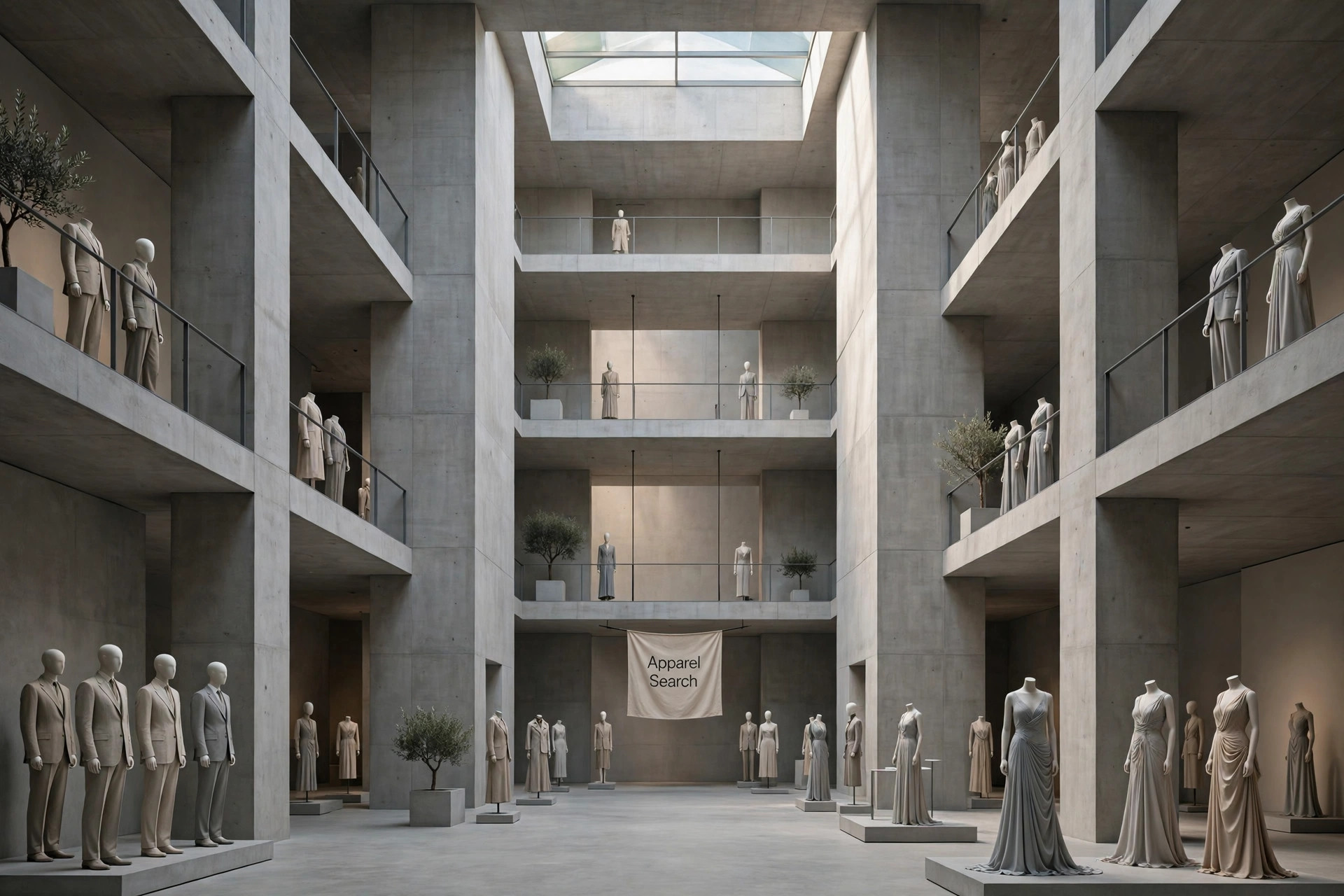
The building makes the argument before a single garment does. Raised in 1950 as the granary of a major international company — on the grounds of the former Nestlé headquarters, as Milan's visitor guide records — it measures, after renovation, around 4,500 square metres across four levels. Armani's renovation preserved its unusual original shape, likened to a beehive — a metaphor for industriousness the designer was happy to keep — and organised the interior on a basilica layout: a central open space rising the full four floors, with two levels of galleries overlooking it on either side. A single ribbon window runs around the perimeter like a crown; inside, black floors and ceilings carry the Armani palette, while the bare glass façade of the foyer on Via Bergognone lets natural light prevail.
On the top floor sits the museum's quietest and, for the fashion trade, most useful room: the Digital Archive. Here Armani opens his personal archive to the public — sketches, technical drawings and material on the prêt-à-porter Giorgio Armani and Giorgio Armani Privé collections, consultable free of charge at workstations and touchscreen tables, with a screening area for the runway and backstage films. The archive holds, by the Silos' account, approximately 1,000 outfits catalogued by season and collection and images of some 2,000 garments and accessories, alongside advertising photographs and material from the Emporio Armani Magazine — all organised through a cataloguing system developed specifically for Armani/Silos. For a designer, a student or a collector trying to date or attribute a piece, it is the most practical research tool any single-designer museum in this series offers.
A granary stored what a city needs in order to live. The Silos makes the same claim for a wardrobe: kept properly, clothes are a part of life — and of memory.
The remaining furniture is deliberately simple: a gift shop and an open-plan café complete a building that was designed, in the phrase the house uses for it, as a living space — a workshop in which nothing is permanent and new material keeps arriving. The programme around the exhibitions runs the same way, with educational activities, cultural meetings and projects with schools and institutions bringing students into the archive the house built for itself. Even the permanent museum, at Armani/Silos, is a work in progress.
Visiting
Visiting Armani/Silos
Armani/Silos stands at Via Bergognone 40 in the Tortona district of Milan, across from the Armani Teatro and the house's headquarters. Plan the visit in two halves: the permanent thematic display on the upper floors, which rewards a slow, floor-by-floor reading — Androgynous, then Ethnicities, then Stars — and whatever temporary exhibition currently holds the ground floor, which in the period documented for this guide is the Privé couture retrospective. Leave real time for the top-floor digital archive: it is free to consult, and visitors who work in fashion consistently rate it the most distinctive part of the building.
Because the ground-floor programme changes and the permanent hang is periodically refreshed, check the museum's own website — armanisilos.com — for the current exhibition, opening days and ticket arrangements before you go; this guide deliberately lists none of them, since all three change. Tortona repays the trip on its own: combine the Silos with the district's design showrooms and, if your visit falls in fashion week, the awareness that the shows themselves are happening across the street.
Exhibitions change and galleries are rehung, so the details here describe Armani/Silos as documented for this guide — the museum's own site always carries the latest version.
Common Questions
Common Questions
Is Armani/Silos a museum or an Armani shop?
It is an exhibition space and archive, not a store. Armani/Silos presents Giorgio Armani's own creations in a permanent thematic display, hosts temporary exhibitions on the ground floor, and houses a digital archive visitors can consult. It does contain a gift shop and a café, but the building's purpose is exhibition and research: it is the museum Giorgio Armani built for his own work.
Why is it called Silos?
Because of the building. The space at Via Bergognone 40 was originally the granary of a major international company, built in 1950 to store grain. Giorgio Armani kept the name when he converted it, explaining that the building used to store food, which is essential for life — and that for him, just as much as food, clothes are also a part of life.
Are the clothes displayed in date order?
No — and that is the point. The permanent display arranges Armani creations from 1980 to the present by theme rather than chronology: Androgynous on the first floor, Ethnicities on the second, and Stars on the third. Garments from different decades hang side by side so visitors can read the constants of the style — the cut, the fabrics, the restraint — instead of following fashion season by season.
What is the digital archive at Armani/Silos?
It is Giorgio Armani's personal archive, opened to the public on the top floor of the Silos. Visitors can consult it free of charge at workstations and touchscreen tables: sketches, technical drawings, runway and backstage films, and a catalogue of approximately 1,000 outfits organised by season and collection, with images of some 2,000 garments and accessories. It is the building's main tool for researchers, students and collectors.
What should a fashion lover not miss at Armani/Silos?
The three thematic floors of the permanent display — Androgynous above all, which is the Armani style in its purest form — the current ground-floor exhibition, and the digital archive on the top floor. While the Privé retrospective runs, its roughly 150 haute couture creations are the rarest sight in the building: the Paris couture line, shown in Milan for the first time. Check the museum's own website for what is on before you go.
In This Series
Every guide in Fashion Museums of the World, from the section hub.
Museums & Exhibitions on Apparel Search
The site's existing museum coverage, including the term guide this series grows from.
Related on Apparel Search
The designer's profile, the industry around him, and the party his red carpet helped inspire.
Search Apparel Search