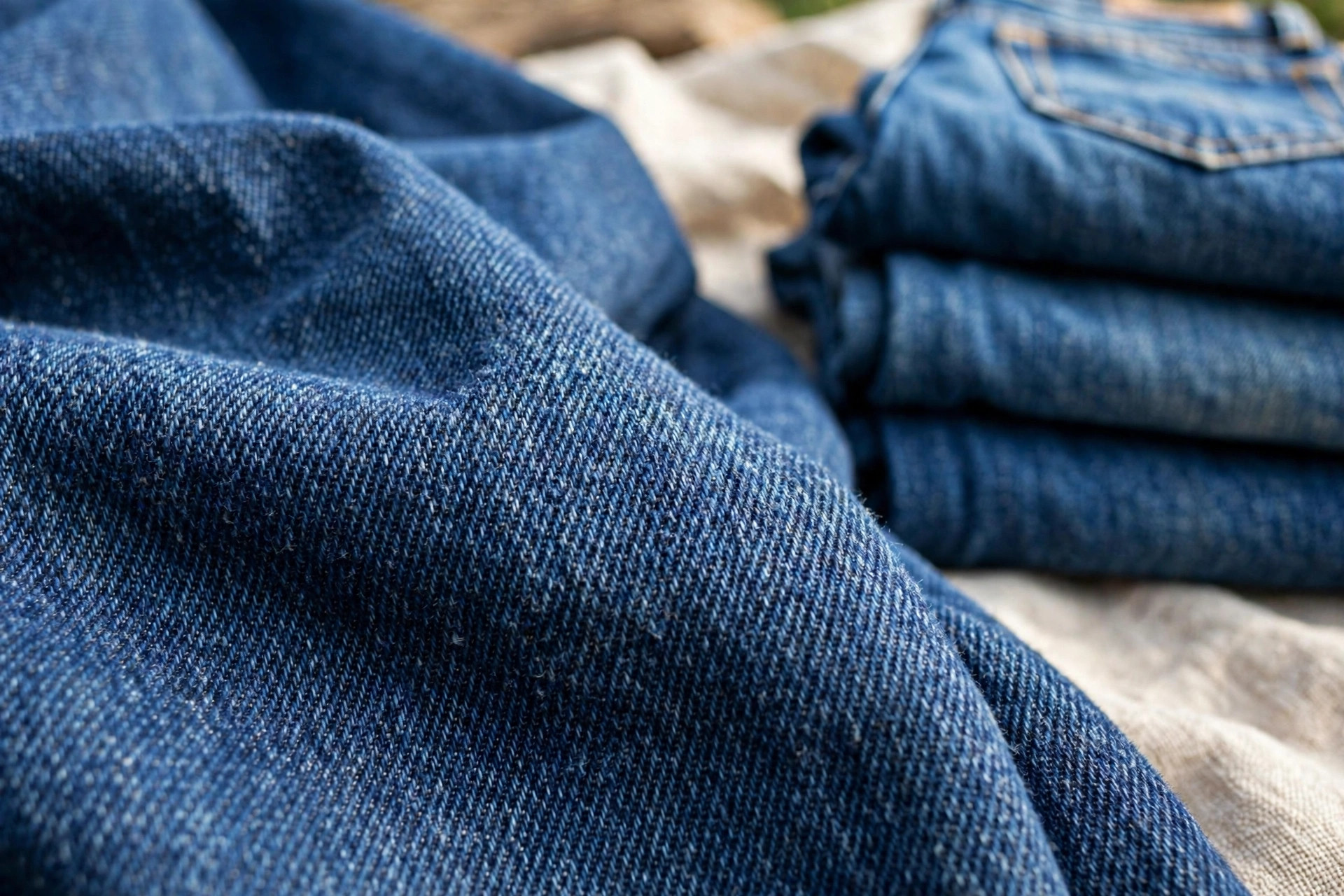
Denim is a sturdy cotton twill weave recognized by its diagonal rib and its classic blue face with a pale reverse. Only the warp yarns are dyed — traditionally with indigo — while the weft stays white, which is why denim fades to that familiar worn-in look. It is the fabric behind blue jeans, jackets, and workwear the world over.
How Denim Gets Its Look
Denim's character comes from the twill weave: each weft yarn passes under two or more warp yarns, stepping over one each row to form the diagonal line. Because the dyed warp dominates the face and the undyed weft shows on the back, the cloth reads blue on the outside and white inside.
Indigo dye only coats the surface of the yarn rather than penetrating it, so every wash and wear rubs a little color away. That is why new jeans are dark and rigid while old favorites turn soft and pale at the knees and thighs — the fade is built into the chemistry.
Denim Through History
The name comes from serge de Nîmes, a twill made in Nîmes, France. In 1873, Levi Strauss and Jacob Davis patented riveted work pants in the fabric, and denim became the uniform of miners, cowboys, and railroad workers.
The 20th century carried denim from workwear to rebellion to high fashion — 1950s youth culture, 1970s designer jeans, 1990s baggy fits, and today's premium selvedge revival. Few fabrics have crossed so many social boundaries.
Working With Denim Today
Denim is sold by weight in ounces per square yard: under 12 oz. is lightweight, 12–16 oz. is midweight, and anything above is heavyweight. Heavier denim lasts longer but needs breaking in; lighter denim drapes better and suits shirts and dresses.
Selvedge denim, woven on old shuttle looms with a self-finished edge, is prized by enthusiasts. Wash denim as rarely as you can stand, inside out in cold water, and skip the dryer — heat and agitation are what age it fastest.
FAQs
- What is the difference between denim and jeans?
- Denim is the fabric; jeans are the garment. Jeans are almost always cut from denim, but denim is also used for jackets, shirts, skirts, and overalls.
- What is selvedge denim?
- Selvedge (self-edge) denim is woven on vintage shuttle looms that produce a narrow, tightly woven strip with a finished edge, often marked with a colored thread. It frays less and is prized for its character.
- Why does denim fade?
- Indigo dye sits on the yarn's surface instead of soaking through. Friction and washing gradually rub it off, exposing the white core — which creates whiskers, honeycombs, and other fade patterns.
- How heavy should my denim be?
- For everyday jeans, 12–14 oz. hits the sweet spot of durability and comfort. Above 16 oz. is enthusiast territory: tougher, but stiff for weeks until it breaks in.
Glossary: see the full fashion glossary for more apparel industry terms.