Before the Needle
Measuring and Pinning: Where Hems Are Won
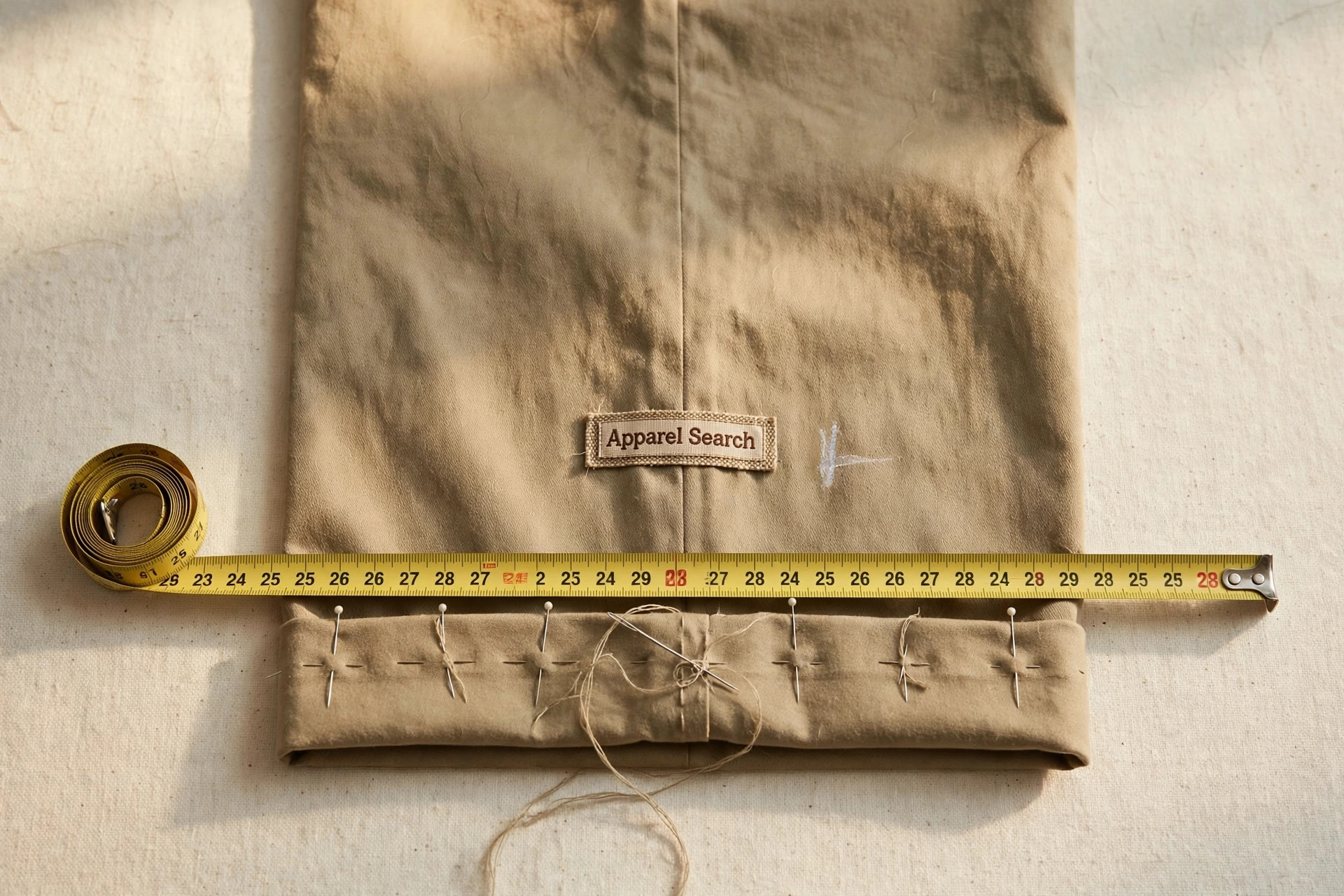
Hand hemming asks for one nearly invisible stitch and a lot of honest measuring. The stitch is the easy part. A hem fails because it was marked in socks instead of shoes, pinned at the front only, or cut before it was checked — so this page spends its first section where good hems are actually decided.
Try the garment on wearing the shoes it will be worn with — heel height changes a trouser break completely. Have a helper, or use a mirror and patience, to pin the new length at several points around the leg or skirt. Then take the garment off and measure the pinned line: for trousers, measure up from the old hem or down from the waistband at four points per leg and average them; for a skirt, measure from the waistband down, all the way around. Press the fold firmly with an iron before any cutting, and only then trim the excess, leaving a hem allowance of about 1½ inches (4 cm) for trousers and skirts — less for very light fabrics. Finish the raw edge by turning under a quarter inch, so it cannot fray inside the hem. The terms themselves are set out in our hems definitions and the decorative cousin, the hemstitch.
The Method
The Blind Stitch, Step by Step
- Thread a fine needle with a single strand matched to the fabric — a single strand hides better than a double — and knot the end inside the hem fold.
- Anchor inside the fold. Bring the needle out through the top edge of the folded hem, hiding the knot inside.
- Catch the garment. Directly above where the needle emerged, pick up just one or two threads of the garment fabric — never a full bite — with the needle pointing back toward your stitching hand.
- Travel inside the fold. Slide the needle back into the hem fold and run it along inside for about a quarter inch (6 mm), then bring it out and repeat.
- Check the outside every few stitches: correctly worked, the outside shows only the faintest dimples, evenly spaced.
- Finish and press. Knot inside the fold, trim, and press the hem with the iron over a cloth for a crisp, professional edge.
The alternative hand stitch is the catch stitch: loose diagonal crosses worked between the hem edge and the garment, each crossing catching a thread or two on both sides. It shows a little more inside the garment but flexes with movement, which is why tailors favour it on skirts and anything that swings.
No-Sew Option
Hemming Tape: The Honest No-Sew Alternative
Fusible hemming tape is a web of heat-activated adhesive sold in rolls. You lay a strip inside the folded hem and press with a hot iron; the web melts and bonds the fold to the garment. It needs no needle at all, takes five minutes, and is a legitimate choice for a quick fix, a costume, a child’s outgrown-next-month trousers, or a wearer who simply will not sew. Be honest about its limits, though: the bond can soften and let go after repeated hot washes, it stiffens the hem slightly, it can leave residue if removed, and it is a poor choice for heavy fabric, sheer fabric, or anything dry-cleaned in solvents. Treat tape as a good temporary and a fair casual permanent — but for a garment you expect to keep, the blind stitch above is stronger, softer and free.
Decisions
Cuffs Versus Straight Hems on Trousers
A straight hem suits almost everything: jeans, chinos, women’s trousers, and any leg that tapers. It is measured, folded and stitched exactly as above. A cuff (a turn-up) is a deliberate style feature on wider, straighter legs — it adds visual weight at the ankle and shortens the apparent leg, which flatters tall wearers and can overwhelm short ones. Cuffs need more allowance: the visible turn-up plus the fold that forms it, so never promise cuffs until you have measured the outseam twice — cutting for a straight hem first can leave too little cloth. Cuffs also collect dust and need pressing to stay crisp. If the trousers came cuffed and you are shortening them, the cuff must be unpicked, the new length cut, and the cuff re-formed at the new line — entirely doable by hand, just slower. Our hemming and basic hand sewing guide covers machine hemming alongside the hand methods when a machine is available.
Questions
Common Questions
What stitch makes a hem invisible from the outside?
The blind stitch — also worked as a slip stitch or, in its crossing form, a catch stitch. The thread travels hidden inside the hem fold and catches only one or two threads of the garment fabric, so the outside shows nothing but faint dimples.
How much hem allowance should I leave when I trim?
About 1½ inches (4 cm) for trousers and skirts, less for lightweight fabrics. Trim only after the new line is pinned, measured all around and pressed — allowance cut away cannot be put back.
Is hemming tape a real alternative to sewing?
For quick fixes and casual garments, yes: it bonds in minutes with an iron. It can loosen in repeated hot washes and stiffens the hem, so for a garment you plan to keep, a hand blind stitch is the stronger, softer choice.
More to Explore
Search Apparel Search