Selecting Embroidery Stabilizers
Choosing cut-away, tear-away and wash-away backing for clean, pucker-free embroidery.
Stabilizers provide a smooth surface so stitches lay parallel and cooperate with each other. A stabilizer often gives embroidery a better finished look and helps prevent puckering and bunching of stitches: every needle penetration pushes and pulls the fabric, and without support behind it, a soft or stretchy garment distorts as the design forms, leaving wavy lettering and outlines that no longer meet.
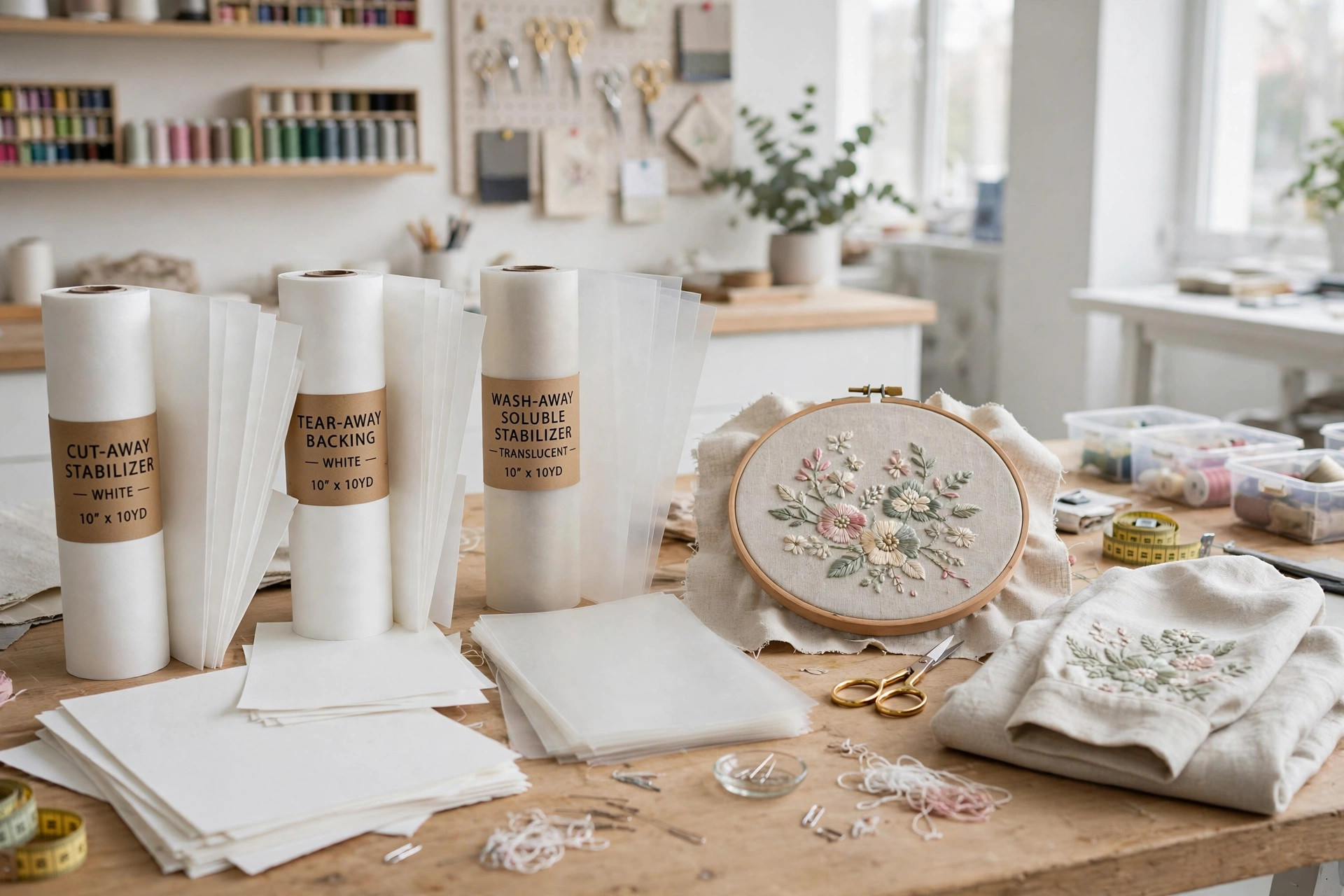
Stabilizers fall into two primary methods: tear-away temporary stabilizers and cut-away permanent stabilizers, with soluble wash-away types completing the toolkit. This page explains each family, its variants, and how to choose among them by fabric type and weight, stitch density and design — then test the choice by washing before mass production.
Stabilizer & Backing Resources
Tear-Away: Temporary Stabilizers
Tear-away backing is available in several weights and can be used in single or multiple layers. It is recommended for use with medium to heavyweight fabrics and densely stitched designs: the fabric itself is stable enough to hold the finished embroidery, so the backing only needs to support the work while it is being stitched. After stitching, the backing is torn away — carefully, supporting the stitches with one hand while tearing with the other, in order not to disturb the stitching of the design. This method is not recommended for delicate fabrics, which the tearing itself can distort or damage.
Variants cover different needs. Iron-on tear-away fuses to the fabric so nothing shifts in the hoop. Adhesive-backed tear-away holds items that are hard to hoop. Soluble stabilizer — a gelatin-like sheet that dissolves in warm water — is the wash-away option: it supports stitching on fabrics where any remaining backing would show or stiffen the garment, and it also serves as a topping over pile fabrics such as toweling and fleece, keeping stitches from sinking into the nap before it is rinsed away.
Cut-Away: Permanent Stabilizers
Cut-away stabilizers are meant to remain with the garment. After stitching, only the excess around the design is trimmed away; the backing behind the stitches stays for the life of the garment, continuing to support the embroidery through wearing and washing. Cut-away washes well and is beneficial for jobs where the stabilizer comes in contact with the skin, because a soft permanent backing is more comfortable than a torn edge, and because knit and stretch fabrics genuinely need the permanent support — without it, embroidery on a polo or tee gradually pulls and puckers as the fabric moves and the stitches do not.
The permanent family includes standard cut-away stabilizers in several weights, poly-mesh cutaway — a soft, sheer, lightweight version favored for lightweight garments and designs worn next to the skin, since it adds support without bulk or show-through — lofty fusible options, and fusible cut-away, which is ironed to the fabric before hooping so the fabric and backing move as one layer through the machine.
How to Choose: Fabric, Design and Testing
When determining which stabilizer is best for a product, evaluate the type of fabric, the weight of the fabric, the density of the stitches, the embroidery design, and other factors. The working logic runs like this: the lighter, softer or stretchier the fabric, and the denser the design, the more support the embroidery needs — which points toward cut-away, sometimes in more than one layer. The heavier and more stable the fabric, the more a tear-away in the right weight will do. Delicate fabrics rule out tearing; designs on towels and fleece call for a soluble topping; garments worn against the skin favor soft poly-mesh.
Whatever the chart suggests, test it. Conduct wash testing to see how well the garment performs with the embroidery before going to mass production: stitch the real design on the real fabric with the chosen stabilizer, wash it the way the end customer will, and check for puckering, distortion and edge curl. A stabilizer choice that survives the wash test is a production specification — record the type, weight and number of layers alongside the design file so every repeat run is supported the same way.
Embroidery Definitions & Styles
- Applique
- Art Needlework
- Assisi Embroidery
- Berlin Wool Work Embroidery
- Blackwork Embroidery
- Canvas Work
- Counted Thread Embroidery
- Crewel Embroidery
- Drawn Thread Work (embroidery)
- Embroidery Stitch
- Free Embroidery
- Hardanger embroidery
- Hastings Embroidery
- Jacobean Embroidery
- Stumpwork Embroidery
- Surface Embroidery
- Whitework Embroidery
- Embroidery Definition
More Embroidery Information
Common Questions
What is the difference between cut-away and tear-away stabilizer?
Cut-away is a permanent backing: it stays behind the stitches for the life of the garment, supporting knit and stretch fabrics through washing and wear. Tear-away is temporary: it supports medium to heavyweight fabrics during stitching and is then torn away carefully so the stitching is not disturbed.
When should a wash-away soluble stabilizer be used?
When no backing should remain — on fabrics where residue would show or stiffen the garment — and as a topping over pile fabrics such as towels and fleece, where it keeps stitches sitting on top of the nap. The gelatin-like sheet dissolves in warm water after stitching.
Why wash-test a stabilizer choice before production?
Washing reveals whether the fabric, design density and stabilizer work together: puckering, distortion and edge curl often appear only after laundering. Testing the real design on the real fabric, then washing it as a customer would, confirms the choice before mass production commits to it.