Stitch 602 · Class 600 Flat / Cover Stitch
Stitch 602 — Two-Needle Bottom Cover Stitch
Stitch 602 is the two-needle cover stitch of Class 600: four threads — two needle threads, a looper thread and a top cover thread. The looper covers the underside between the two needle rows (the bottom cover that gives the stitch its everyday name, inherited from its Class 400 relative, stitch 406), and the Class 600 addition — a cover thread laced across the top face — finishes the seam on both sides.
How Stitch 602 Forms
- The two needles descend side by side, carrying needle threads A1 and A2 through the material together. As they begin to rise, a loop of each needle thread forms beneath the material.
- The looper, travelling across beneath the needle plate, passes its thread B through both needle loops in turn. Drawn up, thread B zigzags from row to row across the underside, interlooping with both needle threads — this is the bottom cover, the looped blanket that covers the underside of the seam and any raw edge beneath it.
- On the top face, a spreader lays the cover thread C across the two needle rows. As the needles descend for the next stitch, they pass on alternating sides of the laid thread, catching it under their penetrations so C is laced back and forth between the rows, stitch by stitch.
- The machine advances the work by one stitch length and the cycle repeats. No thread is ever locked inside the material as in a lock stitch: every thread is held by interlooping, which is what gives the seam its stretch.
Formation diagram for stitch 602. Threads A are the needle threads, B is the looper thread and C is the top cover thread. Illustration by Apparel Search.
The Threads
| Element | Detail |
|---|---|
| Thread count | 4 — two needle threads, one looper thread, one top cover thread. (Professor Kahn's table counts the cover thread among the looper threads: 'two needle and two looper threads'.) |
| Needle threads (A1, A2) | Form the two straight parallel rows visible on the top face, and pass through the material to interloop with the looper beneath. |
| Looper thread (B) | Never passes through the material. It zigzags between the needle rows on the underside, covering the bottom of the seam — the bottom cover. |
| Cover thread (C) | Lies on the top face only, laced in a zigzag between the two needle rows and caught by each needle penetration. It is the thread that makes this a Class 600 stitch rather than a Class 400 one. |
| Typical threads | Textured (woolly) polyester or nylon in the looper and cover positions for softness against the skin; spun or core-spun polyester in the needles. On decorative work the cover thread is often a contrasting colour. |
| Thread use | High compared with a lock stitch — roughly five to six metres of thread, all positions counted, per metre of seam — because both faces are covered. |
What It Looks Like
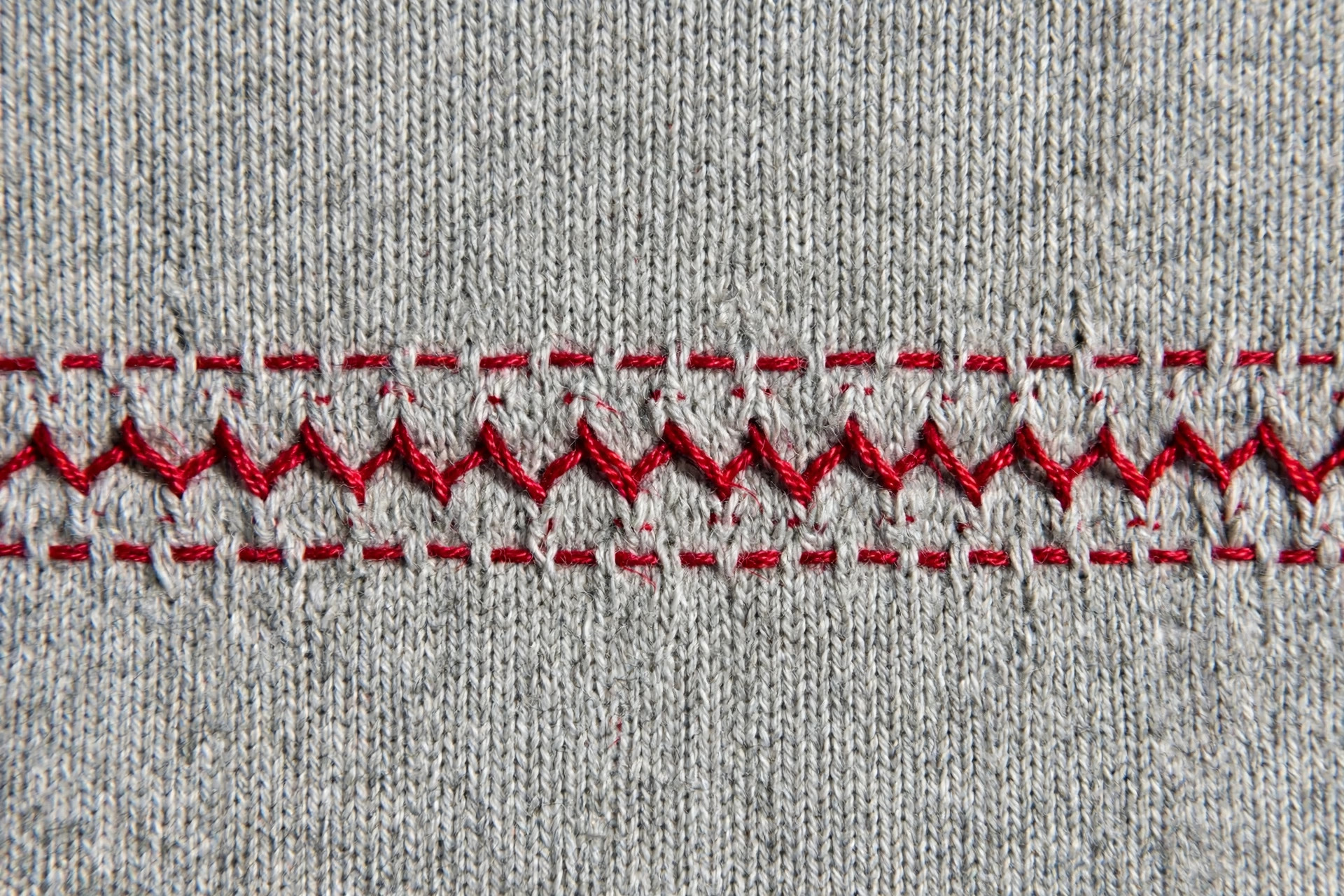
On the top, stitch 602 shows two straight, parallel rows of needle stitching with a third thread laced diagonally between them, zigzagging from row to row: a neat ladder of thread across the seam's width. On the underside, the picture mirrors it — the two needle rows are joined by the looper thread zigzagging between them, covering the whole span so no raw edge or seam allowance shows through.
That two-faced finish is the quickest way to recognise 602 in a garment. Its Class 400 cousin, stitch 406, looks similar from underneath but plain from the top — just two bare rows. If the top face carries the laced cover thread, the stitch is 602. In a matched thread the lacing is subtle and the seam reads as a smart, flat double-row topstitch; in a contrast thread it becomes a deliberate decorative feature, a use the lingerie and sportswear trades exploit constantly.
Because the stitch is set by interlooping rather than by a knot pulled into the fabric, a well-balanced 602 seam lies dead flat and feels smooth on both sides. If the looper is too tight the seam tunnels — the fabric ridges up between the rows — and if the cover thread is too loose it loops and snags; both faults are tension problems, not stitch problems, and a sample seam on the actual fabric is the standard cure.
Strengths and Limits
Strengths
- Finished on both faces: the only compact cover stitch that looks deliberate from the outside and the inside.
- Stretches with knit fabrics and recovers — the interlooped threads carry spare length a lock stitch cannot.
- Covers and secures a raw edge or a seam allowance in the same pass that hems or joins.
- Lies flat and soft: no knot inside the fabric and no ridge, so it is comfortable next to the skin.
Limits
- Needs a coverstitch machine with a top cover spreader — it cannot be sewn on a plain lockstitch or overlock machine.
- Uses far more thread than a lock stitch, and the four tensions must be balanced together.
- As a chain formation it can run back from the finishing end if the end is not secured — ends are locked or caught in a later seam.
- Overkill on stable wovens, where a lock stitch is neater, cheaper and stronger for the purpose.
Where Stitch 602 Is Used
Stitch 602 is the knitwear finisher. It hems T-shirts, polo shirts, sweatshirts and knit dresses, holding the folded hem flat with a seam that stretches as the garment is pulled on. It binds necklines, armholes and leg openings — on vests, babywear and underwear a 602 binding wraps the raw edge and covers it on both faces in one operation, which is why baby garments, whose insides are seen as much as their outsides, are so often bound with it. Run back over a seam that has already been joined, it becomes coverseaming: the stitch pins the seam allowances flat to one side and covers them, the standard finish inside quality knit shirts.
Typical fabrics: single jersey, interlock, rib knits, cotton-elastane blends and light stretch wovens — fabrics that move. The stitch belongs to the flat and lapped seam families it usually sews: see Seam Class FS — Flat Seams and Seam Class LS — Lapped Seams. Where a wider cover is needed, the class steps up to stitch 605; where two edges are to be butted into a seam with no ridge at all, it steps up to stitch 607. All three types, and every other stitch in this guide, are gathered in the Explore Stitches gallery.
Common Questions
Is stitch 602 the stitch on a T-shirt hem?
Often, but check the top face. Many T-shirt hems are sewn with stitch 406 — two plain rows on top, looper cover beneath. If the hem shows a thread laced between the two rows on the outside, it is 602: the top cover thread is the giveaway.
Why is it called a bottom cover stitch if it covers the top too?
The name is inherited from the Class 400 bottom cover stitches (406, 407), whose looper covers the bottom of the seam. Stitch 602 keeps that bottom cover and adds the Class 600 top cover thread. Factory shorthand kept the older name; the thread table on this page gives the full four-thread picture.
Can stitch 602 join seams, or only finish them?
Both. It seams knits in its own right — Kahn's table lists it as a seaming stitch for hemming on knits as well as a cover stitch — but in most garments the structural join is made first (often with an overedge stitch) and 602 covers, flattens and finishes it.
Sources & the photographic reference
The stitch and seam classifications on this page follow ASTM D-6193, Standard Practice for Stitches and Seams, explained here in Apparel Search's own words with original diagrams. For photographs of these stitches and seams, see the Garmenco guide's Class 600 page — Professor Bernard Kahn's photographic guide, which Apparel Search has recommended for years and continues to link as the photo reference for this classification. Our guide is the permanent on-site companion to it.
Related Stitches
 Stitch 605 — Top-and-Bottom Cover Stitch
 Stitch 607 — Flatlock Stitch
 Stitch Class 600 — Flat Stitch
More to Explore
Search Apparel Search
Stitch and seam classifications follow ASTM D-6193, Standard Practice for Stitches and Seams. Diagrams on these pages are original Apparel Search drawings.