Button Sewing · The Stitch & Seams Guide
Machine Button Sewing — Two-Hole, Four-Hole & Shank Buttons
Button sewing is the automatic-cycle operation that attaches a button to a garment: the button is clamped in a jig, the machine's needle passes through its holes in a set pattern for a set number of stitches, and the button is left standing on a neat neck of thread. This page covers the five examples in Professor Kahn's inventory — two-hole and four-hole buttons in chain stitch and lock stitch, the X-pattern four-hole, and the wrapped shank button sewn for heavy cloth.
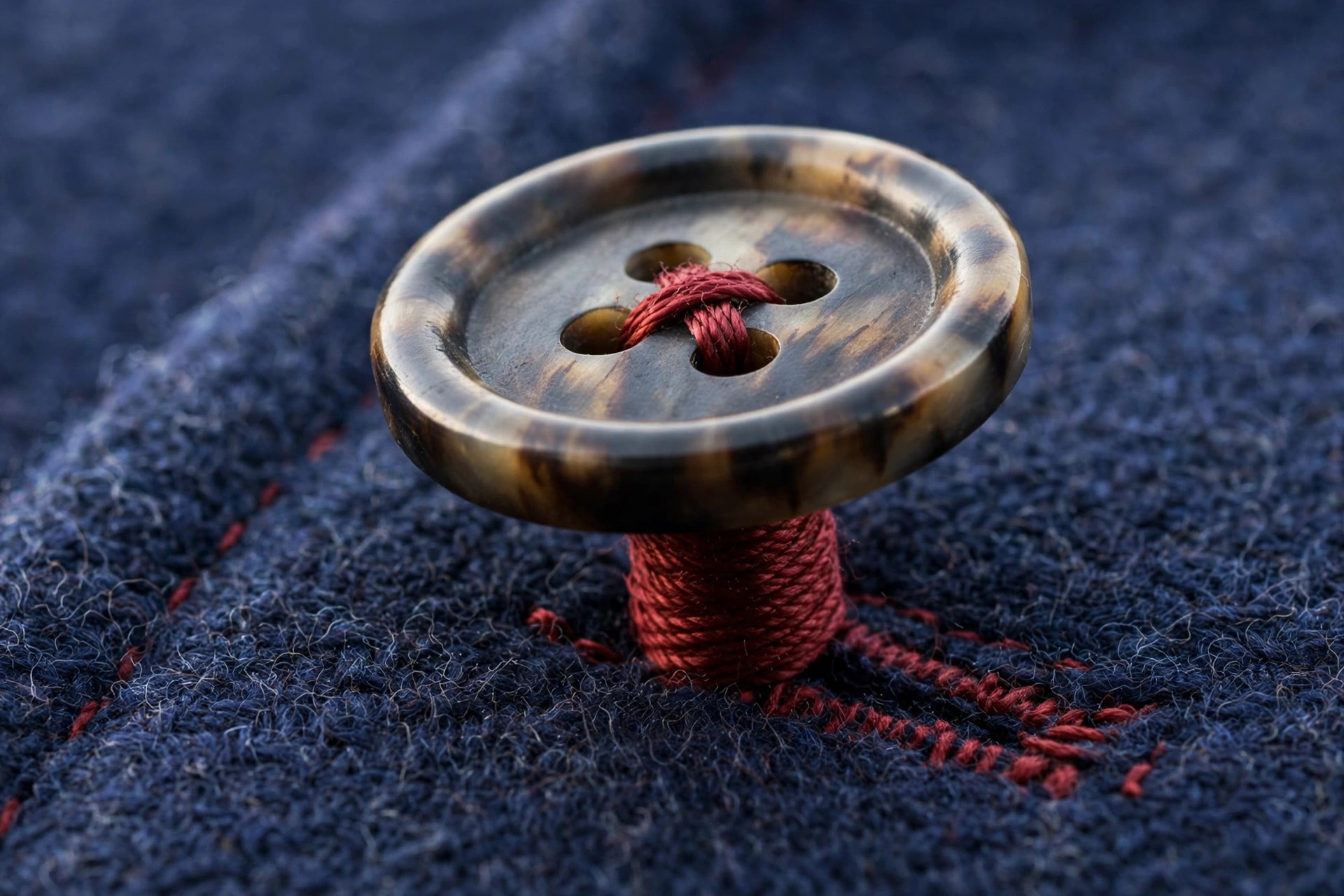
How a Button-Sewing Machine Works
A button-sewing machine does one job, perfectly repetitively. The operator places the button in a clamp that holds it over the marked position on the garment; the machine then moves the clamp (or the needle) in a programmed pattern so the needle passes through each hole of the button in turn, sewing a fixed number of stitches, and stops. The whole cycle takes seconds. Because the pattern is mechanical, every button on a garment — and every garment on the line — is sewn identically, with the same stitch count and the same snugness.
Two details decide whether the result lasts. The first is the formation: as with buttonholes, the work divides between the fast single-thread chain stitch (101) of Class 100 and the secure two-thread lock stitch (301) of Class 300. The second is the shank: buttons on anything thicker than a shirt are sewn on deliberately loose stitches, and the thread is then wound around those stitches — wrapping — to build a firm neck that holds the button at the height of the layers it must close over. The fifth example on this page is devoted to it.
The two standard thread patterns for a four-hole button. Illustration by Apparel Search.
The five button-sewing examples
The Five Examples
101Two-Hole Chain Stitch Buttonsew
Construction. One thread does everything. The needle passes up through one hole of the clamped two-hole button and down through the other, and beneath the fabric each pass interloops with the last — the single-thread chain formation — building two parallel bundles of thread that anchor the button. The machine finishes the cycle with the thread drawn to the underside.
Appearance. From the front, two neat parallel bars of thread cross the button's face between its holes. From the back — photographed separately in Kahn's inventory — the chain loops show as a soft line of loops under the button position.
Typical use and garments. The standard fast attachment for light to medium weight fabrics: shirts, blouses, dresses and light trousers. Its known weakness is the chain's: if the finishing end works free, the stitching can ladder back — better machines add a final locking stitch, and on light garments the risk is accepted for the speed.
301Two-Hole Lock Stitch Buttonsew
Construction. The same two-hole cycle worked in the lock stitch: needle thread and bobbin thread interlace inside the fabric at every pass, so each stitch through the button is independently locked. The machine carries a bobbin as well as a needle thread — the extra mechanism is the price of the formation.
Appearance. Two parallel bars on the face, as with the chain version, but the underside shows the lock stitch's tidy interlaced line rather than chain loops — the two faces of Kahn's photographed example read almost alike.
Typical use and garments. Medium weight goods, or where higher quality is required: tailored trousers, skirts, uniforms and better shirts — anywhere a lost button is a warranty claim rather than a shrug. A broken thread costs one stitch; the button stays on.
101Four-Hole Chainstitch Buttonsew
Construction. The clamp programme extends to four holes: the needle works one pair of holes for its set stitches, then the clamp shifts and it works the second pair, laying the familiar parallel pattern — two bars of thread across the button, as drawn in the diagram above. One thread, interlooped beneath throughout.
Appearance. Two straight, parallel thread bars crossing the button face — the plain, classic four-hole look found on most production clothing. The bars are sewn in the direction the buttonhole runs, so the button sits naturally in its hole.
Typical use and garments. The everyday four-hole button of shirts, trousers, skirts and dresses in light to medium cloth — the most common button-sewing operation in the industry, balancing speed, cost and adequate security.
301“X” Stitch — Four-Hole Buttonsew
Construction. Instead of pairing the holes into parallel bars, the machine's programme crosses the button diagonally: up through one hole, down through the diagonally opposite hole, repeated for both diagonals, so the threads form an X across the button's face. (Kahn's table places this example in its two-thread 301 row while its caption names the four-hole pattern — the X describes the thread pattern across the holes, and button-sewing machines lay it in the formation they are built for.)
Appearance. A bold cross of thread centred on the button — instantly recognisable, and often chosen deliberately as a visible style detail on workwear, denim and fashion garments, sometimes in a contrasting thread.
Typical use and garments. Four-hole buttons on garments that will be pulled at varying angles — workwear, jeans, casual jackets — and any garment where the maker wants the fastening to show its construction. Functionally it anchors all four holes exactly as the parallel pattern does; the choice is part engineering, part signature.
301Shank Button with Wrapping
The wrapped thread shank, seen from the side. Illustration by Apparel Search.
Construction. The button is first sewn on with deliberately loose stitches — the machine (or a spacer in the clamp) holds it away from the fabric while the lock stitches are made. The needle then comes up between button and fabric, and the thread is wound around the loose stitch bundle several times — the wrapping — binding the bundle into a single firm post: the thread shank. A final locking stitch secures the wrapping.
Appearance. The button stands proudly off the fabric on a neat, cord-like neck of thread, exactly as in this page's photograph. Fastened, the button sits level on top of the buttonhole's layers instead of being dragged down into them.
Typical use and garments. Suits and heavy weight goods where fabric is thick, in Kahn's words: coats, jackets, heavy trousers. The shank's height is matched to the thickness it must span — the thicker the closed layers, the taller the neck — and it is the natural partner of the keyhole buttonhole, whose round eye is shaped to receive it.
The Five Examples Compared
| Example | Stitch | Threads | Pattern / finish | Typical work |
|---|---|---|---|---|
| Two-hole buttonsew | 101 | 1 | Parallel bars, chain beneath | Light to medium fabrics: shirts, blouses |
| Two-hole buttonsew | 301 | 2 | Parallel bars, locked stitches | Medium goods; higher quality tailoring |
| Four-hole buttonsew | 101 | 1 | Parallel pattern | Everyday shirts, trousers, dresses |
| Four-hole “X” buttonsew | 301 row | 2 | Crossed diagonals | Workwear, denim, style-detail fastenings |
| Shank button with wrapping | 301 | 2 | Wrapped thread shank | Suits and heavy goods; thick fabrics |
Buttons exist to pass through buttonholes — the companion page on machine buttonholes covers the five buttonhole examples these buttons are sewn to match, including the keyhole eye shaped for a shank button.
Common Questions
What is a thread shank, and why do buttons need one?
A thread shank is the little neck of thread between the button and the fabric. A button fastened through a buttonhole does not sit on the surface — the fabric layers it closes have thickness, and the button must stand off by roughly that thickness or the garment puckers and the buttonhole strains. Sewing the button on loose stitches and then winding the thread around those stitches (wrapping) builds the neck to the right height and firms it into a post the button rides on.
Chain stitch or lock stitch — which holds a button better?
The lock stitch (301) is the more secure: its interlaced threads cannot run, so a broken thread costs a stitch, not the button. The chain stitch (101) is faster and cheaper and entirely adequate for light and medium garments, but if its finishing end is cut or worn through, the chain can ladder back and release the button — which is why better chain-stitch machines add a locking stitch at the end of the cycle, and why Kahn's inventory reserves the lock stitch versions for medium goods and higher quality.
What does the X pattern do on a four-hole button?
It is one of the two standard thread patterns a button-sewing machine can lay across four holes — crossed diagonals instead of two parallel bars. Both patterns anchor all four holes; the X spreads its threads diagonally, which some makers prefer for buttons that will be pulled at an angle, and it has become a recognisable style detail on workwear and fashion garments. The parallel pattern is the plainer, more common choice.
How many stitches hold a factory-sewn button?
The machine cycle is set by the operation — a fixed number of passes through each pair of holes, commonly in the low teens of individual stitches per button, finished with a locking or wrapping sequence where specified. What matters for durability is less the raw count than the combination of stitch formation, a correct shank, and the end of the cycle being properly locked.
Sources & the photographic reference
The stitch and seam classifications on this page follow ASTM D-6193, Standard Practice for Stitches and Seams, explained here in Apparel Search's own words with original diagrams. For photographs of these stitches and seams, see the Garmenco guide's button-sew page — Professor Bernard Kahn's photographic guide, which Apparel Search has recommended for years and continues to link as the photo reference for this classification. Our guide is the permanent on-site companion to it.
Related Pages
 Machine Buttonholes
 Stitch Class 300 — Lock Stitch
 Stitch Class 100 — Chain Stitch
More to Explore
Search Apparel Search
Stitch and seam classifications follow ASTM D-6193, Standard Practice for Stitches and Seams. Diagrams on these pages are original Apparel Search drawings.