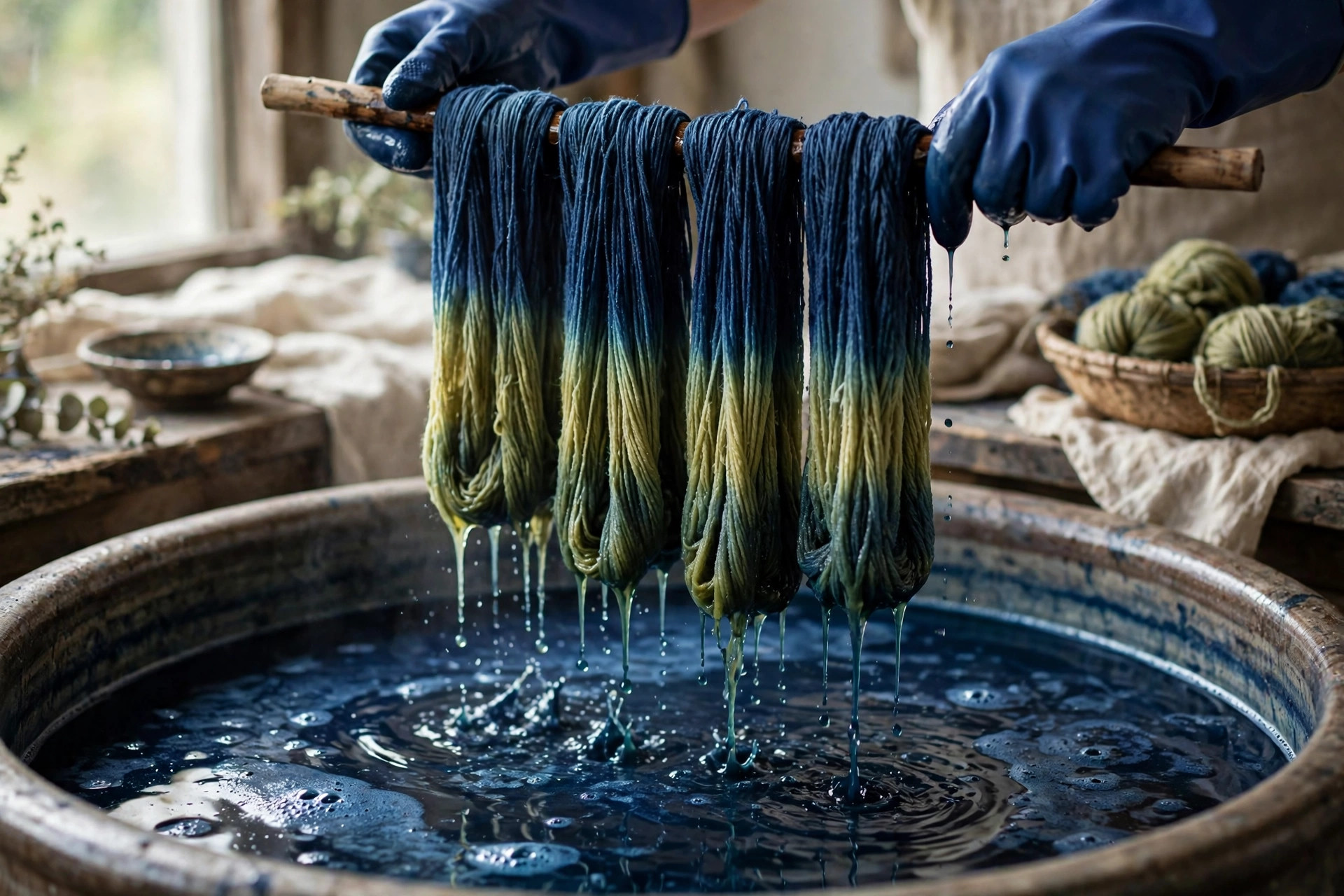
Vat dyes are a class of dyes that are insoluble in water in their colored form. To dye with them, the dyer first reduces the dye in an alkaline vat to a soluble, nearly colorless ‘leuco’ form; the fiber absorbs that form, and exposure to air (or an oxidizer) then converts it back to the insoluble colored pigment, trapped inside the fiber. The result is the most wash- and light-fast dyeing available for cotton — and the method behind indigo denim.
The Vat Process, Step by Step
Reduction: the dye, alkali, and a reducing agent are combined in the vat until the dye dissolves into its leuco form — indigo’s vat famously turns yellow-green. Dyeing: yarn or fabric is immersed, removed, and exposed to air, where oxidation restores the color; shade depth is built by repeated dips, exactly as denim warp yarn is dipped again and again through a series of indigo vats. After-treatment: rinsing, oxidation completion, and soaping remove loose surface dye and develop the true, final shade. Because the finished pigment is insoluble and lodged within the fiber, vat-dyed cotton shrugs off repeated laundering that would strip lesser dye classes.
Indigo: The Special Case
Indigo is a vat dye with a quirk: it has low affinity for cotton, so it deposits mainly on the yarn’s surface (‘ring dyeing’) rather than penetrating to the core. That quirk is denim’s whole aesthetic — abrasion and washing remove the surface indigo and reveal the white core, producing fades, whiskers, and the worn-in character no other dye gives. Brands should understand that indigo’s beloved fading is, technically, the dye class performing below its usual fastness — and that the same vat chemistry applied with high-affinity vat dyes produces workwear and uniforms chosen precisely because they do not fade.
Where Vat Dyes Win
Spec vat dyeing for premium and hard-service cotton: uniforms, workwear, towels, military and institutional textiles, and any program where years of industrial laundering must not shift the shade. The costs are real — vat dyes are among the more expensive dye classes, the reduction chemistry needs skilled control, and shade ranges, while broad, are less brilliant than reactive dyes. Compare the neighboring cotton methods in this series: sulfur dyes for economical dark shades, pigment dyeing for garment-dyed vintage looks, and solution dyeing on the synthetic side.
FAQs
- Why is it called vat dyeing?
- After the vat in which the insoluble dye is reduced to its soluble leuco form. The name predates industrial dyeing — indigo fermentation vats are ancient technology.
- Is indigo a vat dye?
- Yes, the most famous one. Its low fiber affinity causes ring dyeing, which is why denim fades at the surface while other vat-dyed cotton holds its color.
- Are vat dyes colorfast?
- They are the fastest class for cellulosic fibers: excellent wash and light fastness once soaped properly, which is why they are used for uniforms and workwear.
- What fabrics are vat dyed?
- Primarily cotton and other cellulosics (linen, rayon). The dye class is not used on polyester or wool, which have their own dye systems.
More B2B Production Guides
This guide is part of the Apparel Search B2B production series on specifications, printing, dyeing, trade terms, and compliance. Browse the full series below, or start from the manufacturing guides hub.
Spec, Measure & Inspect
Print Methods
Dye Methods
- Solution Dyeing (Dope Dyeing)
- Vat Dyeing (this guide)
- Sulfur Dyeing
- Pigment Dyeing
Trade & Compliance
Apparel Search: explore the manufacturing guides hub and production & sourcing resources for the fashion industry.