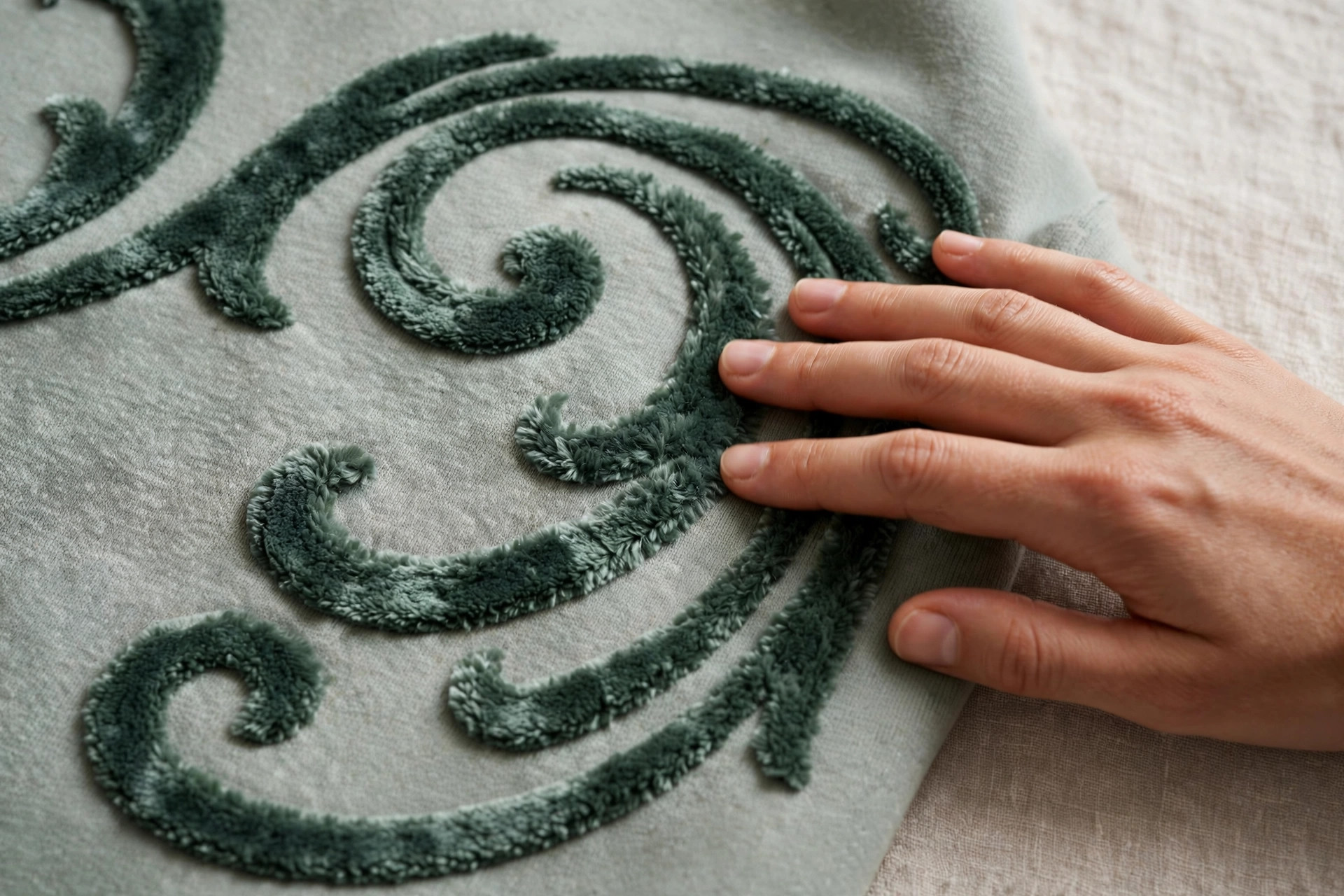
Flocking coats a printed design with thousands of short, fine fibers (flock) that bond to an adhesive layer and stand upright, producing a raised, velvet- or suede-like texture you can feel as clearly as see. Long used on jerseys, collegiate sweatshirts, and fashion graphics, flocking turns a flat logo into a tactile surface in deep, matte colors.
How Flocking Is Done
The design is first screen printed with adhesive. Flock fibers — usually rayon, nylon, or polyester, cut to fractions of a millimeter — are then applied over the wet adhesive. In electrostatic flocking, a charge makes the fibers align and drive upright into the adhesive, which is what creates the dense velvet pile; simpler mechanical application lays fibers less uniformly. Excess flock is vacuumed or shaken off, the adhesive is cured, and the result is a soft raised design. Flock is also sold pre-applied to transfer films (flock heat-transfer vinyl) for names, numbers, and small runs.
Design and Durability
Flocking likes bold shapes, block lettering, and simple silhouettes. Fine lines flock patchily, tight inside corners fill, and multi-color designs need a separate adhesive pass and flock application per color, with registration that gets harder as colors multiply. Durability is good for a special finish: the fibers are anchored in cured adhesive, so a quality flock print survives normal washing well, though the pile gradually flattens and can abrade at fold and friction points. Wash inside out and skip high dryer heat. Compared with its special-effect siblings, flock is softer than puff, matte where foil is mirror-bright, and more opaque on dark garments than standard water-based ink.
Where Flock Earns Its Place
Team and campus apparel is flock’s home ground — names, numbers, and crests that should feel substantial — along with fashion graphics trading on retro velvet lettering, children’s designs where touch is part of the appeal, and premium sweatshirts. Beyond garments, the same process textures packaging, wallpaper, and automotive interiors, which is why flock suppliers often serve several industries. Specify fiber type and length, adhesive, and color standard on the order, and approve a washed sample: flock color reads darker and richer than the same hue in flat ink, so approving from an ink swatch alone misleads.
FAQs
- What is flocking on a shirt?
- A print finish where short fibers are bonded upright onto printed adhesive, creating a raised velvet-like design you can feel.
- Does flocking wash off?
- A properly cured flock print holds up well to normal washing. The pile slowly flattens over time and harsh drying accelerates wear, but the fibers do not simply wash away.
- Can flocking be any color?
- Flock fiber comes in a wide color range, dyed before cutting, so colors are rich and opaque even on dark garments. Exact matching uses the flock supplier’s color card.
- Flock vs. puff print: what is the difference?
- Flock is a fiber pile with a velvet feel; puff is expanded ink with a smooth spongy feel. Both are raised and bold-shape-friendly, but their texture and look are completely different.
More B2B Production Guides
This guide is part of the Apparel Search B2B production series on specifications, printing, dyeing, trade terms, and compliance. Browse the full series below, or start from the manufacturing guides hub.
Spec, Measure & Inspect
Print Methods
- Discharge Printing
- Water-Based Printing
- Puff Print
- Foil Print
- Flocking (this guide)
Dye Methods
Trade & Compliance
Apparel Search: explore the manufacturing guides hub and production & sourcing resources for the fashion industry.