01 — The Garment
What a Chore Coat Is
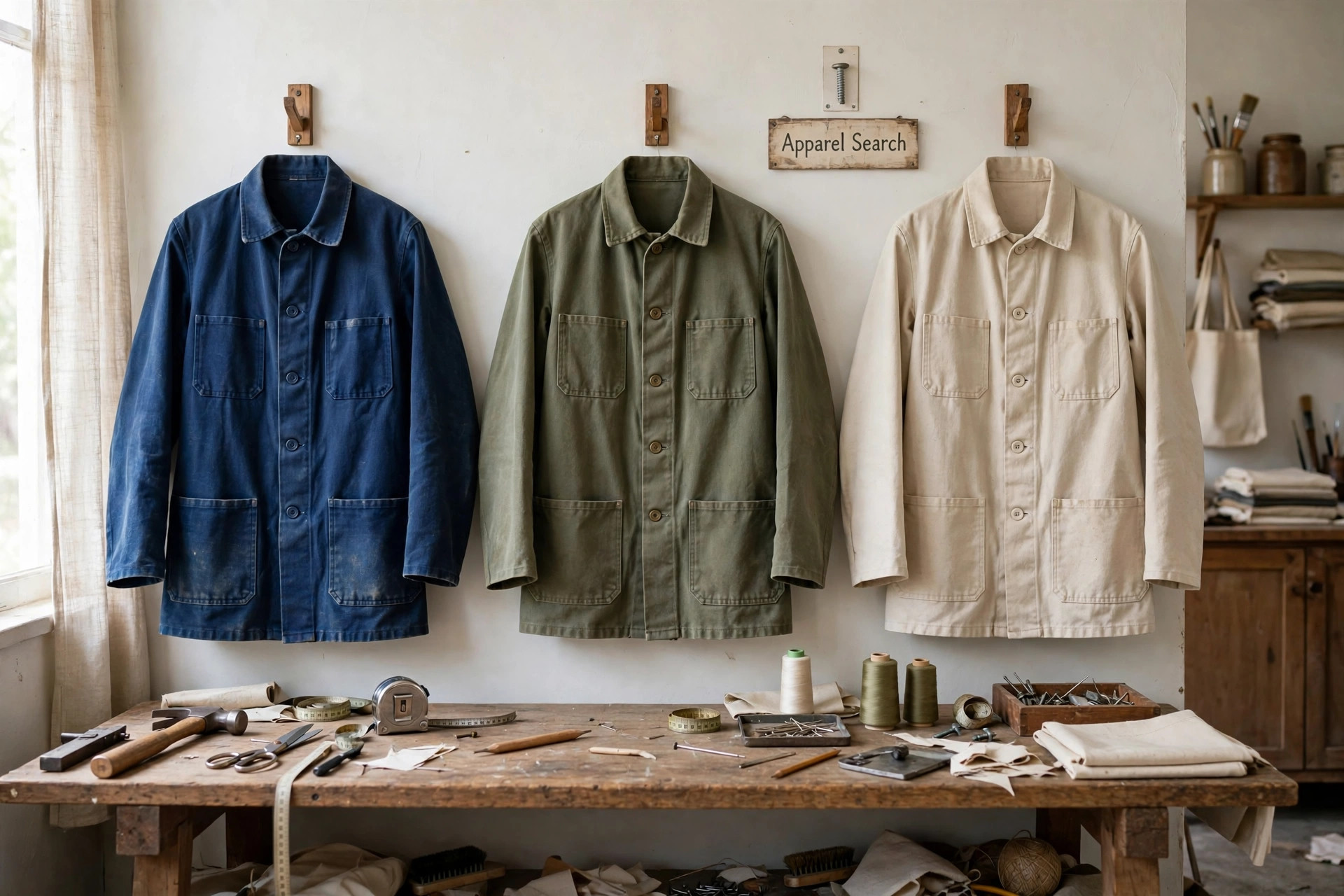
A chore coat is a loose, straight work jacket defined by its pockets: three or four large patch pockets across the front, a simple shirt-style collar, and a button front, cut from a hard-wearing cloth like cotton twill, denim or moleskin. Two traditions meet in the modern version. In France, the bleu de travail — the blue work jacket worn by factory workers, railwaymen and artisans — became so identified with honest labor that it later became a staple of artists' and photographers' wardrobes. In America, railroad and farm chore coats in denim and duck served the same purpose: a layer you could load with tools, gloves and hardware, shrug off at the door, and replace cheaply when it finally wore out.
The chore coat's modern appeal is that it occupies the exact middle ground of outerwear: more structured than a shirt, lighter than a coat, with pockets that turn it into a carry system. It is the lightest member of the heritage workwear family gathered in the barn jacket guide — where the barn jacket is lined and collared for outdoor farm work, the chore coat is unlined and collared like a shirt for the workshop, the garden and the studio. Understanding that division of labor is the key to choosing between them.
02 — Anatomy
Four Pockets and a Shirt Collar
- The pockets. The signature row: usually three patch pockets — two at the hip, one or two at the chest — sewn flat against the front so the coat can be loaded without zips or flaps snagging. Wallets, phones, notebooks, seed packets, pencils and small tools each get a home; the chore coat is worn partly as equipment.
- The collar. A plain point collar, like an overshirt's — the clearest visual difference from the barn jacket's contrasting corduroy collar and from the belted safari jacket, whose definition sits in the clothing definitions.
- The cloth. Cotton twill and denim for all-season use, moleskin for a softer winter hand, canvas for the heaviest work versions, and increasingly linen or linen blends for summer. Cloth weight, more than anything, sets the coat's season.
- The front. Buttons — traditionally metal or corozo — on a plain placket. Buttons beat zips here: they are field-repairable, silent, and let the coat hang open like a blazer.
- The cut. Straight and roomy, hem at the hip or just below, sleeves plain-cuffed or buttoned. It should fit over a sweater without pulling at the buttons; the shacket page covers the even lighter shirt-jacket that borrows the same idea.
Chore Coat, Barn Jacket or Overshirt?
Choose by weight and weather. The overshirt is a shirt in a heavier cloth — indoor-outdoor, minimal pockets, no real wind resistance. The chore coat steps up: jacket construction, the full pocket row, cloth that stands up to a workshop. The barn jacket steps up again: lined, collared in corduroy, built for outdoor weather rather than indoor work — its full treatment is the men's barn jackets guide on the men's side and the hub linked above. And where rain is the deciding factor, none of the three is the answer until the cloth is proofed — which is the whole subject of the waxed jacket guide. Most heritage wardrobes end up with a chore coat for three seasons and one heavier sibling for the fourth.
03 — Choosing & Wearing
Choosing One, and Wearing It Beyond the Workshop
For a first chore coat, choose a mid-weight twill or denim in indigo, olive, ecru or brown, sized to close over your usual knitwear. Denim versions pair naturally with the jeans wardrobe — the men's denim jackets guide covers the neighboring territory — while ecru and olive twills behave like neutral blazers over chinos and trousers. In summer, a linen chore coat is one of the few jacket shapes that still makes sense: the loose cut circulates air and the pockets replace a bag for short trips.
Styling follows the workwear rule of contrast set out in how to style a barn jacket: one work piece at a time. A chore coat over a clean tee and tailored trousers reads as intentional; over full workwear it reads as a uniform. Women wear the same coats oversized over dresses, where the pocket row does the visual work a handbag usually does. Care is minimal — chore coats are among the few jackets that genuinely improve with washing and fading, since the cloth was made to be laundered like work clothes. Wash cold, dry on a line, and let the fade map develop; it is the garment's diary, and the reason a ten-year-old chore coat looks better than a new one.
04 — Good to Know
Common Questions
Why does a chore coat have so many pockets?
Because it was designed as a carry system for work. The hip pockets take tools, gloves and hardware; the chest pockets take notebooks, pencils, tickets and — today — a phone. Flat patch pockets are used because they add almost no bulk when empty, never snag like flaps or zips, and can be re-sewn in minutes when a corner tears. The pocket row is the garment's function, not its decoration.
Is a chore coat the same as a barn jacket?
No — they are siblings, not synonyms. A chore coat is unlined, lighter, and has a plain shirt collar and a row of flat patch pockets; it was made for workshops, railways and studios. A barn jacket is heavier canvas, often lined, with a contrasting corduroy or leather collar and bellows pockets, made for outdoor farm work and weather. If it would hang happily in a workshop, it is a chore coat; if it belongs by the barn door, it is a barn jacket.
Can you wear a chore coat in summer?
Yes, in the right cloth. A chore coat in linen, a linen-cotton blend or a light twill is one of the most useful summer layers: the loose cut lets air move, the sleeves roll, and the pockets carry what shorts cannot. Avoid denim and moleskin versions in heat — those are the coat's autumn and winter cloths. An unlined summer chore coat over a tee is also the easiest way to give a plain outfit structure.
How do you wash a chore coat?
Like the work clothes it descends from: machine wash cold with similar colors, and line dry. Denim and twill chore coats fade gradually and attractively — that fade is considered part of the garment's character, not damage. Wash inside out to slow it if you prefer the color deep. Moleskin should be washed gently and never wrung; linen versions soften with every wash and need no ironing beyond a shake and hang.
More to Explore
Search Apparel Search