01 — The Principle
Start With Contrast: Rugged Jacket, Clean Outfit
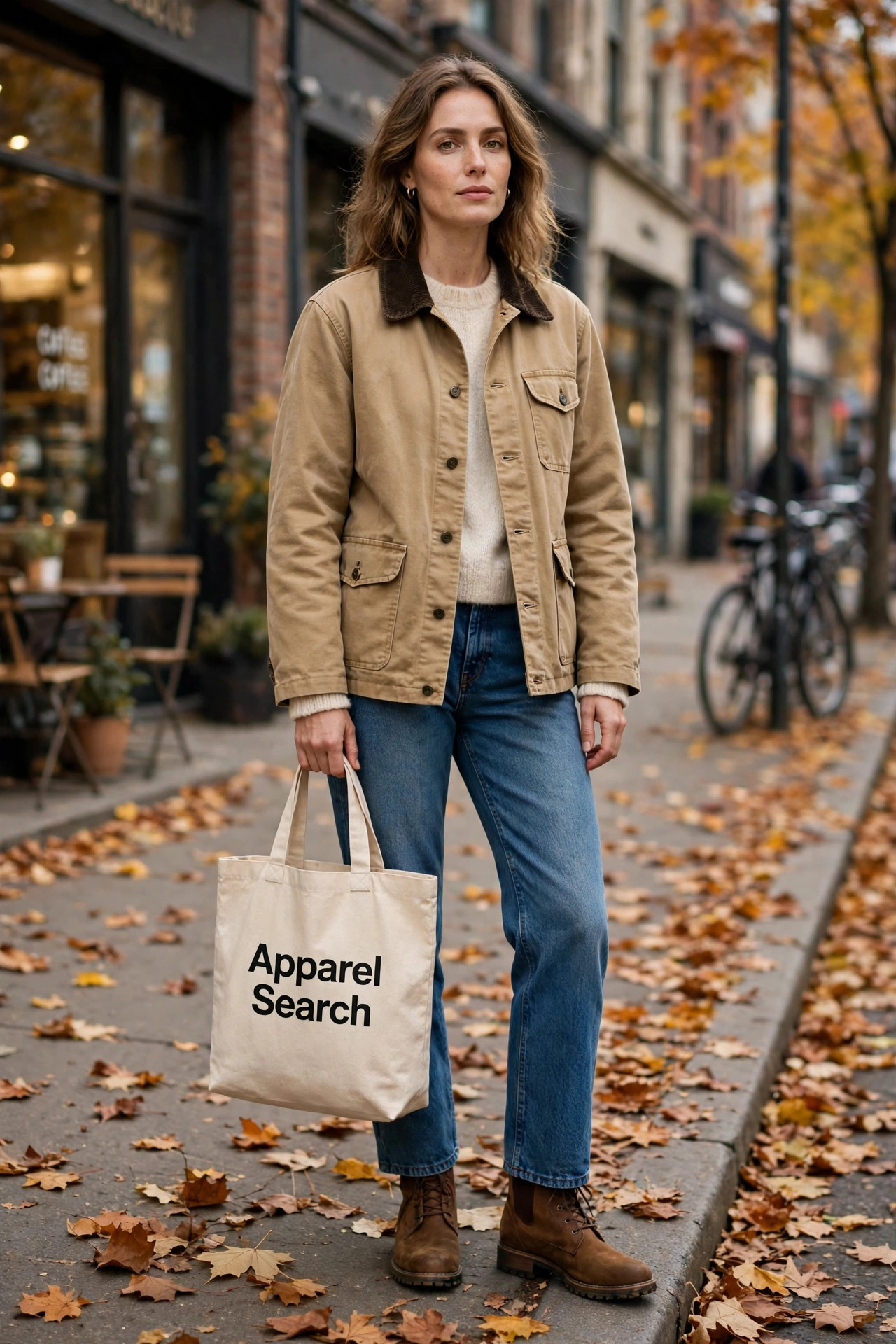
Every good barn jacket outfit runs on one contrast: the jacket is rugged, textured and unmistakably borrowed from work, so everything under it should be clean, simple and deliberate. A barn jacket over a plain sweater and straight trousers reads as a considered outfit. The same jacket over distressed denim, a graphic tee and work boots reads as a costume — the whole outfit is making the same point, and the point gets lost. Choose which side of the contrast you are dressing: most days, the jacket is the only workwear piece, and the rest of the outfit is the foil.
Color does half the work. The classic shells — tan, olive, brown, navy — are earth tones that sit quietly against cream, white, charcoal, black and denim blue, which is why the jacket layers into an existing wardrobe so easily. The corduroy collar is the accent: brown against olive, tan against navy. Keep accessories in the same leather family as the collar and the outfit coheres without effort. The barn jacket guide covers the garment itself — canvas weights, linings and fit — while this page is about what to put with it.
02 — For Women
Women's Outfits That Work
- With a dress. The barn jacket over a midi dress — floral, slip or shirt dress — is the revival's signature outfit. The jacket's straight, hip-length cut frames the dress instead of hiding it, and ankle boots finish the contrast. Belt the dress, not the jacket.
- With straight or wide-leg denim. Cream sweater, straight jeans, barn jacket, loafers or boots. This is the weekend default, and it works because the denim is clean — no rips, no heavy fading to compete with the canvas texture.
- With tailoring. Over a fine knit and pleated trousers, the barn jacket does the job a blazer does in reverse: it relaxes a polished base. Keep shoes polished too — the outfit is the contrast.
- With a skirt and boots. A-line or pleated midi skirts with knee boots give the jacket a country-house line; a mini with loafers gives it a campus line. Both rely on the jacket ending at the hip, above the skirt's widest point.
Proportion is the rule underneath all four: the jacket is boxy, so one other piece can have volume — a wide trouser, a full skirt — but not two. If the bottom half is wide, keep the top layer under the jacket slim; if the dress is flowing, keep footwear neat. The women's coat landscape around the jacket, from trenches to overcoats, is mapped in the women's coats guide and the wider women's jackets guide.
Three Formulas to Copy
- The weekend formula: barn jacket + cream or oatmeal knit + straight blue jeans + brown ankle boots. Works for women and men, in every classic shell color.
- The polished formula: barn jacket + dark fine knit + charcoal or navy tailored trousers + loafers. The jacket replaces a blazer and the outfit stays office-adjacent.
- The country formula: barn jacket + checked or flannel shirt + cords or moleskin trousers + boots. The full heritage register — best kept for genuinely casual days, and the natural partner of the waxed jacket in wet weather.
03 — For Men
Men's Outfits, and the Seasonal Shifts
Men's barn jacket styling starts from the work original and edits it toward town. The jacket over a flannel shirt and canvas pants is the authentic farm register; swap the flannel for an Oxford shirt and the cords for chinos and the same jacket reads smart-casual. The men's barn jackets guide covers choosing the jacket itself — the trimmer fashion cuts style more easily over shirts, while the roomier work cuts want a sweater or the layered approach in how to style layers.
Seasonally, the jacket is a three-season piece. In spring it goes over a tee or light knit, sleeves pushed up. In fall — its home season — it layers over flannel, sweatshirts and fine knits, and anchors the kind of capsule set out in the fall and winter capsule wardrobe guide. In winter it becomes the outer shell over a substantial mid layer in mild climates, and hands over to heavier coats where winters are serious. Summer is its one season off: canvas at this weight is simply too warm, which is the honest limit of the style. For the polished end of the same heritage family, compare the approach in how to style a trench coat — the trench is tailored where the barn jacket is rugged, and the styling logic inverts accordingly.
04 — Good to Know
Common Questions
Can you wear a barn jacket to the office?
In most business-casual offices, yes — styled deliberately. Wear it over a fine knit or an Oxford shirt with tailored trousers and loafers, in a clean, unpatched jacket in tan, olive or navy. It reads as a relaxed alternative to a blazer. In formal or client-facing settings it stays too rugged; the jacket's charm is its workwear origin, and no styling fully removes it.
What shoes go best with a barn jacket?
Boots are the natural partner — ankle boots, Chelsea boots and lace-up leather boots all match the jacket's register. Loafers sharpen it for the polished formula, and clean minimal sneakers work for the weekend formula. Avoid technical trainers and very formal dress shoes: both fight the jacket instead of contrasting with it. Match leather tones roughly to the corduroy collar and the outfit settles.
What pants work with a barn jacket?
Straight and wide-leg trousers in denim, chino cloth, corduroy or moleskin — cuts with enough body to balance the boxy jacket. Very skinny trousers make the top half look oversized by accident rather than design. Cream and ecru denim is the current favorite pairing with tan and olive shells; charcoal tailoring is the dressiest option; cords complete the country formula.
Should a barn jacket be fitted or oversized?
Neither extreme. It should close comfortably over your thickest intended layer, with the shoulder seam at your own shoulder and the hem at or just below the hip. The boxy body is the design — buying oversized adds sleeve length and sloppiness without adding style, and buying it fitted removes the layering room that makes the jacket useful. Try it on over a sweater, not a T-shirt.
More to Explore
Search Apparel Search